


![[Marketing] Questao Topo - deslogado](https://storage.estuda.com.br/banners/0_6b7ebee90b03af1c560c73bb8bcce34a_banner_deslogado_70_dias.png)
Questões de Inglês
19.971 Questões
Questão 16 130242
FCM PB Medicina 2017/1TEXTO
You mean I don’t have to show up? The promise of telemedicine
“Aside from whatever a visit to the doctor costs you in money, it also costs you in time. A lot of it!
End to end, the travel and waiting time for a doctor’s appointment can take several hours — often disrupting work or school. Only 17 percent of it — 20 minutes, on average — is spent actually seeing the doctor, according to a study by the University of Pittsburgh, physician Kristin Ray and colleagues at the Harvard Medical School and the RAND Corporation.
In a year, Americans spend 2.4 billion hours making doctor visits. Valued at average wage rates, that’s worth more than $52 billion — equivalent to the total working time and income of 1.2 million people. On average, we pay $32 when visiting a doctor. But separately, the value of our time adds up to more, $43, according to Dr. Ray’s study.
For certain kinds of health care, there is a better way. Long after electronic communication and technology have revolutionized other services (like preparing taxes, booking travel and banking), emails, phone calls, video chats and other telemedicine applications are gradually supplementing or replacing some types of office visits.
Telemedicine holds the promise of giving some of our time back. And it may have other advantages. Care delivered in this way requires no travel, and if one waits at all it’s at home or work, not at a doctor’s office. In an era of FaceTime and Skype, patients are starting to expect more convenient access to doctors. The vast majority of patients report that they want to be able to communicate with their doctors by email. Perhaps for this reason, the market for telemedicine is growing rapidly.
In a passionate commentary on the establishment’s hesitancy to embrace telemedicine, David Asch, a University of Pennsylvania physician, pointed out that the inconvenience of face-to-face care limits its use, but arbitrarily and invisibly. The costs of waiting and travel time and those borne by rural populations with poor access to in-person care don’t appear on the books. “The innovation that telemedicine promises is not just doing the same thing remotely,” Dr. Asch wrote, “but awakening us to the many things that we thought required face-to-face contact but actually do not. ”
(Adapted from: http://www.nytimes.com/2016/05/17/upshot/you-mean-i-dont-have-to-show-up-the-promise-of-telemedicine.html?ref=policy)
“[…] In an era of FaceTime and Skype, patients are starting to expect more convenient access to doctors. […]”
Assign the correct grammatical classes (underlined words) based on the order that they appear in the sentence above.
Questão 14 130181
FCM PB Medicina 2017/1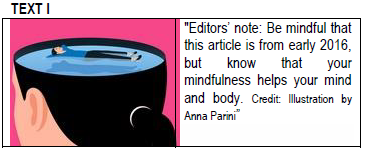
"The benefits of mindfulness meditation, increasingly popular in recent years, are supposed to be many: reduced stress and risk for various diseases, improved well-being, a rewired brain. But the experimental bases to support these claims have been few. Supporters of the practice have relied on very small samples of unrepresentative subjects, like isolated Buddhist monks who spend hours meditating every day, or on studies that generally were not randomized and did not include placebo control groups.
This month, however, a study published in Biological Psychiatry brings scientific thoroughness to mindfulness meditation and for the first time shows that, unlike a placebo, it can change the brains of ordinary people and potentially improve their health.
To meditate mindfully demands ‘‘an open and receptive, nonjudgmental awareness of your present-moment experience,’’ says J. David Creswell, who led the study and is an associate professor of psychology and the director of the Health and Human Performance Laboratory at Carnegie Mellon University. One difficulty of investigating meditation has been the placebo problem. In rigorous studies, some participants receive treatment while others get a placebo: They believe they are getting the same treatment when they are not. But people can usually tell if they are meditating. Dr. Creswell, working with scientists from a number of other universities, managed to fake mindfulness.
First they recruited 35 unemployed men and women who were seeking work and experiencing considerable stress. Blood was drawn and brain scans were given. Half the subjects were then taught formal mindfulness meditation at a residential retreat center; the rest completed a kind of sham mindfulness meditation that was focused on relaxation and distracting oneself from worries and stress. ‘‘
We had everyone do stretching exercises, for instance,’’ Dr. Creswell says. The mindfulness group paid close attention to bodily sensations, including unpleasant ones. The relaxation group was encouraged to chatter and ignore their bodies, while their leader cracked jokes.
At the end of three days, the participants all told the researchers that they felt refreshed and better able to withstand the stress of unemployment. Yet follow-up brain scans showed differences in only those who underwent mindfulness meditation. There was more activity, or communication, among the portions of their brains that process stress-related reactions and other areas related to focus and calm. Four months later, those who had practiced mindfulness showed much lower levels in their blood of a marker of unhealthy inflammation than the relaxation group, even though few were still meditating.
Dr. Creswell and his colleagues believe that the changes in the brain contributed to the subsequent reduction in inflammation, although precisely how remains unknown. Also unclear is whether you need to spend three uninterrupted days of contemplation to reap the benefits. When it comes to how much mindfulness is needed to improve health, Dr. Creswell says, ‘‘we still have no idea about the ideal dose.”
(Adapted from: http://well.blogs.nytimes.com/2016/02/18/contemplation-therapy/)
Which alternative below has the correct synonym of the verb “to reap” (7th paragraph)?
Questão 13 130176
FCM PB Medicina 2017/1
"The benefits of mindfulness meditation, increasingly popular in recent years, are supposed to be many: reduced stress and risk for various diseases, improved well-being, a rewired brain. But the experimental bases to support these claims have been few. Supporters of the practice have relied on very small samples of unrepresentative subjects, like isolated Buddhist monks who spend hours meditating every day, or on studies that generally were not randomized and did not include placebo control groups.
This month, however, a study published in Biological Psychiatry brings scientific thoroughness to mindfulness meditation and for the first time shows that, unlike a placebo, it can change the brains of ordinary people and potentially improve their health.
To meditate mindfully demands ‘‘an open and receptive, nonjudgmental awareness of your present-moment experience,’’ says J. David Creswell, who led the study and is an associate professor of psychology and the director of the Health and Human Performance Laboratory at Carnegie Mellon University. One difficulty of investigating meditation has been the placebo problem. In rigorous studies, some participants receive treatment while others get a placebo: They believe they are getting the same treatment when they are not. But people can usually tell if they are meditating. Dr. Creswell, working with scientists from a number of other universities, managed to fake mindfulness.
First they recruited 35 unemployed men and women who were seeking work and experiencing considerable stress. Blood was drawn and brain scans were given. Half the subjects were then taught formal mindfulness meditation at a residential retreat center; the rest completed a kind of sham mindfulness meditation that was focused on relaxation and distracting oneself from worries and stress. ‘‘
We had everyone do stretching exercises, for instance,’’ Dr. Creswell says. The mindfulness group paid close attention to bodily sensations, including unpleasant ones. The relaxation group was encouraged to chatter and ignore their bodies, while their leader cracked jokes.
At the end of three days, the participants all told the researchers that they felt refreshed and better able to withstand the stress of unemployment. Yet follow-up brain scans showed differences in only those who underwent mindfulness meditation. There was more activity, or communication, among the portions of their brains that process stress-related reactions and other areas related to focus and calm. Four months later, those who had practiced mindfulness showed much lower levels in their blood of a marker of unhealthy inflammation than the relaxation group, even though few were still meditating.
Dr. Creswell and his colleagues believe that the changes in the brain contributed to the subsequent reduction in inflammation, although precisely how remains unknown. Also unclear is whether you need to spend three uninterrupted days of contemplation to reap the benefits. When it comes to how much mindfulness is needed to improve health, Dr. Creswell says, ‘‘we still have no idea about the ideal dose.”
(Adapted from: http://well.blogs.nytimes.com/2016/02/18/contemplation-therapy/)
Choose the appropriate question tag for the following sentence adapted from the text:
“Dr. Creswell and his colleagues believe that the changes in the brain contributed to the subsequent reduction in inflammation, ____________?”
Questão 11 130159
FCM PB Medicina 2017/1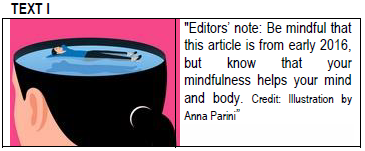
"The benefits of mindfulness meditation, increasingly popular in recent years, are supposed to be many: reduced stress and risk for various diseases, improved well-being, a rewired brain. But the experimental bases to support these claims have been few. Supporters of the practice have relied on very small samples of unrepresentative subjects, like isolated Buddhist monks who spend hours meditating every day, or on studies that generally were not randomized and did not include placebo control groups.
This month, however, a study published in Biological Psychiatry brings scientific thoroughness to mindfulness meditation and for the first time shows that, unlike a placebo, it can change the brains of ordinary people and potentially improve their health.
To meditate mindfully demands ‘‘an open and receptive, nonjudgmental awareness of your present-moment experience,’’ says J. David Creswell, who led the study and is an associate professor of psychology and the director of the Health and Human Performance Laboratory at Carnegie Mellon University. One difficulty of investigating meditation has been the placebo problem. In rigorous studies, some participants receive treatment while others get a placebo: They believe they are getting the same treatment when they are not. But people can usually tell if they are meditating. Dr. Creswell, working with scientists from a number of other universities, managed to fake mindfulness.
First they recruited 35 unemployed men and women who were seeking work and experiencing considerable stress. Blood was drawn and brain scans were given. Half the subjects were then taught formal mindfulness meditation at a residential retreat center; the rest completed a kind of sham mindfulness meditation that was focused on relaxation and distracting oneself from worries and stress. ‘‘
We had everyone do stretching exercises, for instance,’’ Dr. Creswell says. The mindfulness group paid close attention to bodily sensations, including unpleasant ones. The relaxation group was encouraged to chatter and ignore their bodies, while their leader cracked jokes.
At the end of three days, the participants all told the researchers that they felt refreshed and better able to withstand the stress of unemployment. Yet follow-up brain scans showed differences in only those who underwent mindfulness meditation. There was more activity, or communication, among the portions of their brains that process stress-related reactions and other areas related to focus and calm. Four months later, those who had practiced mindfulness showed much lower levels in their blood of a marker of unhealthy inflammation than the relaxation group, even though few were still meditating.
Dr. Creswell and his colleagues believe that the changes in the brain contributed to the subsequent reduction in inflammation, although precisely how remains unknown. Also unclear is whether you need to spend three uninterrupted days of contemplation to reap the benefits. When it comes to how much mindfulness is needed to improve health, Dr. Creswell says, ‘‘we still have no idea about the ideal dose.”
(Adapted from: http://well.blogs.nytimes.com/2016/02/18/contemplation-therapy/)
According to the text, the most suitable title may be:
Questão 80 130120
FAMERP 2017The placebo effect: amazing and real
November 2, 2015
Robert H. Shmerling

The placebo effect is a mysterious thing. I’ve long been
fascinated by the idea that something as inert and harmless
as a sugar pill could relieve a person’s pain or hasten their
recovery just by the expectation that it would. Studies use
placebos – an inactive treatment, such as a sugar pill – in
an attempt to understand the true impact of the active drug.
Comparing what happens to a group of patients taking the
active drug with the results of those taking a placebo can help
researchers understand just how good the active drug is.
The word “placebo” comes from Latin and means “I shall
please.” And “please” it does. In study after study, many
patients who take a placebo show improvement in their
symptoms or condition.
The placebo effect is for real
Recent research on the placebo effect only confirms how
powerful it can be – and that the benefits of a placebo treatment
aren’t just “all in your head.” Measureable physiological
changes can be observed in those taking a placebo, similar to
those observed among people taking effective medications.
In particular, blood pressure, heart rate, and blood test results
have been shown to improve among subsets of research
subjects who responded to a placebo.
Of course, not everyone has a therapeutic response to a
placebo. If that were the case, we wouldn’t need medications
at all. Instead, we could simply wield the power of suggestion.
Understanding why certain people improve with placebo
treatment and others do not is the “holy grail” of placebo research.
Nocebo: Placebo’s evil twin
The power of suggestion is a double-edged sword. If
you expect a treatment to help you, it’s more likely to do so.
And if you expect a treatment will be harmful, you are more
likely to experience negative effects. That phenomenon is
called the “nocebo effect” (from the Latin “I shall harm”). For
example, if you tell a person that a headache is a common
side effect of a particular medication, that person is more
likely to report headaches even if they are actually taking a
placebo. The power of expectation is formidable and probably
plays a significant role in the benefits and the side effects of
commonly prescribed medications.
(www.health.harvard.edu. Adaptado.)
According to the fifth paragraph, nocebo effect
Questão 78 130118
FAMERP 2017The placebo effect: amazing and real
November 2, 2015
Robert H. Shmerling
The placebo effect is a mysterious thing. I’ve long been
fascinated by the idea that something as inert and harmless
as a sugar pill could relieve a person’s pain or hasten their
recovery just by the expectation that it would. Studies use
placebos – an inactive treatment, such as a sugar pill – in
an attempt to understand the true impact of the active drug.
Comparing what happens to a group of patients taking the
active drug with the results of those taking a placebo can help
researchers understand just how good the active drug is.
The word “placebo” comes from Latin and means “I shall
please.” And “please” it does. In study after study, many
patients who take a placebo show improvement in their
symptoms or condition.
The placebo effect is for real
Recent research on the placebo effect only confirms how
powerful it can be – and that the benefits of a placebo treatment
aren’t just “all in your head.” Measureable physiological
changes can be observed in those taking a placebo, similar to
those observed among people taking effective medications.
In particular, blood pressure, heart rate, and blood test results
have been shown to improve among subsets of research
subjects who responded to a placebo.
Of course, not everyone has a therapeutic response to a
placebo. If that were the case, we wouldn’t need medications
at all. Instead, we could simply wield the power of suggestion.
Understanding why certain people improve with placebo
treatment and others do not is the “holy grail” of placebo research.
Nocebo: Placebo’s evil twin
The power of suggestion is a double-edged sword. If
you expect a treatment to help you, it’s more likely to do so.
And if you expect a treatment will be harmful, you are more
likely to experience negative effects. That phenomenon is
called the “nocebo effect” (from the Latin “I shall harm”). For
example, if you tell a person that a headache is a common
side effect of a particular medication, that person is more
likely to report headaches even if they are actually taking a
placebo. The power of expectation is formidable and probably
plays a significant role in the benefits and the side effects of
commonly prescribed medications.
(www.health.harvard.edu. Adaptado.)
No trecho do quarto parágrafo “Understanding why certain people improve with placebo treatment and others do not is the ‘holy grail’ of placebo research.”, a expressão em destaque tem sentido equivalente, em português, a
06