


![[Marketing] Questao Topo - deslogado](https://storage.estuda.com.br/banners/0_6b7ebee90b03af1c560c73bb8bcce34a_banner_deslogado_70_dias.png)
Questões de Inglês
19.971 Questões
Questão 23 138210
FUVEST (USP) 2017A study carried out by Lauren Sherman of the University of California and her colleagues investigated how use of the “like” button in social media affects the brains of teenagers lying in body scanners
Thirtytwo teens who had Instagram accounts were asked to lie down in a functional magnetic resonance imaging (fMRI) scanner. This let Dr. Sherman monitor their brain activity while they were perusing both their own Instagram photos and photos that they were told had been added by other teenagers in the experiment. In reality, Dr. Sherman had collected all the other photos, which included neutral images of food and friends as well as many depicting risky behaviours like drinking, smoking and drug use, from other peoples’ Instagram accounts. The researchers told participants they were viewing photographs that 50 other teenagers had already seen and endorsed with a “like” in the laboratory
The participants were more likely themselves to “like” photos already depicted as having been “liked” a lot than they were photos depicted with fewer previous “likes”. When she looked at the fMRI results, Dr. Sherman found that activity in the nucleus accumbens, a hub of reward circuitry in the brain, increased with the number of “likes” that a photo had
The Economist, June 13, 2016. Adaptado.
Conforme o texto, a região do cérebro que se mostrou mais ativa, quando da análise dos resultados da ressonância, corresponde a um sistema de
Questão 21 138208
FUVEST (USP) 2017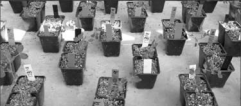
Plants not only remember when you touch them, but they can also make risky decisions that are as sophisticated as those made by humans, all without brains or complex nervous systems
Researchers showed that when faced with the choice between a pot containing constant levels of nutrients or one with unpredictable levels, a plant will pick the mystery pot when conditions are sufficiently poo
In a set of experiments, Dr. Shemesh, from TelHai College in Israel, and Alex Kacelnik, from Oxford University, grew pea plants and split their roots between two pots. Both pots had the same amount of nutrients on average, but in one, the levels were constant; in the other, they varied over time. Then the researchers switched the conditions so that the average nutrients in both pots would be equally high or low, and asked: Which pot would a plant prefer
When nutrient levels were low, the plants laid more roots in the unpredictable pot. But when nutrients were abundant, they chose the one that always had the same amount
The New York Times, June 30, 2016. Adaptado.
De acordo com os experimentos relatados no texto, em condições adversas, as plantas de ervilha priorizaram o crescimento de raízes nos vasos que apresentaram níveis de nutrientes
Questão 20 138207
FUVEST (USP) 2017
Plants not only remember when you touch them, but they can also make risky decisions that are as sophisticated as those made by humans, all without brains or complex nervous systems
Researchers showed that when faced with the choice between a pot containing constant levels of nutrients or one with unpredictable levels, a plant will pick the mystery pot when conditions are sufficiently poo
In a set of experiments, Dr. Shemesh, from TelHai College in Israel, and Alex Kacelnik, from Oxford University, grew pea plants and split their roots between two pots. Both pots had the same amount of nutrients on average, but in one, the levels were constant; in the other, they varied over time. Then the researchers switched the conditions so that the average nutrients in both pots would be equally high or low, and asked: Which pot would a plant prefer
When nutrient levels were low, the plants laid more roots in the unpredictable pot. But when nutrients were abundant, they chose the one that always had the same amount
The New York Times, June 30, 2016. Adaptado.
Conforme o texto, um dos elementos da metodologia empregada nos experimentos foi
Questão 21 137807
ACAFE Medicina 2017/1Answer the questions based on the text below.
The Brazilian government has ratified its participation in the Paris agreement on climate change, a significant step by Latin America’s largest emitter of greenhouse gases that could spur other countries to follow suit.
With a landmass larger than the continental US, Brazil emits about 2.5% of the world’s carbon dioxide and other polluting gases, according to United Nations data.
“Our government is concerned about the future,” said President Michel Temer during a signing ceremony in Brasilia. “Everything we do today is not aimed at tomorrow, but rather at a future that preserves the living conditions of Brazilians.”
Temer said Brazil’s ratification would be presented formally to the UN later this month.
The Paris agreement will enter into force once 55 countries representing at least 55% of global emissions have formally joined it. Climate experts say that could happen later this year.
Countries set their own targets for reducing emissions. The targets are not legally binding, but nations must update them every five years. Using 2005 levels as the baseline, Brazil committed to cutting emissions 37% by 2025 and an “intended reduction” of 43% by 2030.
In the last decade, Brazil has achieved significant emissions cuts thanks to efforts to reduce deforestation in the Amazon and increase in the use of energy from hydropower and other renewable sources including wind, solar and biomass.
The Paris accord got a boost earlier this month when the US president, Barack Obama, and China’s President, Xi Jinping, sealed their nations’ participation.
“Brazil is now the next major country to move forward. It will add even greater momentum,” said David Waskow, director of the International Climate Initiative at the Washington, DC-based think tank the World Resources Institute.
(Source:https://www.theguardian.com/environment/2016/sep/13/brazil-ratifies-paris-agreement-with-pledge-to-sharplyreduce-emissions)
From the words in bold below, which is not an adjective in the text
Questão 20 137806
ACAFE Medicina 2017/1Why has the author used the modal "must" in the sentence: " The targets are not legally binding, but nations must update them every five years"?
Questão 19 137805
ACAFE Medicina 2017/1The Paris agreement will enter into force once 55 countries representing at least 55% of global emissions have formally joined it. What does the conjunction in bold mean?
06