


![[Marketing] Questao Topo - deslogado](https://storage.estuda.com.br/banners/0_6b7ebee90b03af1c560c73bb8bcce34a_banner_deslogado_70_dias.png)
Questões de Inglês
19.971 Questões
Questão 11 16149820
IDOMED Unificado medicina - presencial 2025/2ONYCHOPHAGIA
Onychophagia, or nail-biting, can be a temporary, relatively non-destructive behavior that is merely a cosmetic concern, but it can also develop into a severe, long-term problem. Onychophagia, or Onychophagy, is considered a pathological oral habit and grooming disorder characterized by chronic, seemingly uncontrollable nail-biting that is destructive to fingernails and their surrounding tissue. It is a relatively common problem, but the line between “normal” and pathological nailbiting is not always clear.
According to the DSM-5 (Diagnostic and Statistical Manual of Mental Disorders), diagnosable “body-focused repetitive behavior disorder” (a category that includes Onychophagia) triggers clinically significant distress, interferes with functioning in at least one important life domain, and is characterized by repeated, failed attempts to stop the behaviors. Thus, those who feel intense shame, guilt, or anxiety about their nail-biting, feel unable to stop, and find that it interferes with one or more areas of their life may benefit from seeking treatment.
Possible physical side effects of nail-biting include damaged or disfigured nails and skin, skin infections, fungal infections, and mouth pain or tooth damage. Individuals who swallow the bitten nails may be at risk for stomach or intestinal infections as well. Nails and fingers often carry bacteria or viruses, so, biting them may transmit pathogens into the body, potentially increasing the risk of internal infections or gastrointestinal problems.
There may be a genetic link to Onychophagia, as some people appear to have an inherited tendency toward developing BFRB (Body-focused Repetitive Behavior), as well as higher-than-average rates of mood and anxiety disorders in immediate family members. This condition is, however, very frequently associated with anxiety, because the act of chewing on nails reportedly relieves stress, tension, or boredom. People who habitually bite their nails often report that they do so when they feel nervous, bored, lonely, or even hungry. It can be a habit transferred from earlier thumb or finger sucking as well and can occur without symptoms of another psychiatric condition. It can also be associated with attention-deficit/hyperactivity disorder (ADHD), oppositional defiant disorder, separation anxiety, enuresis, tic disorder, and other mental health issues.
Hiding one’s nails or making them unpleasant to bite – by cutting them short, painting them with bitter-tasting polish, or wearing gloves or mittens – can make it more difficult to engage in the behavior. It’s also helpful to identify one’s “trigger” – the emotion or situation that makes someone most prone to biting – and develop coping mechanisms to replace nail-biting with a healthier alternative. For example, someone who bites while bored could play with a fidget toy in situations where they’re likely to be bored and someone who bites when anxious could squeeze a stress ball or engage in a brief relaxation exercise instead of biting.
Available at: https://www.psychologytoday.com/us/conditions/onychophagia-nail-biting. Accessed on: 8th apr. 2025. (Adapted).
After reading the text, it is correct to conclude that Onychophagia, or nail-biting, is:
Questão 8 16142216
IDOMED Medicina - online 2025/2Ablutomania: Risks and Helpful Tips
July 12, 2024
(1st §) Obsessive bathing, also known as Ablutomania, is a manifestation of obsessive-compulsive disorder (OCD). This disorder leads people to feel a constant and overwhelming need to wash themselves, either to eliminate a feeling of uncleanliness or to relieve anxiety. In other words, it is a type of OCD characterized by an abnormal compulsion to repeatedly bathe or wash oneself.
(2nd §) Ablutomania can have a significant impact on a person's life as a whole. Besides, daily routines can be disrupted, quality of life can drastically decline and personal and professional relationships can also suffer due to the constant need to clean and avoid situations perceived as dirty. Actually, people suffering from this condition feel an intense urge to wash their hands every time they touch any surface and to keep their bodies extremely clean, often due to an irrational fear of germs or dirt. Moreover, this compulsion may become so strong that they may avoid leaving the house so as to keep away from situations that would require them to constantly clean themselves.
(3rd §) The exact causes of Ablutomania are not entirely clear; however, a combination of genetic, biological, and environmental factors is believed to contribute to its development. Sanatorio Allende notes that a family history of OCD, traumatic events, and chemical imbalances in the brain can be triggering factors.
(4th §) Therapy is an effective tool for treating Ablutomania. There are several therapeutic approaches that may be beneficial, such as Cognitive Behavioral Therapy (CBT). CBT is a form of psychotherapy that has been shown to be particularly effective in treating OCD. This therapy focuses on identifying and changing negative thought and behavior patterns. Exposure and Response Prevention (ERP) therapy can also offer relief and a significant improvement in quality of life. ERP is a specific technique within CBT that involves exposing the person to situations that trigger their compulsions, while preventing them from performing the cleaning rituals. This technique helps reduce anxiety and the need to perform compulsions over time.
(5th §) This manifestation can be extremely debilitating. However, with the right help, it is possible to manage and overcome this condition. So, those who are struggling with a bathing compulsion, should consider seeking professional help. It’s important to keep in mind, however, that the first step toward recovery is accepting there is a problem and being willing to work on it, to find support to move towards a more balanced life free from compulsions.
Available at: https://enterapiaonline.com/obsesion-con-banarse/. Accessed in: 2nd apr. 2025. (Adapted).
Considering the topic Ablutomania, the main aim of the article is the following:
Questão 14 16140952
IDOMED Medicina (edital 2) 2025/1BRAIN ROT
Anna Tyzack
December 20, 2024
While not a clinical diagnosis, the term “brain rot” captures the burnt out feeling that follows an online scrolling session. The brain is exposed to far more information and demands than it can handle without proper breaks, which over time leads to difficult concentration, poor memory and emotional exhaustion. If we are finding it hard to focus, feeling a bit low and having a memory like a sieve, chances are we need a break – a screen break. Brain rot, the colloquial term used to describe excessive consumption of low-quality online content, particularly short videos on social media, has become so mainstream that it was voted Oxford Dictionary’s Word of the Year for 2024.
Content demands and digital distractions are leaving us feeling mentally burnt out. When our brain is under stress it acts like a computer with too many tabs open – it slows down, overheats and struggles to function effectively. This can affect our performance at school, university or work and lead to relationship issues and struggles with mental health and addictions. It can also be compared to “fast food”. In the past we used to have to hunt and gather food, but today we can get information whenever we want through artificial intelligence or video content as fast as we get fast food, and our brains are suffering the consequences. This happens because the brain actually prefers focused, intellectual engagement and if we want to keep it healthy, we need to be aware of this and change our behavior accordingly.
Digital media traps us in a reward system, with each ‘like’, share, or engaging article triggering the brain to release the feel-good hormone, dopamine. Clicking on a funny short video or interesting headline gives a dopamine hit, but this content is so quickly digestible that you instantly want another, so you keep scrolling, creating a feedback loop. In the short term, we feel happy and engaged, but in the long term this kind of dopamine-driven behavior affects critical thinking and higher order cognitive function.
Doom scrolling also impairs our memory and ability to solve problems, as we’re constantly living in our limbic brain which processes emotions. A 2018 study by psychologists at Stanford University found that those who engage with multiple social media platforms at once perform worse on memory tasks. The hippocampus, the part of our brain that creates and retains new memories, is not stimulated by repetitive content and we are also not using our prefrontal cortex, which deals with future planning, problem solving and personality development. In this case, a digital detox with no access to your favorite platforms is the most effective way to reset brain function and improve emotional wellbeing, but this is easier said than done given that our screens are how we work and socialize.
All in all, the key is to follow a healthy digital diet, taking regular screen breaks and carving out tech-free spaces in the day. We should also aim to promote brain health by eating healthily and mindfully, with no screens at the dinner table, and taking time to exercise, which increases blood flow to the brain. The more we rely on tech, the more sedentary we are. It’s about noticing the impact of digital media on our brain and finding a way to relieve stress. A bath, a walk with a friend and small screen-free pauses can make a big difference to how our brain works and how we feel.
Available at: https://www.yahoo.com/lifestyle/brain-rot-modern-life-turning-070000390.html?fr=sycsrp_catchall. Access in: 6 jan. 2025. (Adapted).
The main message in the last paragraph is the following:
Questão 13 16140944
IDOMED Medicina (edital 2) 2025/1BRAIN ROT
Anna Tyzack
December 20, 2024
While not a clinical diagnosis, the term “brain rot” captures the burnt out feeling that follows an online scrolling session. The brain is exposed to far more information and demands than it can handle without proper breaks, which over time leads to difficult concentration, poor memory and emotional exhaustion. If we are finding it hard to focus, feeling a bit low and having a memory like a sieve, chances are we need a break – a screen break. Brain rot, the colloquial term used to describe excessive consumption of low-quality online content, particularly short videos on social media, has become so mainstream that it was voted Oxford Dictionary’s Word of the Year for 2024.
Content demands and digital distractions are leaving us feeling mentally burnt out. When our brain is under stress it acts like a computer with too many tabs open – it slows down, overheats and struggles to function effectively. This can affect our performance at school, university or work and lead to relationship issues and struggles with mental health and addictions. It can also be compared to “fast food”. In the past we used to have to hunt and gather food, but today we can get information whenever we want through artificial intelligence or video content as fast as we get fast food, and our brains are suffering the consequences. This happens because the brain actually prefers focused, intellectual engagement and if we want to keep it healthy, we need to be aware of this and change our behavior accordingly.
Digital media traps us in a reward system, with each ‘like’, share, or engaging article triggering the brain to release the feel-good hormone, dopamine. Clicking on a funny short video or interesting headline gives a dopamine hit, but this content is so quickly digestible that you instantly want another, so you keep scrolling, creating a feedback loop. In the short term, we feel happy and engaged, but in the long term this kind of dopamine-driven behavior affects critical thinking and higher order cognitive function.
Doom scrolling also impairs our memory and ability to solve problems, as we’re constantly living in our limbic brain which processes emotions. A 2018 study by psychologists at Stanford University found that those who engage with multiple social media platforms at once perform worse on memory tasks. The hippocampus, the part of our brain that creates and retains new memories, is not stimulated by repetitive content and we are also not using our prefrontal cortex, which deals with future planning, problem solving and personality development. In this case, a digital detox with no access to your favorite platforms is the most effective way to reset brain function and improve emotional wellbeing, but this is easier said than done given that our screens are how we work and socialize.
All in all, the key is to follow a healthy digital diet, taking regular screen breaks and carving out tech-free spaces in the day. We should also aim to promote brain health by eating healthily and mindfully, with no screens at the dinner table, and taking time to exercise, which increases blood flow to the brain. The more we rely on tech, the more sedentary we are. It’s about noticing the impact of digital media on our brain and finding a way to relieve stress. A bath, a walk with a friend and small screen-free pauses can make a big difference to how our brain works and how we feel.
Available at: https://www.yahoo.com/lifestyle/brain-rot-modern-life-turning-070000390.html?fr=sycsrp_catchall. Access in: 6 jan. 2025. (Adapted).
The main objective of the article is:
Questão 19 16046542
UESB 1 Dia 2025There have always been myths about immortality, that is, being able to live forever. Well, our Marine Biologists have found a creature that comes close – a tiny transparent jellyfish. While it has the unofficial name of Immortal Jellyfish, its official name is Turritopsis dohrnii. After an adult male T. dohrnii squirts his sperm into the ocean waters, some of them end up inside a female T. dohrnii. This creates the fertilised eggs, which then turn into tiny free-swimming larvae called “planula”. After a while, the planula give up swimming, dive down to the sea floor, and attach themselves to a rock. They then change shape entirely into columns of highly branched polyps. After a few days, another change of shape happens. Tiny jellyfish (about 1 mm across) “bud” off from the tips of the polyp and, like miniature asexual umbrellas with tentacles, float through the ocean. After 2-4 weeks, they become sexually mature males or females.
Now T. dohrnii jellyfish can be eaten by bigger creatures – so they are not truly immortal. But when T. dohrnii suffers a physical attack, instead of dying, they change firstly into a tiny blob, and then back to the polyp stage within 3 days. They become another polyp colony sitting on a rock. The polyp is genetically identical to the original jellyfish – but is packaged differently.
Did that original jellyfish die? Not really. Did that original jellyfish continue to live in the same body? No. It’s kind of like a butterfly that instead of dying changes back to a caterpillar – or an aged chicken turning back into an egg. So technically it’s more like “Regeneration”, but it’s the closest that we have to immortality. And once we learn how T. dohrnii does it, we could apply this knowledge to medical science for humans.
Internet:www.natgeokids.com (adapted).
An adequate synonym for “squirts” (fourth sentence of the first paragraph) in the context presented in the text is
Questão 16 16046526
UESB 1 Dia 2025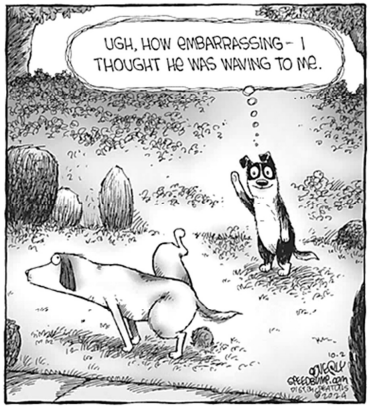
Dave Coverly. Speed Bump. 2/10/2024.
The humorous aspect of the cartoon above is due to the fact that
06