


![[Marketing] Questao Topo - deslogado](https://storage.estuda.com.br/banners/0_6b7ebee90b03af1c560c73bb8bcce34a_banner_deslogado_70_dias.png)
Questões de Inglês
19.971 Questões
Questão 27 139680
FATEC 2017/1Here’s how long you can work before your brain 1shuts down
I’m having a hard time starting this article. According to research out of the University of Melbourne, that might be because I’m middle-aged and work too much. Economists determined that burning the midnight oil makes you, well, dumber.” Our study highlights that too much work can have adverse effects on cognitive functioning,” they conclude.
Tell us something we didn’t know. Who hasn’t, at the end of a seemingly endless workweek, found themselves staring blankly at their computer screen or into space unable to remember what they had for lunch, let alone form a coherent thought about the task at hand?
For some employees, of course – the average resident 2 physician or, these days, that “3 gig economy” worker who makes ends meet by banging away at multiple projects – long hours are a fact of modern working life. And there’s a cost. Medical researchers have shown that working too much can affect employees’ physical and mental health.
So how much is too much? For people age 40 and older, working up to roughly 25 hours per week boosts memory, the ability to quickly process information and other aspects of cognitive function, according to the study, which drew on a longitudinal survey that tracks the well-being of 6,000 Australians. Beyond 25 hours a week, the middle-aged brain doesn’t work as well, the study indicates, noting that the findings apply to both men and women.
http://tinyurl.com/j4os8ck Acesso em: 24.08.2016. Adaptado.
Glossário
1 to shut down: parar de operar/funcionar.
2 physician: médico.
3 gig economy: ambiente de trabalho baseado em empregos temporários e contratos de curta duração.
Considere a afirmação: “Our study highlights that too much work can have adverse effects on cognitive functioning.” Um dos efeitos adversos do trabalho excessivo apresentado pelo autor é
Questão 26 139679
FATEC 2017/1Here’s how long you can work before your brain 1shuts down
I’m having a hard time starting this article. According to research out of the University of Melbourne, that might be because I’m middle-aged and work too much. Economists determined that burning the midnight oil makes you, well, dumber.” Our study highlights that too much work can have adverse effects on cognitive functioning,” they conclude.
Tell us something we didn’t know. Who hasn’t, at the end of a seemingly endless workweek, found themselves staring blankly at their computer screen or into space unable to remember what they had for lunch, let alone form a coherent thought about the task at hand?
For some employees, of course – the average resident 2 physician or, these days, that “3 gig economy” worker who makes ends meet by banging away at multiple projects – long hours are a fact of modern working life. And there’s a cost. Medical researchers have shown that working too much can affect employees’ physical and mental health.
So how much is too much? For people age 40 and older, working up to roughly 25 hours per week boosts memory, the ability to quickly process information and other aspects of cognitive function, according to the study, which drew on a longitudinal survey that tracks the well-being of 6,000 Australians. Beyond 25 hours a week, the middle-aged brain doesn’t work as well, the study indicates, noting that the findings apply to both men and women.
http://tinyurl.com/j4os8ck Acesso em: 24.08.2016. Adaptado.
Glossário
1 to shut down: parar de operar/funcionar.
2 physician: médico.
3 gig economy: ambiente de trabalho baseado em empregos temporários e contratos de curta duração.
A respeito do autor, o primeiro parágrafo nos informa que ele
Questão 25 139673
FATEC 2017/1Here’s how long you can work before your brain 1shuts down
I’m having a hard time starting this article. According to research out of the University of Melbourne, that might be because I’m middle-aged and work too much. Economists determined that burning the midnight oil makes you, well, dumber.” Our study highlights that too much work can have adverse effects on cognitive functioning,” they conclude.
Tell us something we didn’t know. Who hasn’t, at the end of a seemingly endless workweek, found themselves staring blankly at their computer screen or into space unable to remember what they had for lunch, let alone form a coherent thought about the task at hand?
For some employees, of course – the average resident 2 physician or, these days, that “3 gig economy” worker who makes ends meet by banging away at multiple projects – long hours are a fact of modern working life. And there’s a cost. Medical researchers have shown that working too much can affect employees’ physical and mental health.
So how much is too much? For people age 40 and older, working up to roughly 25 hours per week boosts memory, the ability to quickly process information and other aspects of cognitive function, according to the study, which drew on a longitudinal survey that tracks the well-being of 6,000 Australians. Beyond 25 hours a week, the middle-aged brain doesn’t work as well, the study indicates, noting that the findings apply to both men and women.
http://tinyurl.com/j4os8ck Acesso em: 24.08.2016. Adaptado.
Glossário
1 to shut down: parar de operar/funcionar.
2 physician: médico.
3 gig economy: ambiente de trabalho baseado em empregos temporários e contratos de curta duração.
Ao escrever, no início do texto, “I’m having a hard time starting this article”, o autor
Questão 5 139650
FATEC 2017/1Considere o cartum.
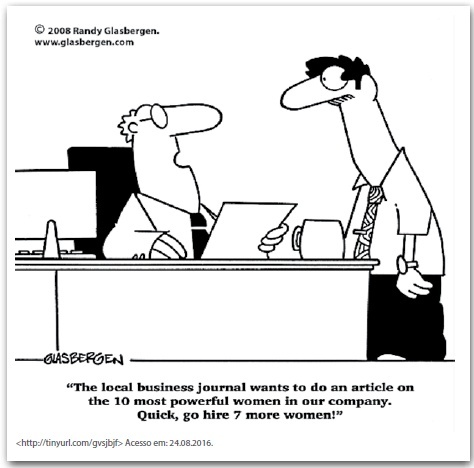
De acordo com o texto do cartum,
Questão 30 139440
UNESP 2017/2“One never builds something finished”: the brilliance of architect Paulo Mendes da Rocha
Oliver Wainwright
February 4, 2017
“All space is public,” says Paulo Mendes da Rocha. “The only private space that you can imagine is in the human mind.” It is an optimistic statement from the 88-year-old Brazilian architect, given he is a resident of São Paulo, a city where the triumph of the private realm over the public could not be more stark. The sprawling megalopolis is a place of such marked inequality that its superrich hop between their rooftop helipads because they are too scared of street crime to come down from the clouds.
But for Mendes da Rocha, who received the 2017 gold medal from the Royal Institute of British Architects this week – an accolade previously bestowed on such luminaries as Le Corbusier and Frank Lloyd Wright – the ground is everything. He has spent his 60-year career lifting his massive concrete buildings up, in gravity-defying balancing acts, or else burying them below ground in an attempt to liberate the Earth’s surface as a continuous democratic public realm. “The city has to be for everybody,” he says, “not just for the very few.”
(www.theguardian.com. Adaptado.)
No trecho do segundo parágrafo “The city has to be for everybody”, a expressão em destaque pode ser substituída, sem alteração de sentido, por
Questão 28 139438
UNESP 2017/2“One never builds something finished”: the brilliance of architect Paulo Mendes da Rocha
Oliver Wainwright
February 4, 2017
“All space is public,” says Paulo Mendes da Rocha. “The only private space that you can imagine is in the human mind.” It is an optimistic statement from the 88-year-old Brazilian architect, given he is a resident of São Paulo, a city where the triumph of the private realm over the public could not be more stark. The sprawling megalopolis is a place of such marked inequality that its superrich hop between their rooftop helipads because they are too scared of street crime to come down from the clouds.
But for Mendes da Rocha, who received the 2017 gold medal from the Royal Institute of British Architects this week – an accolade previously bestowed on such luminaries as Le Corbusier and Frank Lloyd Wright – the ground is everything. He has spent his 60-year career lifting his massive concrete buildings up, in gravity-defying balancing acts, or else burying them below ground in an attempt to liberate the Earth’s surface as a continuous democratic public realm. “The city has to be for everybody,” he says, “not just for the very few.”
(www.theguardian.com. Adaptado.)
No trecho do primeiro parágrafo “The sprawling megalopolis is a place of such marked inequality”, o termo em destaque indica
06