


![[Marketing] Questao Topo - deslogado](https://storage.estuda.com.br/banners/0_6b7ebee90b03af1c560c73bb8bcce34a_banner_deslogado_70_dias.png)
Questões de Inglês
19.971 Questões
Questão 34 141211
UPE 1° Fase / 1° Dia SSA 2017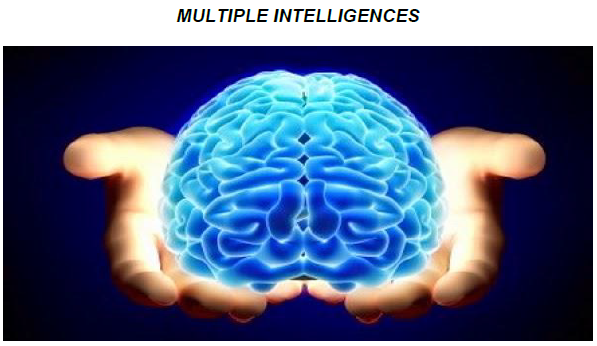
Howard Gardner believes that a person __________ is good at math is not more intelligent than someone who is good at sports. He believes they are intelligent in a different way.
Howard Gardner is a psychologist, and a long time __________ (in 1983) he wrote a book about his theory. In his view there is not just one kind of intelligence – there are multiple intelligences. It‟s possible to be good (or not so good) at one or more of them. You can have trouble __________ words, for example, but be quite good at drawing and at athletics. Or you can find it hard to understand yourself but be really good at connecting with other people!
The idea __________ „multiple intelligences‟ is very interesting. It‟s also really useful. People __________ a strong musical intelligence for example, can use songs to help them learn. You can also develop your weaker intelligences to give yourself more choices and to make your life more interesting.
(In: Jetstream, Pre-intermediate A. REVELL, J and TOMALIN, M. Helbling Languages, 2015. Adaptado.)
After reading the text, mark T (true) or F (false).
( ) Some people are intelligent but others aren‟t.
( ) No one is stupid. Everyone is intelligent.
( ) Different people are intelligent in different ways.
( ) There‟s just one kind of intelligence.
( ) People with a strong musical intelligence can help to learn just songs.
Mark the alternative that contains the CORRECT sequence.
Questão 80 141060
UFPR 2017Six things I learned from riding in a Google self-driving car
1 - Human beings are terrible drivers.
We drink. We doze. We text. In the US, 30,000 people die from automobile accidents every year. Traffic crashes are the primary cause of death worldwide for people aged 15-24, and during a crash, 40% of drivers never even hit the brakes. We’re flawed organisms, barreling around at high speeds in vessels covered in glass, metal, distraction, and death. This is one of Google’s “moonshots” – to remove human error from a job which, for the past hundred years, has been entirely human.
2 - Google self-driving cars are timid.
The car we rode in did not strike me as dangerous. It drove slowly and deliberately, and I got the impression that it’s more likely to annoy other drivers than to harm them.
In the early versions they tested on closed courses, the vehicles were programmed to be highly aggressive. Apparently during these tests, which involved obstacle courses full of traffic cones and inflatable crash-test objects, there were a lot of screeching brakes, roaring engines and terrified interns.
3 - They’re cute.
Google’s new fleet was intentionally designed to look adorable. Our brains are hardwired to treat inanimate (or animate) objects with greater care, caution, and reverence when they resemble a living thing. By turning self-driving cars into an adorable Skynet Marshmallow Bumper Bots, Google hopes to spiritually disarm other drivers. I also suspect the cuteness is used to quell some of the road rage that might emerge from being stuck behind one of these things. They’re intended as moderate-distance couriers, not openroad warriors, so their max speed is 25 miles per hour.
4 - It’s not done and it’s not perfect.
Some of the scenarios autonomous vehicles have the most trouble with are the same human beings have the most trouble with, such as traversing four-way stops or handling a yellow light.
The cars use a mixture of 3D laser-mapping, GPS, and radar to analyze and interpret their surroundings, and the latest versions are fully electric with a range of about 100 miles.
Despite the advantages over a human being in certain scenarios, however, these cars still aren’t ready for the real world. They can’t drive in the snow or heavy rain, and there’s a variety of complex situations they do not process well, such as passing through a construction zone. Google is hoping that, eventually, the cars will be able to handle all of this as well (or better) than a human could.
5 - I want this technology to succeed, like… yesterday.
I’m biased. Earlier this year my mom had a stroke. It damaged the visual cortex of her brain, and her vision was impaired to the point that she’ll probably never drive again. This reduced her from a fully-functional, independent human being with a career and a buzzing social life into someone who is homebound, disabled, and powerless.
When discussing self-driving cars, people tend to ask many superficial questions. They ignore that 45% of disabled people in the US still work. They ignore that 95% of a car’s lifetime is spent parked. They ignore how this technology could transform the lives of the elderly, or eradicate the need for parking lots or garages or gas stations. They dismiss the entire concept because they don’t think a computer could ever be as good at merging on the freeway as they are. They ignore the great, big, beautiful picture: that this technology could make our lives so much better.
6 - It wasn’t an exhilarating ride, and that’s a good thing.
Riding in a self-driving car is not the cybernetic thrill ride one might expect. The car drives like a person, and after a few minutes you forget that you’re being driven autonomously. You forget that a robot is differentiating cars from pedestrians from mopeds from raccoons. You forget that millions of photons are being fired from a laser and interpreting, processing, and reacting to the hand signals of a cyclist. You forget that instead of an organic brain, which has had millions of years to evolve the cognitive ability to fumble its way through a four-way stop, you’re being piloted by an artificial one, which was birthed in less than a decade.
The unfortunate part of something this transformative is the inevitable, ardent stupidity which is going to erupt from the general public. Even if in a few years self-driving cars are proven to be ten times safer than human-operated cars, all it’s going to take is one tragic accident and the public is going to lose their minds. There will be outrage. There will be politicizing. There will be hashtags.
I say look at the bigger picture. All the self-driving cars currently on the road learn from one another, and possess 40 years of driving experience. And this technology is still in its infancy.
(Adapted from: <http://theoatmeal.com/blog/google_self_driving_car>. 21/08/2016.)
Based on the text, it is correct to affirm that the author:
Questão 76 141045
UFPR 2017Six things I learned from riding in a Google self-driving car
1 - Human beings are terrible drivers.
We drink. We doze. We text. In the US, 30,000 people die from automobile accidents every year. Traffic crashes are the primary cause of death worldwide for people aged 15-24, and during a crash, 40% of drivers never even hit the brakes. We’re flawed organisms, barreling around at high speeds in vessels covered in glass, metal, distraction, and death. This is one of Google’s “moonshots” – to remove human error from a job which, for the past hundred years, has been entirely human.
2 - Google self-driving cars are timid.
The car we rode in did not strike me as dangerous. It drove slowly and deliberately, and I got the impression that it’s more likely to annoy other drivers than to harm them.
In the early versions they tested on closed courses, the vehicles were programmed to be highly aggressive. Apparently during these tests, which involved obstacle courses full of traffic cones and inflatable crash-test objects, there were a lot of screeching brakes, roaring engines and terrified interns.
3 - They’re cute.
Google’s new fleet was intentionally designed to look adorable. Our brains are hardwired to treat inanimate (or animate) objects with greater care, caution, and reverence when they resemble a living thing. By turning self-driving cars into an adorable Skynet Marshmallow Bumper Bots, Google hopes to spiritually disarm other drivers. I also suspect the cuteness is used to quell some of the road rage that might emerge from being stuck behind one of these things. They’re intended as moderate-distance couriers, not openroad warriors, so their max speed is 25 miles per hour.
4 - It’s not done and it’s not perfect.
Some of the scenarios autonomous vehicles have the most trouble with are the same human beings have the most trouble with, such as traversing four-way stops or handling a yellow light.
The cars use a mixture of 3D laser-mapping, GPS, and radar to analyze and interpret their surroundings, and the latest versions are fully electric with a range of about 100 miles.
Despite the advantages over a human being in certain scenarios, however, these cars still aren’t ready for the real world. They can’t drive in the snow or heavy rain, and there’s a variety of complex situations they do not process well, such as passing through a construction zone. Google is hoping that, eventually, the cars will be able to handle all of this as well (or better) than a human could.
5 - I want this technology to succeed, like… yesterday.
I’m biased. Earlier this year my mom had a stroke. It damaged the visual cortex of her brain, and her vision was impaired to the point that she’ll probably never drive again. This reduced her from a fully-functional, independent human being with a career and a buzzing social life into someone who is homebound, disabled, and powerless.
When discussing self-driving cars, people tend to ask many superficial questions. They ignore that 45% of disabled people in the US still work. They ignore that 95% of a car’s lifetime is spent parked. They ignore how this technology could transform the lives of the elderly, or eradicate the need for parking lots or garages or gas stations. They dismiss the entire concept because they don’t think a computer could ever be as good at merging on the freeway as they are. They ignore the great, big, beautiful picture: that this technology could make our lives so much better.
6 - It wasn’t an exhilarating ride, and that’s a good thing.
Riding in a self-driving car is not the cybernetic thrill ride one might expect. The car drives like a person, and after a few minutes you forget that you’re being driven autonomously. You forget that a robot is differentiating cars from pedestrians from mopeds from raccoons. You forget that millions of photons are being fired from a laser and interpreting, processing, and reacting to the hand signals of a cyclist. You forget that instead of an organic brain, which has had millions of years to evolve the cognitive ability to fumble its way through a four-way stop, you’re being piloted by an artificial one, which was birthed in less than a decade.
The unfortunate part of something this transformative is the inevitable, ardent stupidity which is going to erupt from the general public. Even if in a few years self-driving cars are proven to be ten times safer than human-operated cars, all it’s going to take is one tragic accident and the public is going to lose their minds. There will be outrage. There will be politicizing. There will be hashtags.
I say look at the bigger picture. All the self-driving cars currently on the road learn from one another, and possess 40 years of driving experience. And this technology is still in its infancy.
(Adapted from: <http://theoatmeal.com/blog/google_self_driving_car>. 21/08/2016.)
Consider the following characteristics of the new Google self-driving car:
1. It runs on batteries and petrol.
2. It can be used in extreme weather conditions.
3. It has a design which requires further modifications.
4. It can reach the speed of 25 miles per hour.
Mark the correct alternative.
Questão 35 140449
UDESC Manhã 2017/1Text
Eclipse in Africa: 'Ring of Fire' eclipse wows stargazers
Stargazers in parts of Africa have been treated to a spectacular "ring of fire" in the sky as the sun was almost - but not completely - eclipsed.
An annular eclipse happens when the moon is farther away from the Earth than during a total eclipse.
The result is a bright circle of sunshine surrounding a dark, shadowy core.
The best views were seen in Tanzania, where the event lasted about three minutes.
The eclipse could also be viewed in parts of Gabon, Congo-Brazzaville, the Democratic Republic of Congo, Madagascar, and the French Indian Ocean island of La Reunion.
The moon does not move in a perfect circle around the earth - instead, its orbit is slightly elliptical. That means the distance of the moon varies between around 225,000-252,000 miles (362,000-405,555 km).
When the moon is farther away from the earth, it appears smaller - and does not totally cover the sun's disc during a total eclipse. The result is also known as a "ring of fire" eclipse.
The next eclipse is due to take place in February 2017, and can be seen from parts of South America and Africa.
Avaiable at:http://www.bbc.com/news/world-africa. Accessed on 02/09/16.
The underlined grammatical construction is a:
Questão 33 140447
UDESC Manhã 2017/1Text 3
The Mice In Council
One day a group of mice decided to call a meeting to see what they could do about the cat which was always trying to catch them. They talked about lots of plans but none of them seemed like they would work. At last, a young mouse got up and said that a bell should be hung around the cat\'s neck so all the mice would be able to hear when he was coming closer. All the mice thought this was an excellent idea. However, an older mouse got up and spoke, "This is a really good idea but who is going to tie the bell around the cat\'s neck?"
Avaiable at: www.johnmh.com/advreaidngs. Acessed on 22/08/16.
According to the Text 3, it is correct to say that:
Questão 32 140446
UDESC Manhã 2017/1Text 3
The Mice In Council
One day a group of mice decided to call a meeting to see what they could do about the cat which was always trying to catch them. They talked about lots of plans but none of them seemed like they would work. At last, a young mouse got up and said that a bell should be hung around the cat\'s neck so all the mice would be able to hear when he was coming closer. All the mice thought this was an excellent idea. However, an older mouse got up and spoke, "This is a really good idea but who is going to tie the bell around the cat\'s neck?"
Avaiable at: www.johnmh.com/advreaidngs. Acessed on 22/08/16.
Mark the proverb which best represents the Text 3.
06