


![[Marketing] Questao Topo - deslogado](https://storage.estuda.com.br/banners/0_6b7ebee90b03af1c560c73bb8bcce34a_banner_deslogado_70_dias.png)
Questões de Inglês
19.971 Questões
Questão 16 212169
UNIVAG 2017/1Zika, Ebola outbreaks can be predicted using
climate change, scientists say
Jamie A.
June 14, 2016
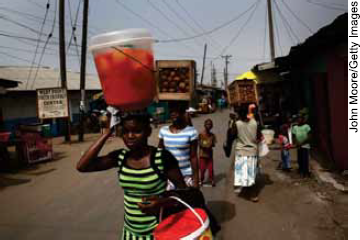
Women walk with their wares through the West Point slum on February 9, 2016 in Monrovia, Liberia. West Point, the most impoverished and overpopulated community in Liberia, was hard hit by the Ebola outbreak, and health facilities at the time were overwhelmed. After almost two years, on January 14, 2016 the World Health Organization declared the epidemic over, after the virus had killed some 11,300 people and infected more than 28,500 people in West Africa.
Scientists in the UK said that Zika and Ebola outbreaks could be predicted based on changes in the environment. Researchers at the University College London (UCL) developed a model that can predict outbreaks of zoonotic diseases – such as Zika and Ebola that came from animals – based on changes in climate, population growth and land use.
The study, which was published in Methods in Ecology and Evolution, is described as “a major improvement in our understanding of the spread of diseases from animals to humans,” and the researchers said that the study could help governments prepare and respond to outbreaks, as well as consider the environmental risks when making policies. “Our model can help decision-makers assess the likely impact (on zoonotic disease) of any interventions or change in national or international government policies, such as conversion of grasslands to agricultural lands,” Kate Jones, professor at the University College London’s genetics, evolution and environment department and co-author of the study, said in a press release. According to the study, more than 60 percent of emerging infectious diseases are zoonotic by nature, and that aside from Zika and Ebola, other highly infectious diseases such as Rift Valley fever and Lassa fever are predicted to spread with changing environmental factors.
Researchers tested the new model with the Lassa fever epidemic in West Africa, which was caused by the Lassa virus from rats. The team used the locations of 408 known Lassa fever outbreaks in West Africa between 1967 and 2012 and the changes in land use and crop yields, temperature and rainfall, behavior and access to healthcare.
To track the virus’ location against ecological factors, the researchers also identified the sub-species of the multimammate rat (Mastomys natalensis) responsible for transmitting the virus. With these information, the model predicts that the number of people infected by the disease will double from 195,125 to 406,725 by 2070.
“Our new approach successfully predicts outbreaks of individual diseases by pairing the changes in the host’s distribution as the environment changes with the mechanics of how that disease spreads from animals to people, which hasn’t been done before,” Dr. David Redding of UCL and co-author of the study said in the press release. “It allows us to calculate how often people are likely to come into contact with disease-carrying animals and their risk of the virus spilling over. Alongside population increases, the expected future changes to climatic patterns will drive an expansion of the areas of West Africa considered high risk, especially the western most regions around Senegal and Guinea, the coastline of Cote d’Ivoire and Ghana, and in Central Nigeria,” Redding added. According to the researchers, the model could be refined to include the impact of travel infrastructure, human-to-human contact rates and poverty.
(www.natureworldnews.com. Adaptado.)
De acordo com o último parágrafo, o modelo desenvolvido pelos pesquisadores
Questão 15 212168
UNIVAG 2017/1Zika, Ebola outbreaks can be predicted using
climate change, scientists say
Jamie A.
June 14, 2016
Women walk with their wares through the West Point slum on February 9, 2016 in Monrovia, Liberia. West Point, the most impoverished and overpopulated community in Liberia, was hard hit by the Ebola outbreak, and health facilities at the time were overwhelmed. After almost two years, on January 14, 2016 the World Health Organization declared the epidemic over, after the virus had killed some 11,300 people and infected more than 28,500 people in West Africa.
Scientists in the UK said that Zika and Ebola outbreaks could be predicted based on changes in the environment. Researchers at the University College London (UCL) developed a model that can predict outbreaks of zoonotic diseases – such as Zika and Ebola that came from animals – based on changes in climate, population growth and land use.
The study, which was published in Methods in Ecology and Evolution, is described as “a major improvement in our understanding of the spread of diseases from animals to humans,” and the researchers said that the study could help governments prepare and respond to outbreaks, as well as consider the environmental risks when making policies. “Our model can help decision-makers assess the likely impact (on zoonotic disease) of any interventions or change in national or international government policies, such as conversion of grasslands to agricultural lands,” Kate Jones, professor at the University College London’s genetics, evolution and environment department and co-author of the study, said in a press release. According to the study, more than 60 percent of emerging infectious diseases are zoonotic by nature, and that aside from Zika and Ebola, other highly infectious diseases such as Rift Valley fever and Lassa fever are predicted to spread with changing environmental factors.
Researchers tested the new model with the Lassa fever epidemic in West Africa, which was caused by the Lassa virus from rats. The team used the locations of 408 known Lassa fever outbreaks in West Africa between 1967 and 2012 and the changes in land use and crop yields, temperature and rainfall, behavior and access to healthcare.
To track the virus’ location against ecological factors, the researchers also identified the sub-species of the multimammate rat (Mastomys natalensis) responsible for transmitting the virus. With these information, the model predicts that the number of people infected by the disease will double from 195,125 to 406,725 by 2070.
“Our new approach successfully predicts outbreaks of individual diseases by pairing the changes in the host’s distribution as the environment changes with the mechanics of how that disease spreads from animals to people, which hasn’t been done before,” Dr. David Redding of UCL and co-author of the study said in the press release. “It allows us to calculate how often people are likely to come into contact with disease-carrying animals and their risk of the virus spilling over. Alongside population increases, the expected future changes to climatic patterns will drive an expansion of the areas of West Africa considered high risk, especially the western most regions around Senegal and Guinea, the coastline of Cote d’Ivoire and Ghana, and in Central Nigeria,” Redding added. According to the researchers, the model could be refined to include the impact of travel infrastructure, human-to-human contact rates and poverty.
(www.natureworldnews.com. Adaptado.)
No trecho do último parágrafo “It allows us to calculate how often people are likely to come into contact with disease-carrying animals and their risk of the virus spilling over”, o termo em destaque refere-se a
Questão 14 212166
UNIVAG 2017/1Zika, Ebola outbreaks can be predicted using
climate change, scientists say
Jamie A.
June 14, 2016
Women walk with their wares through the West Point slum on February 9, 2016 in Monrovia, Liberia. West Point, the most impoverished and overpopulated community in Liberia, was hard hit by the Ebola outbreak, and health facilities at the time were overwhelmed. After almost two years, on January 14, 2016 the World Health Organization declared the epidemic over, after the virus had killed some 11,300 people and infected more than 28,500 people in West Africa.
Scientists in the UK said that Zika and Ebola outbreaks could be predicted based on changes in the environment. Researchers at the University College London (UCL) developed a model that can predict outbreaks of zoonotic diseases – such as Zika and Ebola that came from animals – based on changes in climate, population growth and land use.
The study, which was published in Methods in Ecology and Evolution, is described as “a major improvement in our understanding of the spread of diseases from animals to humans,” and the researchers said that the study could help governments prepare and respond to outbreaks, as well as consider the environmental risks when making policies. “Our model can help decision-makers assess the likely impact (on zoonotic disease) of any interventions or change in national or international government policies, such as conversion of grasslands to agricultural lands,” Kate Jones, professor at the University College London’s genetics, evolution and environment department and co-author of the study, said in a press release. According to the study, more than 60 percent of emerging infectious diseases are zoonotic by nature, and that aside from Zika and Ebola, other highly infectious diseases such as Rift Valley fever and Lassa fever are predicted to spread with changing environmental factors.
Researchers tested the new model with the Lassa fever epidemic in West Africa, which was caused by the Lassa virus from rats. The team used the locations of 408 known Lassa fever outbreaks in West Africa between 1967 and 2012 and the changes in land use and crop yields, temperature and rainfall, behavior and access to healthcare.
To track the virus’ location against ecological factors, the researchers also identified the sub-species of the multimammate rat (Mastomys natalensis) responsible for transmitting the virus. With these information, the model predicts that the number of people infected by the disease will double from 195,125 to 406,725 by 2070.
“Our new approach successfully predicts outbreaks of individual diseases by pairing the changes in the host’s distribution as the environment changes with the mechanics of how that disease spreads from animals to people, which hasn’t been done before,” Dr. David Redding of UCL and co-author of the study said in the press release. “It allows us to calculate how often people are likely to come into contact with disease-carrying animals and their risk of the virus spilling over. Alongside population increases, the expected future changes to climatic patterns will drive an expansion of the areas of West Africa considered high risk, especially the western most regions around Senegal and Guinea, the coastline of Cote d’Ivoire and Ghana, and in Central Nigeria,” Redding added. According to the researchers, the model could be refined to include the impact of travel infrastructure, human-to-human contact rates and poverty.
(www.natureworldnews.com. Adaptado.)
O estudo
Questão 12 212164
UNIVAG 2017/1Zika, Ebola outbreaks can be predicted using
climate change, scientists say
Jamie A.
June 14, 2016
Women walk with their wares through the West Point slum on February 9, 2016 in Monrovia, Liberia. West Point, the most impoverished and overpopulated community in Liberia, was hard hit by the Ebola outbreak, and health facilities at the time were overwhelmed. After almost two years, on January 14, 2016 the World Health Organization declared the epidemic over, after the virus had killed some 11,300 people and infected more than 28,500 people in West Africa.
Scientists in the UK said that Zika and Ebola outbreaks could be predicted based on changes in the environment. Researchers at the University College London (UCL) developed a model that can predict outbreaks of zoonotic diseases – such as Zika and Ebola that came from animals – based on changes in climate, population growth and land use.
The study, which was published in Methods in Ecology and Evolution, is described as “a major improvement in our understanding of the spread of diseases from animals to humans,” and the researchers said that the study could help governments prepare and respond to outbreaks, as well as consider the environmental risks when making policies. “Our model can help decision-makers assess the likely impact (on zoonotic disease) of any interventions or change in national or international government policies, such as conversion of grasslands to agricultural lands,” Kate Jones, professor at the University College London’s genetics, evolution and environment department and co-author of the study, said in a press release. According to the study, more than 60 percent of emerging infectious diseases are zoonotic by nature, and that aside from Zika and Ebola, other highly infectious diseases such as Rift Valley fever and Lassa fever are predicted to spread with changing environmental factors.
Researchers tested the new model with the Lassa fever epidemic in West Africa, which was caused by the Lassa virus from rats. The team used the locations of 408 known Lassa fever outbreaks in West Africa between 1967 and 2012 and the changes in land use and crop yields, temperature and rainfall, behavior and access to healthcare.
To track the virus’ location against ecological factors, the researchers also identified the sub-species of the multimammate rat (Mastomys natalensis) responsible for transmitting the virus. With these information, the model predicts that the number of people infected by the disease will double from 195,125 to 406,725 by 2070.
“Our new approach successfully predicts outbreaks of individual diseases by pairing the changes in the host’s distribution as the environment changes with the mechanics of how that disease spreads from animals to people, which hasn’t been done before,” Dr. David Redding of UCL and co-author of the study said in the press release. “It allows us to calculate how often people are likely to come into contact with disease-carrying animals and their risk of the virus spilling over. Alongside population increases, the expected future changes to climatic patterns will drive an expansion of the areas of West Africa considered high risk, especially the western most regions around Senegal and Guinea, the coastline of Cote d’Ivoire and Ghana, and in Central Nigeria,” Redding added. According to the researchers, the model could be refined to include the impact of travel infrastructure, human-to-human contact rates and poverty.
(www.natureworldnews.com. Adaptado.)
No trecho do segundo parágrafo “Our model can help decision-makers assess the likely impact (on zoonotic disease) of any interventions or change in national or international government policies, such as conversion of grasslands to agricultural lands”, a expressão em destaque exprime ideia de
Questão 44 211942
UNEMAT 2017/2ANOTHER TWO BRAZIL DAMS ‘AT RISK OF COLLAPSING’
Brazilian mining company Samarco says two dams it uses to hold waste from iron production are damaged and at risk of collapsing
One of the company’s reservoir burst earlier this month, flooding dozens of homes in the southeastern state of Minas Gerais. Eleven people were killed and 12 are missing presumed dead. Emergency work to try to avoid another breach will begin immediately and will last up to 90 days, the company said. The company initially said that two of its dams – Fundao e Germano – had burst on 5 November. But it has now clarified that only the Fundao reservoir collapsed. Germano and another nearby dam, Santarem, are still standing but are at risk, said Samarco’s Infrastructure Director Kleber Terra.
‘First instalment’
Samarco is owned by mining giants Vale, from Brazil, and Anglo-Australian company BHP Billiton. It agreed on Monday to pay the Brazilian government 1bn reais (…) compensation. The money will be used to cover the initial clean-up and to offer some compensation to the victims and their families.
Disponível em: http://www.bbc.com/news/world-latin-america-3485 1895. Acesso em 25 nov. 2015.
Assinale a alternativa que corresponde às informações contidas no texto.
Questão 43 211941
UNEMAT 2017/2LIQUID LOVE: ON THE FRAILTY OF HUMAN BONDS
[…]
The tone of Liquid Love isn’t elegiacal, or not often. Rather, Bauman’s book is a hymn to what he calls our liquid modern society. (…) The work of the liquid modern is likewise never done, but it takes much more imagination. Bauman finds his hero working everywhere – jabbering into mobile phones, addictively texting, leaping from one chat room to another, internet dating (whose key appeal, Bauman notes, is that you can always delete a dating without pain or peril). The liquid modern is forever at work, forever replacing quality of relationship with quantity.
What’s the significance of all this anxious work? For Bauman the medium is not the message - the new gadgets we use hardly determine who we are. Nor are the messages that people send each other significant in themselves; rather, the message is the circulation of messages. The sense of belonging or security that the liquid modern creates consists in being cocooned in a web of messages. That way, we hope, the vexing problem of freedom and security will disappear.
We text, argues Bauman, therefore we are. “We belong,” he writes, “to the even flow of words and unfinished sentences (abbreviated, to be sure, truncated to speed up the circulation). We belong to talking, not what talking about…So stop talking – and you are out. Silence equals exclusion.” (…) It is the fear of silence and the exclusion it implies makes us anxious that our ingeniously assembled security will fall apart. (…)
Disponível em http://www.theguardian.com/books/2003/apr/19/hi ghereducation.news. Acesso em nov. 2015.
Assinale a alternativa que corresponde às informações contidas no texto.
06