


![[Marketing] Questao Topo - deslogado](https://storage.estuda.com.br/banners/0_6b7ebee90b03af1c560c73bb8bcce34a_banner_deslogado_70_dias.png)
Questões de Inglês
19.971 Questões
Questão 19 271955
Unit-AL 2017TEXTO:
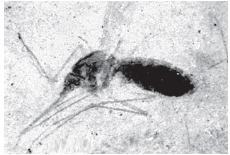
Jurassic Park’s iconic image of a fossilized blood
filled mosquito was thought to be fiction — until now. For
the first time, researchers have identified a fossil of a
female mosquito with traces of blood in its engorged
[5] abdomen. A team led by Dale Greenwalt at the US
National Museum of Natural History in Washington DC
reported the fossil discovery in Proceedings of the
National Academy of Sciences.
Although scientists have found fossils of suspected
[10] blood-sucking insects, the creatures’ feeding habits have
mostly been inferred from their anatomy or the presence
of blood-borne parasites in their guts. But Greenwalt’s
fossilized mosquito contains molecules that provide strong
evidence of blood-feeding among ancient insects back
[15] to 46 million years ago. It is a fortunate find. “The abdomen
of a blood-engorged mosquito is like a balloon ready to
burst. It is very fragile,” says Greenwalt. “The chances
that it wouldn’t have disintegrated prior to fossilization
were infinitesimally small.”
[20] The insect was found not in amber, as depicted
in Jurassic Park, but in shale rock sediments from
Montana. After 46 million years, any DNA would be long
degraded, but other molecules can survive. Greenwalt’s
team showed that the insect’s abdomen still contains
[25] large traces of iron and the organic molecule porphyrin
— both constituents of hemoglobin, the oxygen-carrying
pigment found in vertebrate blood. These molecules were
either rare or absent in the abdomen of a fossilized male
mosquito (which does not drink blood) of the same age,
[30] found at the same location. “This shows that details of a
blood-sucking mosquito can be nicely preserved in a
medium other than amber,” says George Poinar, who
studies fossilized insects at Oregon State University in
Corvallis. “It also shows that some porphyrin compounds
[35] in vertebrate blood can survive under the right conditions
for millions of years.”
YOUNG. Ed. Disponível em: . Acesso em: 24 jun. 2016.
Considering language use in the text, it’s correct to say:
Questão 17 271950
Unit-AL 2017TEXTO:
Jurassic Park’s iconic image of a fossilized blood
filled mosquito was thought to be fiction — until now. For
the first time, researchers have identified a fossil of a
female mosquito with traces of blood in its engorged
[5] abdomen. A team led by Dale Greenwalt at the US
National Museum of Natural History in Washington DC
reported the fossil discovery in Proceedings of the
National Academy of Sciences.
Although scientists have found fossils of suspected
[10] blood-sucking insects, the creatures’ feeding habits have
mostly been inferred from their anatomy or the presence
of blood-borne parasites in their guts. But Greenwalt’s
fossilized mosquito contains molecules that provide strong
evidence of blood-feeding among ancient insects back
[15] to 46 million years ago. It is a fortunate find. “The abdomen
of a blood-engorged mosquito is like a balloon ready to
burst. It is very fragile,” says Greenwalt. “The chances
that it wouldn’t have disintegrated prior to fossilization
were infinitesimally small.”
[20] The insect was found not in amber, as depicted
in Jurassic Park, but in shale rock sediments from
Montana. After 46 million years, any DNA would be long
degraded, but other molecules can survive. Greenwalt’s
team showed that the insect’s abdomen still contains
[25] large traces of iron and the organic molecule porphyrin
— both constituents of hemoglobin, the oxygen-carrying
pigment found in vertebrate blood. These molecules were
either rare or absent in the abdomen of a fossilized male
mosquito (which does not drink blood) of the same age,
[30] found at the same location. “This shows that details of a
blood-sucking mosquito can be nicely preserved in a
medium other than amber,” says George Poinar, who
studies fossilized insects at Oregon State University in
Corvallis. “It also shows that some porphyrin compounds
[35] in vertebrate blood can survive under the right conditions
for millions of years.”
YOUNG. Ed. Disponível em: . Acesso em: 24 jun. 2016.
As far as the fossilized mosquito is concerned, it’s correct to say that
Questão 28 262894
UNCISAL 2° Dia 2017
Na tirinha, o menino está argumentando sobre aspectos relacionados a
Questão 27 262892
UNCISAL 2° Dia 2017California awaits “The Big One”
Back in the 1980s, scientists completed a ten-year survey on the earthquake risk in California; and they came up with an alarming prediction. The next "Big One", that massive earthquake that Californians know is coming, could well strike by or shortly after the year 2018. And Californians know that this prediction could be right. California often experiences earthquakes, and a "big one" is sure to hit the state again sometime soon. Larry Wood, who lives virtually on top of the "Hayward fault", knows what it is like to be in an earthquake.
California is known for its size, its sun, and its surf, its glamour and its optimism. But it is known too as "Earthquake Country" — a truly vulnerable region where big devastating quakes have occurred in the past and could happen again. It is unlikely that a disaster on the scale of recent disasters in Italy or Japan could occur in California; California has learnt from its past disasters, and most buildings are designed to withstand major quakes. Nevertheless, Californians are worried. When will the next big quake strike the state, and where will all the shaking and crumbling and rocking begin?
Nobody knows for sure, but at all times California is on the alert. The earth has been monitored with high-tech seismographs situated in universities and government research stations; they are constantly watched by highly-trained employees and volunteers from the California Office of Emergency Services; and students are given training in what to do in the event of an earthquake.
Working at Menlo Park, near Stanford University, in the middle of "Earthquake Country", scientists from the United States Geological Survey are always monitoring and studying fault systems, and trying to predict where earthquakes are going to take place next. […]
Disponível em: . Acesso em: 23 nov. 2016 (adaptado).
Assinale a alternativa que apresenta somente verbos na voz passiva.
Questão 26 262891
UNCISAL 2° Dia 2017Teenagers are heavy smartphone users – many spend six hours a day on their phones – and Apple's iPhone remains their brand of choice. Nearly 7 out of 10 teens surveyed by Piper Jaffray own an iPhone, and 75% percent said they intend to buy an iPhone as their next smartphone. The investment bank found that 69% of teenagers surveyed are currently iPHone users. That's the highest interest in the iPhone among teenagers since at least 2013. […]
Disponível em: . Acesso em: 18 nov. 2016.
De acordo com o texto, considera-se que
Questão 25 262890
UNCISAL 2° Dia 2017Bella Swan has always been a little bit different. Never one to run with the crowd, Bella never cared about fitting in with the trendy, plastic girls at her Phoenix, Arizona high school. When her mother remarried and Bella chooses to live with her father in the rainy little town of Forks, Washington, she didn't expect much of anything to change. But things do change when she meets the mysterious and dazzlingly beautiful Edward Cullen. For Edward is nothing like any boy she's ever met. He's nothing like anyone she's ever met, period. He's intelligent and witty, and he seems to see straight into her soul. In no time at all, they are swept up in a passionate and decidedly unorthodox romance – unorthodox because Edward really isn't like the other boys. He can run faster than a mountain lion. He can stop a moving car with his bare hands. Oh, and he hasn't aged since 1918. Like all vampires, he's immortal […].
Disponível em: . Acesso em: 22 nov. 2016.
Considera-se que o personagem Edward
06