


![[Marketing] Questao Topo - deslogado](https://storage.estuda.com.br/banners/0_6b7ebee90b03af1c560c73bb8bcce34a_banner_deslogado_70_dias.png)
Questões de Inglês
19.971 Questões
Questão 55 303003
FPP Medicina Verão 2017Read the strip.
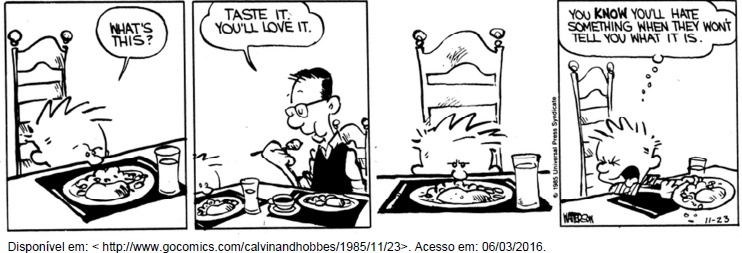
It can be inferred from the comic strip all of the sentences, EXCEPT
Questão 38 302139
FPP Verão Demais Cursos 2017According to the text, read the options and choose the CORRECT alternative.
London mayor: The Sadiq Khan story
By Esther Webber
Labour's Sadiq Khan has been elected as London's new mayor - but who is the man who will be in charge of the UK's capital city for the next four years?
Sadiq Khan's life to date has been characterised by beating the odds - which is what he has just done to become mayor of London.
When Labour politicians put themselves forward to run for mayor last year, Mr Khan was far from being the favourite. The bookies' money was on Baroness Jowell, a veteran of the Tony Blair years who had helped bring the Olympics to London.
But if there is a pattern in Mr Khan's career, it's one of coming from behind.
The new mayor did not have a privileged start in life. He was one of eight children born to Pakistani immigrants, a bus driver and a seamstress, on a south London housing estate.
From an early age, he showed a firm resolve to defy the odds in order to win success for himself and the causes important to him.
That resolve has won him the biggest personal mandate in the UK, a job with wide-ranging powers over London and with enormous emotional significance for him.
Some question whether he has the experience or record of good judgement necessary for the role.
He insists he is there to represent all Londoners and to tackle inequality in the capital, and now he has the chance to prove it.
Available in: . Access on: May 2016.
I. Most of Sadiq Khan’s life has been beating odds.
II. He comes from Tony Blair’s government.
III. He’s a son of foreign born parents.
IV. Sadiq Khan ran for mayor in the Labour Party.
V. People don’t know what kind of man is the new London mayor.
Questão 40 302061
FPP Inverno Demais Cursos 2017Read the text.
E.U. Lawmakers Call for End to Visa-Free Travel for Americans
BRUSSELS — The European Parliament has passed a nonbinding resolution calling for the reintroduction of visa requirements for American citizens, raising the stakes in a long-running battle over the United States’ refusal to grant visa-free access to citizens of five European Union countries.
In the vote on Thursday, European lawmakers played tit-for-tat in their dispute with the United States, demanding restrictions on American travelers unless the Trump administration lifts travel requirements for citizens of Bulgaria, Croatia, Cyprus, Poland and Romania.
Disponível em: https://www.nytimes.com/2017/03/03/world/europe/eu-visas-parliament-unitedstates.html?rref=collection%2Fsectioncollection%2Ftravel&_r=0
Analyse the type of language used in the excerpt:
Questão 39 302060
FPP Inverno Demais Cursos 2017Read the text.
DAYLIGHT SAVING TIME MAKES PEOPLE CLUMSY, LAZY AND SICK
Studies show that Daylight Saving Time — which starts at 2 a.m. Sunday — disrupts your circadian rhythm, the biological clock that’s synchronized with the rising and setting of the sun and regulates bodily processes such as sleep, metabolism and hormonal secretions.
“The circadian clock is our 24-hour rhythm that exists in our whole body,” says Dr. Michael Halassa, an assistant professor of neuroscience at New York University. “If you travel to Europe and spend a couple weeks there, then your circadian clock is going to reset, that ultimately is linked to the regulation of sleep.”
When we are sleep deprived, the connectivity between neural circuits is impaired. Sleep resets the weight of these neural circuits. Like a computer microprocessor, these circuits in the brain must be tuned well for us to make decisions. Otherwise you have cognitive inflexibility. “To be flexible you have to be able to process a lot of info,” Halassa says. “People default to a lower processing capacity when they can’t process a lot of information.” Judges who hand out tougher sentences on Monday morning may not be mean; they may just be suffering from cognitive inflexibility caused by sleep deprivation.
Disponível em: http://www.newsweek.com/daylight-saving-time-people-clumsy-lazy-sick-566625.
According to the text, it is CORRECT to state that:
Questão 38 302059
FPP Inverno Demais Cursos 2017Read the text.
SCIENCE INCHES CLOSER TO A UNIVERSAL BLOOD TEST FOR CANCER
A universal blood test for any type of cancer is an oncologist’s dream come true, and a new study suggests this concept may soon become a reality. Research from the University of California, San Diego, has found a new way to detect cancer in the blood that could both alert doctors to the presence of cancer, and tell them where in the body the tumor is located.
The new study, published online in the journal Nature Genetics, describes the discovery of a new clue found in the blood. Although the discovery is preliminary, the team hopes to soon advance to the clinical stage where it can be tested. If the testing proceeds as hoped, it could make cancer diagnosis faster and more effective.
Disponível em: http://www.newsweek.com/science-inches-closer-universal-blood-test-cancer-565824.
Mark the alternative which only shows items you can find in the text:
Questão 21 301267
UERJ 2017/2THE COST OF BEING HAWAIIAN: DEFENDING OUR IDENTITY
A beautiful Polynesian woman moves her hips from side to side, a flower adorning her ear as her
hands glide across her body in harmony with the music. She looks like a photograph come to
life. Beside her is a dark and handsome man smiling and playing the ukulele*. He sings through
his gigantic smile a beautiful love song to the dancing girl. After a time, the man stops playing
[5] and the woman stops dancing. The two stare lovingly into each other’s eyes and jump into their
canoe, disappearing into the sunset.
This misconception about the Hawaiian culture has always been around, and although I do not
profess to be an expert in Hawaiian studies by any means, I know that these ideas are only cheap
imitations and generic stereotypes created more to appeal to tourists than to perpetuate and
[10] preserve the Hawaiian way of life. The more people are exposed to these misconceptions, the
less they understand the true beauty of the Hawaiian people and the richness of their culture
steeped in politics, agriculture, aquaculture, dance, storytelling and an oral tradition that include
both extensive genealogies and mythology.
Imagine the reaction of our Hawaiian forefathers if they were to view one of the many dinner/
[15] cocktail shows that litter the pages of our tourist guides. What would they think? Would they
proudly applaud our efforts to preserve their contributions to history? Or would they laugh at
its absurdity? Is the need to be an economically viable state causing us to compromise our true
identity as Hawaiians in exchange for the luxuries that come with being a tourist destination?
As a boy, I took trips to the Big Island. Visiting there reminded me that Hawaiians had their own
[20] place in history and a proper culture complete with its own form of government, its own form
of religion and its own legal system. These discoveries about my heritage filled me with equal
portions of pride and wonderment.
The most concerning thing to me as a Hawaiian is the growing commercialization of our culture
and its possible consequences. Simplifying the culture merely for financial gain may actually
[25] cost Hawaiians more than they think. I do not dispute the fact that the tourism industry brings
in much needed revenue to the state, but how long can we tolerate the integrity of our culture
being violated simply to earn money? How much longer can we sell these fabricated ideas of the
islands before they imbue themselves upon the cultural consciousness of all Hawaiians?
I am not suggesting that we shut down every hula show that makes a profit off of reinforcing
[30] stereotypes, but that Hawaiians as a people with a rich heritage and a long cultural history need
to be more active in understanding our cultural identity. As western influence grows, we need to
take steps to preserve our culture so that our children don’t grow up believing the stereotypes
that are so readily conditioned into the mind of every tourist. Tourism will not go away, but
we need to take steps as Hawaiians to ensure our traditions are not swallowed up by these
superficial shadows.
*ukulele − Hawaiian musical instrument
pupuaoewa.org
In the last paragraph, the author refers to the hula show to reinforce the following idea:
06