


![[Marketing] Questao Topo - deslogado](https://storage.estuda.com.br/banners/0_6b7ebee90b03af1c560c73bb8bcce34a_banner_deslogado_70_dias.png)
Questões de Inglês
19.971 Questões
Questão 15 311816
ACAFE Demais Cursos 2017/2TEXTO
Brazil has declared an end to its public health emergency over the Zika virus, 18 months after a surge in cases drew headlines around the world. The mosquito-borne virus was not considered a major health threat until the 2015 outbreak revealed that Zika can lead to severe birth defects. One of those defects, microcephaly, causes babies to be born with skulls much smaller than expected.
Photos of babies with the defect spread panic around the globe as the virus was reported in dozens of countries. Many would-be travellers cancelled their trips to Zika-infected places. The concern spread even more widely when health officials said it could also be transmitted through sexual contact with an infected person.
The health scare came just as Brazil, the epicentre of the outbreak, was preparing to host the 2016 Olympics, fuelling concerns the Games could help spread the virus. One athlete, a Spanish wind surfer, said she got Zika while training in Brazil ahead of the Games.
In response to the outbreak, Brazil launched a mosquito-eradication campaign. The health ministry said those efforts have helped to dramatically reduce cases of Zika. Between January and mid-April, 95% fewer cases were recorded than during the same period last year. The incidence of microcephaly has fallen as well.
The World Health Organization (WHO) lifted its own international emergency in November, even while saying the virus remained a threat.
“The end of the emergency doesn’t mean the end of surveillance or assistance” to affected families, said Adeilson Cavalcante, the secretary for health surveillance at Brazil’s health ministry. “The health ministry and other organisations involved in this area will maintain a policy of fighting Zika, dengue and chikungunya.”
All three diseases are carried by the Aedes aegypti mosquito.
But the WHO has warned that Zika is “here to stay,” even when cases of it fall off, and that fighting the disease will be an ongoing battle.
(Fonte: Associated Press, Friday 12 May 2017 10.18 BST. Last modified on Friday 12 May 2017 22.00 BST)
Which of the titles below best sums up the main idea of the text?
Questão 15 310147
UFVJM 2017/1Leia o texto II para responder a questão
Texto II
ACTIVE TEENS BUILD STRONG BONES FOR LIFE
Tweens and teens who run, jump and dance may become adults with less breakable bones
Sharon Oosthoek - May 8, 2017
As much as a third of an adult’s skeleton will form during adolescence. So the more active someone is during this time, the stronger those bones will become.
Adolescence is a critical time for growing strong bones. That's especially true between the ages of 10 and 14 in girls, and 12 to 16 for boys. As much as 36 percent of the adult skeleton forms during these four years. But how strong those bones become depends on how active someone had been during those formative years. That’s the finding of a new study.
"The bigger the bones children make when they are young, the harder it will be to break when they get older," explains Laura Tosi. She’s a doctor who was not involved in the new work. But she knows the topic well. Tosi directs the Bone Health Program at Children’s National Medical Center in Washington, D.C.
Marque a alternativa em que as informações NÃO estão de acordo com o texto:
Questão 13 309469
UFVJM 2017/2Leia o texto I para responder à questão
Texto I
FANS BEG JUSTIN BIEBER TO CANCEL HIS CONCERT IN THE WAKE OF THE MANCHESTER ATTACKS
By Alex Riccardi - Yesterday at 4:23 pm

No one should have to live in fear but right now, in the wake of the Manchester attacks, some teens and young adults are scared. And you have a good reason. Bombs went off just minutes after Ariana Grande's performance in England taking the lives of 22 people and injuring many others. But, it's important to remember that concert venues and staff try to do everything they can to keep the audience members safe.
Ariana has officially postponed her "Dangerous Woman" until at least the beginning of June, however, there's no telling if she will cancel more shows after that. In the wake of all of this, fans are encouraging Justin Bieber to pull out of his performances in the U.K. The "Sorry" singer is set to headline at the British Summertime Festival on July 2nd. But, fans don't think it's a good idea.
They have been expressing their concern on social media and even starting the trend, #nopurposetour. One fan wrote, "@scooterbraun please. We're so worried about Justin's Security.... please please cancel Justin's purpose tour #NoPurposeTour." Another fan said, "Justin, please cancel Purpose Tour, we want you to be safe, we want you alive! We love you! #prayersforManchester #NoPurposeTour." This is absolutely heartbreaking. A third Belieber wrote, "#NoPurposeTourUK @justinbieber I don't want you to die, please do something."
Justin nor his manager Scooter Braun have yet to comment on the whole thing. However, we also must note that Scooter is Ariana's manager too. He definitely has his clients' best interest and their safety in mind. Now that Ariana has canceled some of her upcoming shows, Scooter definitely had a role in that decision. While fans may be scared for Justin, we have a feeling he is in good hands. If there was any chance of a threat or immediate danger, he wouldn't do the performance. However, the music can't be stopped because of evil in this world. Katy Perry, The Chainsmokers, and Lorde have all vowed to continue doing their upcoming shows in the wake of this tragedy.
Fonte: <http://www.j-14.com/posts/justin-bieber-tour-ariana-grande-manchester-attack-133157> Acesso: 24 May 2017.
Segundo o texto, as apresentações musicais não podem ser interrompidas por causa:
Questão 33 308859
FASA 1° Dia 2017/1Eastern Europe opposed to EU refugee plan
Ahead of the EU-Turkey summit, Chancellor Merkel of Germany continues to aim for a pan-European solution to the refugee crisis. But some Eastern EU states have rejected the agreement – they don’t want to accept any refugees.
Hungarian Prime Minister Viktor Orban still spearheads the Visegrad states’ battle against a common EU refugee policy. In his speech to the country on Hungary’s national holiday, two days before the EU summit, Orban reiterated his position on the refugee crisis. He said he would not accept a redistribution of migrants from Turkey to Europe. About two-thirds of the population now supports his tough stance on refugee policy. Orban wants to decide in a referendum whether the Hungarians agree to the EU allocation quotas.
No illusions about political agenda
Other eastern European countries share the same view, especially the Czech Republic and Slovakia. That is why Gerald Knaus, an Austrian expert on Eastern Europe, told DW in interview that he was concerned about the upcoming EU summit. There will be a limited European solution to the refugee crisis, said Knaus, head of the think tank European Stability Initiative (ESI). In particular, the Hungarian prime minister’s lobbying means that several countries have now adopted his policy.
“If Orban and the others stand on the edge and want to sabotage this because they have a different political vision of the future of refugee law, the future of Europe, then you can only remind yourself of this in the future and must not have illusions about the political agenda behind it; but that should not stop anyone”, said Knaus.
Romania hesitantly willing
Brussels is still hoping for a compromise. Some eastern EU countries, such as Romania and Bulgaria, do not want to support Orban’s position. However, their situation is different. Romania has not proven to be an El Dorado for refugees. The country does not belong to the Schengen area and the standard of living there is relatively low. Romania also is not on the standard Balkan route and not appealing as a potential transit country. Nevertheless, there are plans to boost border security, just in case the refugees themselves should look for new a detour on the way to Western Europe after other borders have been closed.
In September last year, Romania – just like the four Visegrad countries Poland, Hungary, Czech Republic and Slovakia – voiced its opposition to a mandatory refugee quota, but is not generally against receiving refugees. Romanian Prime Minister Dacian Ciolos would like the distribution mechanism to work on a voluntary basis, regardless of a state’s actual potential for accepting migrants and integrating them.
In early March, the first 15 refugees arrived in Romania via a “hotspot” in Greece. Overall, the country has promised to accept 6,351 refugees. This is not without controversy in the population. In a survey conducted last year, 75 percent of respondents were against the policy. On the other hand, the majority would agree to provide humanitarian assistance to war refugees from Syria.
Available at: http://www.dw.com/en/eastern-europeopposed-to-eu-refugee-plan/a-19121054. Accessed on: Sept. 18th, 2016 (Edited).
According to the text, in relation to the Hungarian position as to the refugee policy:
Questão 31 308852
FASA 1° Dia 2017/1Eastern Europe opposed to EU refugee plan
Ahead of the EU-Turkey summit, Chancellor Merkel of Germany continues to aim for a pan-European solution to the refugee crisis. But some Eastern EU states have rejected the agreement – they don’t want to accept any refugees.
Hungarian Prime Minister Viktor Orban still spearheads the Visegrad states’ battle against a common EU refugee policy. In his speech to the country on Hungary’s national holiday, two days before the EU summit, Orban reiterated his position on the refugee crisis. He said he would not accept a redistribution of migrants from Turkey to Europe. About two-thirds of the population now supports his tough stance on refugee policy. Orban wants to decide in a referendum whether the Hungarians agree to the EU allocation quotas.
No illusions about political agenda
Other eastern European countries share the same view, especially the Czech Republic and Slovakia. That is why Gerald Knaus, an Austrian expert on Eastern Europe, told DW in interview that he was concerned about the upcoming EU summit. There will be a limited European solution to the refugee crisis, said Knaus, head of the think tank European Stability Initiative (ESI). In particular, the Hungarian prime minister’s lobbying means that several countries have now adopted his policy.
“If Orban and the others stand on the edge and want to sabotage this because they have a different political vision of the future of refugee law, the future of Europe, then you can only remind yourself of this in the future and must not have illusions about the political agenda behind it; but that should not stop anyone”, said Knaus.
Romania hesitantly willing
Brussels is still hoping for a compromise. Some eastern EU countries, such as Romania and Bulgaria, do not want to support Orban’s position. However, their situation is different. Romania has not proven to be an El Dorado for refugees. The country does not belong to the Schengen area and the standard of living there is relatively low. Romania also is not on the standard Balkan route and not appealing as a potential transit country. Nevertheless, there are plans to boost border security, just in case the refugees themselves should look for new a detour on the way to Western Europe after other borders have been closed.
In September last year, Romania – just like the four Visegrad countries Poland, Hungary, Czech Republic and Slovakia – voiced its opposition to a mandatory refugee quota, but is not generally against receiving refugees. Romanian Prime Minister Dacian Ciolos would like the distribution mechanism to work on a voluntary basis, regardless of a state’s actual potential for accepting migrants and integrating them.
In early March, the first 15 refugees arrived in Romania via a “hotspot” in Greece. Overall, the country has promised to accept 6,351 refugees. This is not without controversy in the population. In a survey conducted last year, 75 percent of respondents were against the policy. On the other hand, the majority would agree to provide humanitarian assistance to war refugees from Syria.
Available at: http://www.dw.com/en/eastern-europeopposed-to-eu-refugee-plan/a-19121054. Accessed on: Sept. 18th, 2016 (Edited).
The government which plans an agreement for the solution of the refugee crisis is
Questão 19 306459
FCM PB 2017/2TEXTO II
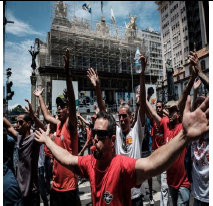
"Firefighters shouting slogans during a public servants’ demonstration against austerity measures in Rio de Janeiro in December.” (CreditYasuyoshi Chiba/Agence France- Presse — Getty Images)
Brazil’s Leaders Tout Austerity
Brazil’s sickly economy is hemorrhaging thousands of jobs a day, States are scrambling to pay police officers and teachers, and money for subsidized meals is in such short supply that one legislator suggested that the poor could “eat every other day.” Still, not everyone is suffering. Civil servants in the judicial branch are enjoying a 41 percent raise. Legislators here in São Paulo, Brazil’s largest city, voted to increase their own salaries by more than 26 percent. And Congress, which is preparing to cut pension benefits around the country, is now allowing its members to retire with lifelong pensions after just two years in office.
Brazil is struggling to pull out of its worst economic crisis in decades, and President Michel Temer says the country needs to curb public spending to do so. Yet, it did not help his dismal approval ratings when he hosted a lavish taxpayerfunded banquet to persuade members of Congress to support his budget cuts, with 300 guests eating shrimp and filet mignon. Outside such rarefied circles, Mr. Temer’s austerity measures are igniting a fierce debate over how the richest and most powerful Brazilians are protecting their wealth and privileges at a time when much of the country is enduring a harrowing economic decline.
economic decline.
“This government talks about austerity for everyone, but of course forces the costs on society’s most vulnerable people,” said Giovana Santos Pereira, 25, a schoolteacher. “It’s ridiculous to the point of being tragic.” Much of the ire revolves around the centerpiece of Mr. Temer’s austerity drive: his success in persuading the scandal-ridden Congress to impose a cap on federal spending for the next 20 years.
Mr. Temer, who rose to power last year after supporting the impeachment of his predecessor, Dilma Rousseff, says the cap, which would limit the growth in spending to the rate of inflation, is needed to scale back ballooning budget deficits. Investors have applauded the measure as a turning point for Latin America’s largest economy. But critics are lashing out at the spending cap, saying it could harm the poor for decades to come, especially in areas like education. Philip Alston, the United Nations special rapporteur on extreme poverty and human rights, said the spending cap placed Brazil “in a socially retrogressive category all of its own.”
The debate is all the more caustic because Mr. Temer’s government is resisting calls to raise taxes on wealthy Brazilians, who still enjoy what some economists describe as one of the most generous tax systems for the rich among major economies. For instance, Brazilians remain exempt from paying any taxes at all on dividends from stock holdings, and they can easily use loopholes to significantly lower taxes on other sources of income.
Economists at the government’s Institute of Applied
Economic Research said in a 2016 study that a 15 percent tax on dividends could generate nearly $17 billion in revenue a year, but such proposals have failed to gain traction in a government that has shifted to the right. “The system is engineered to perpetuate inequality, and Temer is doubling down on bets that Brazil needs Greek-style austerity,” said Pedro Paulo Zahluth Bastos, an economist at the Universidade de Campinas, drawing parallels between Brazil’s multiyear slowdown and Greece’s seemingly interminable economic crisis.
Mr. Temer has not been a popular president, and his approval ratings stand at just 10 percent. But his supporters point out that his leftist predecessor, Ms. Rousseff, sought her own austerity measures before her ouster last year, and that his government has promised to maintain some widely popular antipoverty programs expanded by her party years ago.
Mr. Temer’s government says it is reversing the freespending ways of previous governments. Brazil’s economy shrank about 4 percent in 2016, when its political class was consumed by infighting over the impeachment. But last month, the finance minister, Henrique Meirelles claimed, “the recession has ended.”
Some promising signs of a recovery may be emerging. Foreign investment has increased and, after performing poorly, Brazil’s stock market was one of the best performing in the world in 2016, creating a windfall for the relatively prosperous Brazilians who put money into equities. Mr. Temer is especially bullish, predicting that the economy will grow 3 percent next year. But, the conditions on the streets of cities around Brazil tell a different story, reflecting devilishly complex structural challenges as millions of Brazilians fall into poverty.
Given this scenario, the Brazilian States are facing crippling strikes by public employees over unpaid or inadequate salaries. In the State of Espírito Santo, in Southeast Brazil, a police strike last month produced an anarchic week marked by looting and a surge in homicides.
(Adapted from: https://www.nytimes.com/2017/03/03/world/americas)
The conjunction “But” (9th paragraph) might be replaced, without causing grammatical loss, by:
06