


![[Marketing] Questao Topo - deslogado](https://storage.estuda.com.br/banners/0_6b7ebee90b03af1c560c73bb8bcce34a_banner_deslogado_70_dias.png)
Questões de Inglês
19.971 Questões
Questão 20 336193
CESMAC Medicina 1° Dia 2017/1Treating the UK’s loneliness epidemic
Over a million people in the UK aged over 65 now experience chronic loneliness. This figure will only rise as our population ages. And research shows that severe loneliness affects people across their life course, including children and young people.
Chronic loneliness is as bad for our health as smoking 15 cigarettes a day and as damaging as obesity and physical inactivity. It is linked with depression, dementia and high blood pressure alongside a number of other conditions. Loneliness impacts on our struggling health and social care system, with evidence showing that those living with loneliness are far more likely to visit their local doctor or A&E. New research shows the health cost alone of loneliness is equivalent to some £12,000 per person over 15 years.
National and local policymakers are now waking up. Health and wellbeing boards across England are making loneliness a priority and the Welsh and Scottish governments have recently announced commitments to develop national cross-governmental strategies to address loneliness and social isolation.
We are calling on the UK government to follow suit and commit to the development of a UK-wide strategy for tackling loneliness and social isolation to help end this growing crisis.
Adaptado de: https://www.theguardian.com/society/2016/oct/04/treating-ukloneliness-epidemic Acessado em 4 de outubro de 2016.
The UK authorities
Questão 21 325434
CESMAC Demais cursos 2017/1Maltreatment Highest Among Youngest Children
Children under age 1 have the highest rate of abuse or neglect, with about 24 per 1,000 children victmized. The maltreatment rate decreases with age; 17-year-olds, for instance, have victimization rates of 3.5 per 1,000.
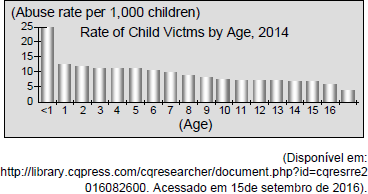
According to the graphic, it is true to assert that
Questão 17 325337
CESMAC Demais cursos 2017/1Transportation Re-imagined
The transportation industry enables more than just a means of getting around. With the advance of high technology, changing consumer priorities, and the increased access to travel for much of the developed world, taking a car or train from point A to point B has evolved in ways not previously imagined. Digital technologies are a key component of the new mobility concept.
Next generation cars that can think for themselves have clear advantages over flesh-and-blood drivers: they don't get drunk or drowsy, daydream or get distracted by mobile phones and squabbling kids. As the driver is taken out of the equation, so too will a large proportion of accidents.
Worldwide, 1.24 million people die each year in road accidents and as many as 50 million are injured. Human error causes over 90 percent of these collisions. Driverless cars, which can sense other vehicles on the road as well as obstacles and lane markings, are already proving much safer than human-driven cars.
Driverless cars use a mix of GPS, cameras, complex scanners and sensors to detect vehicles, traffic signals, curbs, pedestrians and other obstacles. A central computer system analyzes the data to control acceleration, steering and braking. The software can simulate different eventualities to ensure safety on the road - and the results can be incorporated into the design and production process.
As well as detecting their surroundings using ultrasophisticated mapping systems, future cars will be able to communicate with each other, allowing as many cars as possible to fit on the roads. Connected vehicles will feature safety warnings that alert drivers of potentially dangerous conditions - impending collisions, icy roads and dangerous curves.
Experts say it's not the technology slowing our progress, but legal and practical issues such as who is responsible in the case of an accident, urban infrastructure planning, and the security of car computer systems. Once these details are worked out, and manufacturers have used sophisticated software tools to eliminate all potential problems, it won't be long until we're all a lot safer on the roads.
Disponível em: <http://ifwe.3ds.com/accelerating-transportationdreams-
reality#transportation-re-imagined> Acessado em 13 de
setembro de 2016.
It is true to affirm that
Questão 20 324969
CESMAC Demais cursos 2017/2Most Teenagers happy with their lives but
schoolwork anxiety and bullying an issue
Most teenagers happy with their lives but schoolwork anxiety and bullying an issue
Teenagers who feel part of a school community and enjoy good relations with their parents and teachers are more likely to perform better academically and be happier with their lives, according to the first OECD PISA assessment of students’ well-being.
PISA 2015 Results analyses for the first time students’ motivation to perform well in school, their relationships with peers and teachers, their home life, and how they spend their time outside of school. The findings are based on a survey of 540,000 students in 72 participating countries and economies who also completed the main OECD PISA 2015 test on science, mathematics and reading.
Many students are very anxious about school work and tests and the analysis reveals this is not related to the number of school hours or the frequency of tests but with how supportive they feel their teachers and schools to be: on average across OECD countries, 59% of students reported they often worry that taking a test will be difficult, and 66% reported feeling stressed about poor grades. Some 55% of students say they are very anxious for a test even if they are well prepared. In all countries, girls reported greater schoolwork-related anxiety than boys; and anxiety about schoolwork, homework and tests is negatively related to performance.
Teachers play a big role in creating the conditions for students’ well-being at school and governments should not define the role of teachers solely through the number of instruction hours. Happier students tend to report positive relations with their teachers. Students in schools where life satisfaction is above the national average reported a higher level of support from their teacher than students in schools where life satisfaction is below average.
“These findings show how teachers, schools and parents can make a real difference to children’s well-being,” said OECD Chief of Staff Gabriela Ramos, launching the report in London. “Together they can help young people develop a sense of control over their future and the resilience they need to be successful in life. There is no secret, you perform better if you feel valued, if you feel well treated, if you are given a hand to succeed!”
Adaptado de: <http://www.oecd.org/newsroom/most-teenagers-happywith-their-lives-but-schoolwork-anxiety-and-bullying-an-issue.htm> Acessado em 19 de abril de 2017.
The findings suggest that students’ well-being also depend on their teachers’
Questão 18 324956
CESMAC Demais cursos 2017/2Most Teenagers happy with their lives but
schoolwork anxiety and bullying an issue
Most teenagers happy with their lives but schoolwork anxiety and bullying an issue
Teenagers who feel part of a school community and enjoy good relations with their parents and teachers are more likely to perform better academically and be happier with their lives, according to the first OECD PISA assessment of students’ well-being.
PISA 2015 Results analyses for the first time students’ motivation to perform well in school, their relationships with peers and teachers, their home life, and how they spend their time outside of school. The findings are based on a survey of 540,000 students in 72 participating countries and economies who also completed the main OECD PISA 2015 test on science, mathematics and reading.
Many students are very anxious about school work and tests and the analysis reveals this is not related to the number of school hours or the frequency of tests but with how supportive they feel their teachers and schools to be: on average across OECD countries, 59% of students reported they often worry that taking a test will be difficult, and 66% reported feeling stressed about poor grades. Some 55% of students say they are very anxious for a test even if they are well prepared. In all countries, girls reported greater schoolwork-related anxiety than boys; and anxiety about schoolwork, homework and tests is negatively related to performance.
Teachers play a big role in creating the conditions for students’ well-being at school and governments should not define the role of teachers solely through the number of instruction hours. Happier students tend to report positive relations with their teachers. Students in schools where life satisfaction is above the national average reported a higher level of support from their teacher than students in schools where life satisfaction is below average.
“These findings show how teachers, schools and parents can make a real difference to children’s well-being,” said OECD Chief of Staff Gabriela Ramos, launching the report in London. “Together they can help young people develop a sense of control over their future and the resilience they need to be successful in life. There is no secret, you perform better if you feel valued, if you feel well treated, if you are given a hand to succeed!”
Adaptado de: <http://www.oecd.org/newsroom/most-teenagers-happywith-their-lives-but-schoolwork-anxiety-and-bullying-an-issue.htm> Acessado em 19 de abril de 2017.
The first OECD PISA assessment of students’ wellbeing
Questão 14 324621
UNIMONTES 3° Etapa 2017Leia o texto que se segue, a fim de responder à questão que a ele se refere.
WAR PHOTOGRAPHER WHO SURVIVED LEUKAEMIA EXPOSED AS A FAKE
Eduardo Martins passed off photos of British surfer as himself and some of his war zone pictures were stolen.
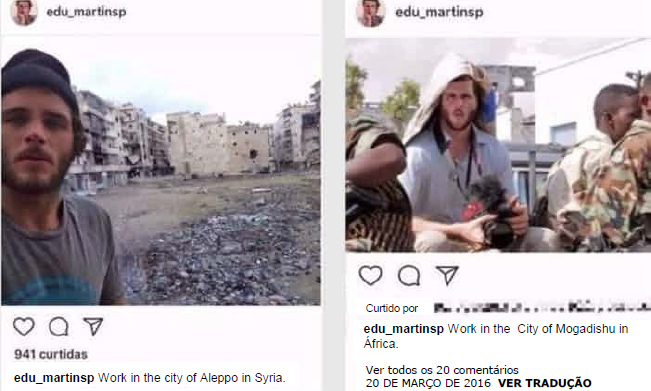
[1] The compelling photos that Eduardo Martins took from some of the world’s worst war zones earned
him a growing reputation, glowing interviews, space in some of the world’s biggest media outlets and more
than 120,000 followers on Instagram.
People loved the story of the handsome blond 32-year-old Brazilian surfer, who survived leukaemia
[5] then found new meaning in photographing conflict. His dramatic images of war zones were published by the
Wall Street Journal, Vice and the BBC.
But there was just one problem: it was a lie. An investigation by BBC Brasil has revealed Martins
stole photos of a British surfer called Max Hepworth-Povey and passed them off as himself.
The BBC’s Brazilian site first published an interview along with photos and videos supposedly shot
[10] by Martins in July, then revealed his scam after an investigation by a Lebanon-based reporter, Natasha
Ribeiro. The scale of the deception, which emerged in recent days, has sent shockwaves through Brazilian
photographic circles.
As his story began to unravel, reporters made contact with the Brazilian photographer Fernando
Costa Netto, who had been talking to Martins on the internet for over a year and had published an interview
[15] with him on the Brazilian surfing site Waves.
According to the BBC, Costa Netto inadvertently told Martins that suspicions were circulating that
he was fake – he told the Guardian he had not warned Martins. He then received a final message, which he
shared with Waves. “I am in Australia. I took the decision to pass a year in a van. I am going to cut
everything, including internet. I want to be in peace, we will see each other when I return,” he wrote. “A big
[20] hug.”
Costa Netto, who had been in touch with Martins over plans to stage an exhibition of his work, told
the Guardian in an email that he was deeply disappointed. “I have more pity than anger,” he said. “There is
a certain deception with human beings, to trick people is ugly.”
Getty Images said in a statement they had removed all the work purporting to be by Martins.
[25] “Eduardo Martins… was identified as a collaborator and content supplier for one of our partners
who has already been notified about this infraction. While we work together with all our internal
departments to urgently clarify this issue, we are removing all the material involved from the air,” a
spokesman said in an email.
In his interview with Costa Netto for Waves, published in July, Martins said he had leukaemia at 18
[30] and had spent seven years in treatment. He told Costa Netto he was currently in Mosul, Iraq, had
accompanied the Free Syrian Army in 2015 and had even been grazed by a shot in Aleppo.
“I became a conflict zone photographer,” Martins said in the interview. “I found what I really
wanted as a photographer.” [...]
Disponível em: <https://www.theguardian.com/world/2017/sep/05/war-photographer-eduardo martins-survived-leukaemiaexposed- fake>. Acesso em: 14 set. 2017. Adaptado.
Analise as afirmativas a seguir, tendo como base o texto, e assinale a alternativa CORRETA.
06