


![[Marketing] Questao Topo - deslogado](https://storage.estuda.com.br/banners/0_6b7ebee90b03af1c560c73bb8bcce34a_banner_deslogado_70_dias.png)
Questões de Inglês
19.971 Questões
Questão 9 982775
UEA - SIS 1ª Etapa 2017Leia o texto para responder à questão.
Amazon deforestation, once reduced, comes back
Forest loss is detrimental to the earth’s climate. The clearing of woodlands and the fires that accompany it generate one-tenth of all global warming emissions, according to the Union of Concerned Scientists, making the loss of forests one of the biggest single contributors to climate change.
Only about 15 percent of the world’s forest cover remains intact, according to the World Resources Institute. The rest has been cleared, degraded or is in fragments, eliminating ecosystems and dislocating indigenous communities, scientists say.
Behind the rise in deforestation is a strategy by multinational food companies to source their agricultural commodities from ever more remote areas around the world. These areas tend to be where legal protections of forests are weakest.
(Hiroco Tabuchi et al. www.nytimes.com, 24.02.2017. Adaptado.)
A perda das florestas é nociva para o clima porque
Questão 11 982537
UEA - SIS 2ª Etapa 2017Leia o texto para responder à questão.
Was the Amazon once an ocean?
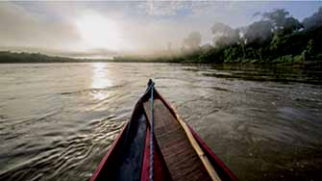
The Amazon rainforest is a valuable source of biodiversity, containing 10% of the planet’s species in its 6.7 million square kilometers. How it got to be that way has been highly disputed for decades. Now, a new study suggests that a large section of the forest was twice flooded by the Caribbean Sea more than 10 million years ago, creating a short-lived inland sea that jump-started the evolution of new species. But the new evidence still scientists on the other side of the debate.
Researchers generally agree that parts of the Amazon were once under water, but they don’t agree on where the water came from. Those in the “river camp” argue that freshwater streaming down from the rising Andes divided the land below, dividing plants and animals into isolated groups that later turned into new species. The fastgrowing mountains also created microclimates at different elevations, sparking speciation and funnelling new plants and animals into the Amazon basin. However, when marine microorganisms were discovered in Amazonian sediments in the 1990s, some scientists hypothesized that the forest was once inundated by an ocean, which created new species as forest inhabitants quickly adapted to the flood.
(Lizzie Wade. www.sciencemag.org, 03.05.2017. Adaptado.)
Sobre a hipótese de que partes da Amazônia já estiveram submersas, os pesquisadores em geral
Questão 10 982536
UEA - SIS 2ª Etapa 2017Leia o texto para responder à questão.
Was the Amazon once an ocean?
The Amazon rainforest is a valuable source of biodiversity, containing 10% of the planet’s species in its 6.7 million square kilometers. How it got to be that way has been highly disputed for decades. Now, a new study suggests that a large section of the forest was twice flooded by the Caribbean Sea more than 10 million years ago, creating a short-lived inland sea that jump-started the evolution of new species. But the new evidence still scientists on the other side of the debate.
Researchers generally agree that parts of the Amazon were once under water, but they don’t agree on where the water came from. Those in the “river camp” argue that freshwater streaming down from the rising Andes divided the land below, dividing plants and animals into isolated groups that later turned into new species. The fastgrowing mountains also created microclimates at different elevations, sparking speciation and funnelling new plants and animals into the Amazon basin. However, when marine microorganisms were discovered in Amazonian sediments in the 1990s, some scientists hypothesized that the forest was once inundated by an ocean, which created new species as forest inhabitants quickly adapted to the flood.
(Lizzie Wade. www.sciencemag.org, 03.05.2017. Adaptado.)
Assinale a alternativa que completa corretamente a lacuna do primeiro parágrafo.
Questão 9 982531
UEA - SIS 2ª Etapa 2017Leia o texto para responder à questão.
Was the Amazon once an ocean?
The Amazon rainforest is a valuable source of biodiversity, containing 10% of the planet’s species in its 6.7 million square kilometers. How it got to be that way has been highly disputed for decades. Now, a new study suggests that a large section of the forest was twice flooded by the Caribbean Sea more than 10 million years ago, creating a short-lived inland sea that jump-started the evolution of new species. But the new evidence still scientists on the other side of the debate.
Researchers generally agree that parts of the Amazon were once under water, but they don’t agree on where the water came from. Those in the “river camp” argue that freshwater streaming down from the rising Andes divided the land below, dividing plants and animals into isolated groups that later turned into new species. The fastgrowing mountains also created microclimates at different elevations, sparking speciation and funnelling new plants and animals into the Amazon basin. However, when marine microorganisms were discovered in Amazonian sediments in the 1990s, some scientists hypothesized that the forest was once inundated by an ocean, which created new species as forest inhabitants quickly adapted to the flood.
(Lizzie Wade. www.sciencemag.org, 03.05.2017. Adaptado.)
O texto apresenta um novo estudo que sugere que a Amazônia
Questão 12 978650
UEA - SIS 3ª Etapa 2017Leia o texto para responder à questão.
A resurgence of deforestation in the Brazilian Amazon
The Brazilian Amazon is the size of Western Europe, and in the 41 years I have lived in the region and worked on problems of deforestation, an area larger than France has been cleared. Over the decades, I have watched as economic cycles, swings in commodity prices, and land speculation have led to peaks and valleys in the clearing of the Amazon, with 1995 setting a record for destruction: 11,200 square miles — an area the size of Belgium — fell to loggers, cattle ranchers, and farmers.
When the annual deforestation rate in Brazil’s Amazon plunged from nearly 11,000 square miles in 2004 to 1,700 square miles in 2012 — an 84 percent decline — I was of course relieved. But I had witnessed too much destruction in the Amazon to celebrate. Unfortunately, these widely publicized declines led not only to the impression among the international conservation community that Amazon deforestation was finally ebbing. It also led to a dangerous illusion taking hold in the capital of Brasília — the belief that deforestation was thoroughly under control, and thus the government could build roads, dams, and other infrastructure at will in Amazonia, without consequences for the world’s largest rain forest.
Clearly, that turned out not to be the case. Deforestation has trended upwards since 2012, with a sharp 29 percent increase in the rate of clearing in 2016.
(Philip Fearnside. https://daily.jstor.org, 22.04.2017. Adaptado.)
No trecho do segundo parágrafo “the government could build roads, dams, and other infrastructure at will in Amazonia”, a expressão em destaque equivale, em português, a
Questão 11 978649
UEA - SIS 3ª Etapa 2017Leia o texto para responder à questão.
A resurgence of deforestation in the Brazilian Amazon
The Brazilian Amazon is the size of Western Europe, and in the 41 years I have lived in the region and worked on problems of deforestation, an area larger than France has been cleared. Over the decades, I have watched as economic cycles, swings in commodity prices, and land speculation have led to peaks and valleys in the clearing of the Amazon, with 1995 setting a record for destruction: 11,200 square miles — an area the size of Belgium — fell to loggers, cattle ranchers, and farmers.
When the annual deforestation rate in Brazil’s Amazon plunged from nearly 11,000 square miles in 2004 to 1,700 square miles in 2012 — an 84 percent decline — I was of course relieved. But I had witnessed too much destruction in the Amazon to celebrate. Unfortunately, these widely publicized declines led not only to the impression among the international conservation community that Amazon deforestation was finally ebbing. It also led to a dangerous illusion taking hold in the capital of Brasília — the belief that deforestation was thoroughly under control, and thus the government could build roads, dams, and other infrastructure at will in Amazonia, without consequences for the world’s largest rain forest.
Clearly, that turned out not to be the case. Deforestation has trended upwards since 2012, with a sharp 29 percent increase in the rate of clearing in 2016.
(Philip Fearnside. https://daily.jstor.org, 22.04.2017. Adaptado.)
O trecho do segundo parágrafo “the belief that deforestation was thoroughly under control, and thus the government could build roads, dams, and other infrastructure at will in Amazonia, without consequences for the world’s largest rain forest” é uma explicação de
06