


![[Marketing] Questao Topo - deslogado](https://storage.estuda.com.br/banners/0_6b7ebee90b03af1c560c73bb8bcce34a_banner_deslogado_70_dias.png)
Questões de Inglês
19.971 Questões
Questão 25 173652
UEL 2° Fase 2018Leia o texto a seguir.

Com relação ao meme, considere as afirmativas a seguir.
I. O efeito de humor do meme reside no uso inapropriado de expressões informais em ocasiões formais.
II. A expressão “My bad” é inadequada para o contexto, pois expressa superficialidade de sentimentos.
III. A utilização de “My bad” no contexto do funeral é uma admissão de culpa, daí o efeito cômico.
IV. O efeito cômico do meme é ressaltado pelo uso da palavra “unless” cuja função é especificar o contexto.
Assinale a alternativa CORRETA.
Questão 24 173649
UEL 2° Fase 2018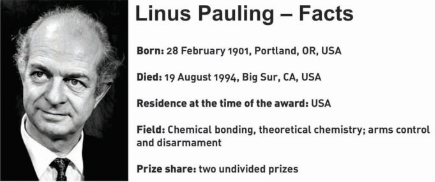
Life
Linus Pauling was born in Portland, Oregon, in the United States. His family came from a line of Prussian farmers, and his father worked as a pharmaceuticals salesman, among other things. After first studying at Oregon State University in Corvallis, Oregon, Linus Pauling earned his PhD from the California Institute of Technology in Pasadena, with which he maintained ties for the rest of his career. In the 1950s, Linus Pauling’s involvement in the anti-nuclear movement led to his being labeled a suspected communist, which resulted in his passport being revoked at times. Linus and Ava Helen Pauling had four children together.
Work
1954 Prize: The development of quantum mechanics during the 1920s had a great impact not only on the field of physics, but also on chemistry. During the 1930s Linus Pauling was among the pioneers who used quantum mechanics to understand and describe chemical bonding – that is, the way atoms join together to form molecules. Linus Pauling worked in a broad range of areas within chemistry. For example, he worked on the structures of biologically important chemical compounds. In 1951 he published the structure of the alpha helix, which is an important basic component of many proteins.
1962 Prize: The atom bombs dropped on Hiroshima and Nagasaki were a turning point in Linus Pauling’s life. Together with other scientists he spoke and wrote against the nuclear arms race, and he was a driving force in the Pugwash movement. It sought to reduce the role of nuclear arms in international politics and was awarded the Peace Prize in 1995. In 1959, Linus Pauling drafted the famous “Hiroshima Appeal”, the concluding document issued after the Fifth World Conference against Atomic and Hydrogen Bombs. He was one of the prime movers who urged the nuclear powers the USA, the Soviet Union and Great Britain to conclude a nuclear test ban treaty, which entered into force on 10 October 1963. On the same day, the Norwegian Nobel Committee announced that Linus Pauling had been awarded the Peace Prize that had been held over from 1962.
(Adaptado de: Linus Pauling - Facts. In: Nobelprize.org. (web) Nobel Media AB 2014.Disponível em:. http://www.nobelprize.org/nobel_prizes/peace/laureates/1962/pauling-facts.html. Acesso em: 2 jul. 2017.)
Com base nos termos sublinhados no texto, considere as afirmativas a seguir.
I. O emprego da expressão “into force” enfatiza o caráter arbitrário do tratado assinado em 1963.
II. O uso da expressão “turning point” ressalta a importância que os acontecimentos de Hiroshima e Nagasaki tiveram sobre Linus Pauling.
III. Os termos “not only” e “but also” estão interligados e adicionam ênfase à informação sobre as aplicações da mecânica quântica também na Química.
IV. A expressão “that is” introduz uma explicação e poderia ser substituída, sem alteração de sentido por “in other words”.
Assinale a alternativa correta.
Questão 23 173647
UEL 2° Fase 2018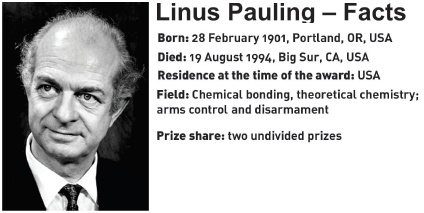
Life
Linus Pauling was born in Portland, Oregon, in the United States. His family came from a line of Prussian farmers, and his father worked as a pharmaceuticals salesman, among other things. After first studying at Oregon State University in Corvallis, Oregon, Linus Pauling earned his PhD from the California Institute of Technology in Pasadena, with which he maintained ties for the rest of his career. In the 1950s, Linus Pauling’s involvement in the anti-nuclear movement led to his being labeled a suspected communist, which resulted in his passport being revoked at times. Linus and Ava Helen Pauling had four children together.
Work
1954 Prize: The development of quantum mechanics during the 1920s had a great impact not only on the field of physics, but also on chemistry. During the 1930s Linus Pauling was among the pioneers who used quantum mechanics to understand and describe chemical bonding – that is, the way atoms join together to form molecules. Linus Pauling worked in a broad range of areas within chemistry. For example, he worked on the structures of biologically important chemical compounds. In 1951 he published the structure of the alpha helix, which is an important basic component of many proteins.
1962 Prize: The atom bombs dropped on Hiroshima and Nagasaki were a turning point in Linus Pauling’s life. Together with other scientists he spoke and wrote against the nuclear arms race, and he was a driving force in the Pugwash movement. It sought to reduce the role of nuclear arms in international politics and was awarded the Peace Prize in 1995. In 1959, Linus Pauling drafted the famous “Hiroshima Appeal”, the concluding document issued after the Fifth World Conference against Atomic and Hydrogen Bombs. He was one of the prime movers who urged the nuclear powers the USA, the Soviet Union and Great Britain to conclude a nuclear test ban treaty, which entered into force on 10 October 1963. On the same day, the Norwegian Nobel Committee announced that Linus Pauling had been awarded the Peace Prize that had been held over from 1962.
(Adaptado de: Linus Pauling - Facts. In: Nobelprize.org. (web) Nobel Media AB 2014.Disponível em:. . Acesso em: 2 jul. 2017.)
De acordo com o texto, o movimento Pugwash
Questão 22 173646
UEL 2° Fase 2018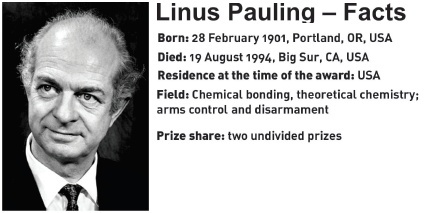
Life
Linus Pauling was born in Portland, Oregon, in the United States. His family came from a line of Prussian farmers, and his father worked as a pharmaceuticals salesman, among other things. After first studying at Oregon State University in Corvallis, Oregon, Linus Pauling earned his PhD from the California Institute of Technology in Pasadena, with which he maintained ties for the rest of his career. In the 1950s, Linus Pauling’s involvement in the anti-nuclear movement led to his being labeled a suspected communist, which resulted in his passport being revoked at times. Linus and Ava Helen Pauling had four children together.
Work
1954 Prize: The development of quantum mechanics during the 1920s had a great impact not only on the field of physics, but also on chemistry. During the 1930s Linus Pauling was among the pioneers who used quantum mechanics to understand and describe chemical bonding – that is, the way atoms join together to form molecules. Linus Pauling worked in a broad range of areas within chemistry. For example, he worked on the structures of biologically important chemical compounds. In 1951 he published the structure of the alpha helix, which is an important basic component of many proteins.
1962 Prize: The atom bombs dropped on Hiroshima and Nagasaki were a turning point in Linus Pauling’s life. Together with other scientists he spoke and wrote against the nuclear arms race, and he was a driving force in the Pugwash movement. It sought to reduce the role of nuclear arms in international politics and was awarded the Peace Prize in 1995. In 1959, Linus Pauling drafted the famous “Hiroshima Appeal”, the concluding document issued after the Fifth World Conference against Atomic and Hydrogen Bombs. He was one of the prime movers who urged the nuclear powers the USA, the Soviet Union and Great Britain to conclude a nuclear test ban treaty, which entered into force on 10 October 1963. On the same day, the Norwegian Nobel Committee announced that Linus Pauling had been awarded the Peace Prize that had been held over from 1962.
(Adaptado de: Linus Pauling - Facts. In: Nobelprize.org. (web) Nobel Media AB 2014.Disponível em:. . Acesso em: 2 jul. 2017.)
De acordo com o texto, Linus Pauling
Questão 21 173645
UEL 2° Fase 2018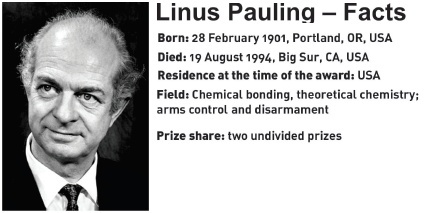
Life
Linus Pauling was born in Portland, Oregon, in the United States. His family came from a line of Prussian farmers, and his father worked as a pharmaceuticals salesman, among other things. After first studying at Oregon State University in Corvallis, Oregon, Linus Pauling earned his PhD from the California Institute of Technology in Pasadena, with which he maintained ties for the rest of his career. In the 1950s, Linus Pauling’s involvement in the anti-nuclear movement led to his being labeled a suspected communist, which resulted in his passport being revoked at times. Linus and Ava Helen Pauling had four children together.
Work
1954 Prize: The development of quantum mechanics during the 1920s had a great impact not only on the field of physics, but also on chemistry. During the 1930s Linus Pauling was among the pioneers who used quantum mechanics to understand and describe chemical bonding – that is, the way atoms join together to form molecules. Linus Pauling worked in a broad range of areas within chemistry. For example, he worked on the structures of biologically important chemical compounds. In 1951 he published the structure of the alpha helix, which is an important basic component of many proteins.
1962 Prize: The atom bombs dropped on Hiroshima and Nagasaki were a turning point in Linus Pauling’s life. Together with other scientists he spoke and wrote against the nuclear arms race, and he was a driving force in the Pugwash movement. It sought to reduce the role of nuclear arms in international politics and was awarded the Peace Prize in 1995. In 1959, Linus Pauling drafted the famous “Hiroshima Appeal”, the concluding document issued after the Fifth World Conference against Atomic and Hydrogen Bombs. He was one of the prime movers who urged the nuclear powers the USA, the Soviet Union and Great Britain to conclude a nuclear test ban treaty, which entered into force on 10 October 1963. On the same day, the Norwegian Nobel Committee announced that Linus Pauling had been awarded the Peace Prize that had been held over from 1962.
(Adaptado de: Linus Pauling - Facts. In: Nobelprize.org. (web) Nobel Media AB 2014.Disponível em:. . Acesso em: 2 jul. 2017.)
Sobre a vida de Linus Pauling, considere as afirmativas a seguir.
I. Manteve vínculo com o Instituto de Tecnologia da Califórnia onde defendeu sua tese de doutorado.
II. Graduou-se no Instituto de Tecnologia da Califórnia onde conheceu sua futura companheira, Ava Helen Pauling.
III. Foi deportado para a Prússia onde trabalhou na indústria farmacêutica com seu pai até a devolução de seu passaporte.
IV. Envolveu-se com o movimento contra os armamentos nucleares pelo qual foi taxado de comunista.
Assinale a alternativa correta.
Questão 55 168689
PUC-PR Verão - Demais Cursos 2018Revealed: scale of hospital staff shortages1 in top Tory areas
The maternity unit at the main hospital used by Theresa May’s local constituents is so severely understaffed2 that wards are running with only a quarter3 of the nurses they need, potentially putting mothers’ and babies’ lives at risk.
The Royal Berkshire hospital’s staffing data shows that on some days in March its delivery suite lacked4 two-thirds of the nurses it needed to provide5 safe care, while the midwife-led unit had as few as a third of the preferred number nurses on duty, despite evidence that staff shortages increase the risks of childbirth.
06