


![[Marketing] Questao Topo - deslogado](https://storage.estuda.com.br/banners/0_6b7ebee90b03af1c560c73bb8bcce34a_banner_deslogado_70_dias.png)
Questões de Inglês
19.971 Questões
Questão 16 184532
ITA 2018As questões de 16 a 20 referem-se ao texto a seguir:
AUGMENTATION OF BRAIN FUNCTION: FACTS, FICTION AND CONTROVERSY
[1] Augmentation of brain function is no longer just a theme of science fiction. __________(I) advances in
neural sciences, it has become a matter of reality that a person may consider at some point in life, for example
as a treatment of a neurodegenerative disease. Currently, several approaches offer enhancements for sensory,
motor and cognitive brain functions,__________(II) for mood and emotions. Such enhancements may be
[5] achieved pharmacologically, using brain implants for recordings, stimulation and drug delivery,__________(III)
employing brain-machine interfaces, or even by ablation of certain brain areas.
In this Research Topic, we welcome papers critically evaluating the existing methods of brain
augmentation, introducing new approaches and probing particular parts of brain circuitry and particular
neuronal mechanisms as candidates for an enhancement. We welcome scientists from different fields: from
[10] neuroscience of microcircuits to systems neuroscience of large-scale networks and neural engineering. The
work can be experimental or computational. Reviews and papers on philosophical and ethical issues are
__________(IV) welcome.
While the scope of possible relevant topics is broad, the authors are encouraged to clearly indicate how
their studies address the announced theme of brain augmentation.
[15]
Important Note: All contributions to this Research Topic must be within the scope of the section and
journal to which they are submitted, as defined in their mission statements. Frontiers reserves the right to guide
an out-of-scope manuscript to a more suitable section or journal at any stage of peer review.
Fonte: . Acesso em: 15 jul. 2017.
Marque a opção que preenche, correta e respectivamente, as lacunas I, II, III e IV inseridas no texto.
Questão 15 184531
ITA 2018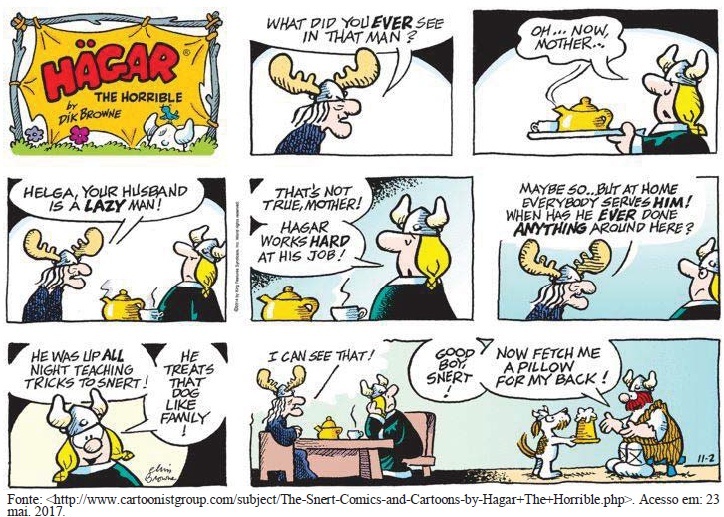
A ironia da mãe de Helga, ao afirmar: “I can see that!”, reside no fato de que
Questão 14 184528
ITA 2018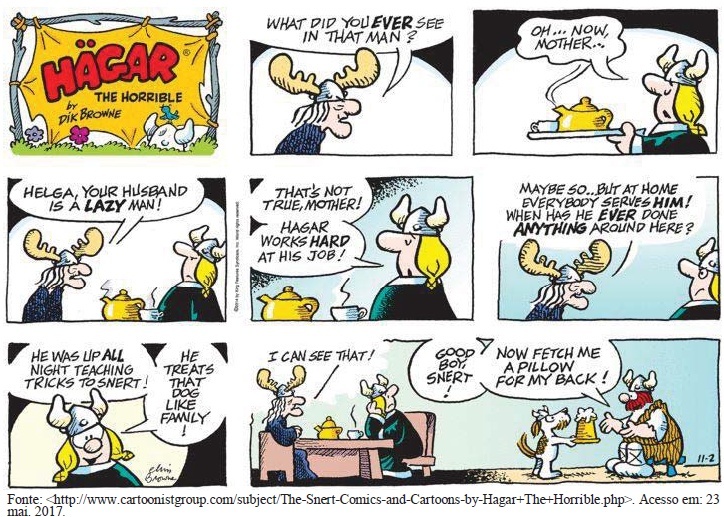
O fato de Helga usar a expressão “Oh... now, mother...”, significa que ela
Questão 13 184526
ITA 2018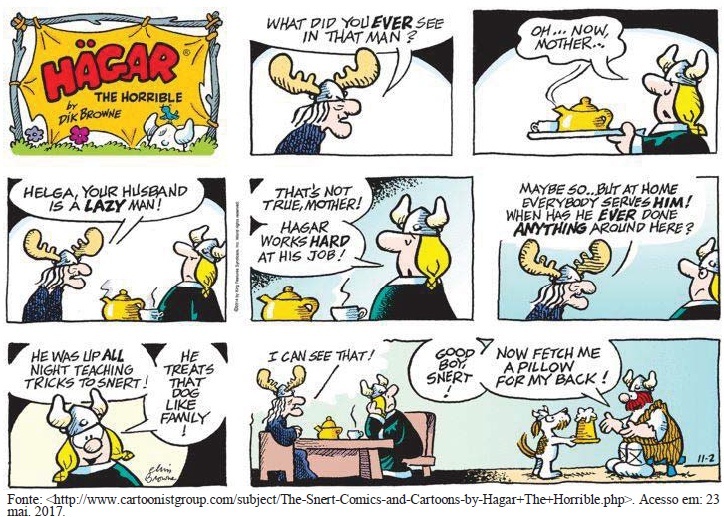
A mãe de Helga pergunta "What did you ever see in that man?" porque
Questão 12 184524
ITA 2018WE RECORDED VCs CONVERSATIONS AND ANALYZED HOW DIFFERENTLY THEY TALK ABOUT FEMALE ENTREPRENEURS
[1] When venture capitalists (VCs) evaluate investment proposals, the language they use to describe the
entrepreneurs who write them plays an important but often hidden role in shaping who is awarded funding
and why.[…] We were given access to government venture capital decision making meetings in Sweden and
were able to observe the types of language that VCs used over a two-year period. One major thing stuck out:
[5] The language used to describe male and female entrepreneurs was radically different. And these differences
have very real consequences for those seeking funding — and for society in general.
[…] Worldwide, government venture capital is important for bridging significant financial gaps and
supporting innovation and growth, as VCs can take risks where banks are not allowed to. When uncertainty is
high regarding assessment of product and market potential, for example, the assessment of the
[10] entrepreneur’s potential becomes highly central in government VCs’ decision making.
In Sweden, about one-third of businesses are owned and run by women, although they are not granted
a corresponding proportion of government funding. In fact, women-owned businesses receive much less —
only 13%–18%, the rest going to male-owned companies.
This brings us back to our research. From 2009 to 2010 we were invited to silently observe
[15] governmental VC decision-making meetings and, more important, the conversations they had about
entrepreneurs applying for funding. […] We observed closed-room, face-to-face discussions leading final
funding decisions for 125 venture applications. Of these, 99 (79%) were from male entrepreneurs and 26
(21%) were from female entrepreneurs. The group of government venture capitalists observed included
seven individuals: two women and five men. […]
[20] Aside from a few exceptions, the financiers rhetorically produce stereotypical images of women as
having qualities opposite to those considered important to being an entrepreneur, with VCs questioning their
credibility, trustworthiness, experience, and knowledge.
Conversely, when assessing male entrepreneurs, financiers leaned on stereotypical beliefs about men
that reinforced their entrepreneurial potential. Male entrepreneurs were commonly described as being
[25] assertive, innovative, competent, experienced, knowledgeable, and having established networks.
We developed male and female entrepreneur personas based on our findings […]. These personas
highlight a few key differences in how the entrepreneurs were perceived depending on their gender. Men
were characterized as having entrepreneurial potential, while the entrepreneurial potential for women was
diminished. Many of the young men and women were described as being young, though youth for men was
[30] viewed as promising, while young women were considered inexperienced. Men were praised for being
viewed as aggressive or arrogant, while women’s experience and excitement were tempered by discussions
of their emotional shortcomings. Similarly, cautiousness was viewed very differently depending on the gender
of the entrepreneur.
Unsurprisingly, these stereotypes seem to have played a role in who got funding and who didn’t.
[35] Women entrepreneurs were only awarded, on average, 25% of the applied-for amount, whereas men
received, on average, 52% of what they asked for. Women were also denied financing to a greater extent
than men, with close to 53% of women having their applications dismissed, compared with 38% of men. […]
Such stereotyping will inevitably influence the distribution of financing, but could also have other major
consequences. Because the purpose of government venture capital is to use tax money to stimulate growth
[40] and value creation for society as a whole, gender bias presents the risk that the money isn’t being invested in
businesses that have the highest potential. This isn’t only damaging for women entrepreneurs; it’s potentially
damaging for society as a whole.
Fonte: Adaptado de Harvard Business Review . Acesso em: 17 mai. 2017.
Na sentença "Men were characterized as having entrepreneurial potential, while the entrepreneurial potential for women was diminished", indique a expressão que pode substituir while mantendo o significado e a correção gramatical.
Questão 11 184522
ITA 2018WE RECORDED VCs CONVERSATIONS AND ANALYZED HOW DIFFERENTLY THEY TALK ABOUT FEMALE ENTREPRENEURS
[1] When venture capitalists (VCs) evaluate investment proposals, the language they use to describe the
entrepreneurs who write them plays an important but often hidden role in shaping who is awarded funding
and why.[…] We were given access to government venture capital decision making meetings in Sweden and
were able to observe the types of language that VCs used over a two-year period. One major thing stuck out:
[5] The language used to describe male and female entrepreneurs was radically different. And these differences
have very real consequences for those seeking funding — and for society in general.
[…] Worldwide, government venture capital is important for bridging significant financial gaps and
supporting innovation and growth, as VCs can take risks where banks are not allowed to. When uncertainty is
high regarding assessment of product and market potential, for example, the assessment of the
[10] entrepreneur’s potential becomes highly central in government VCs’ decision making.
In Sweden, about one-third of businesses are owned and run by women, although they are not granted
a corresponding proportion of government funding. In fact, women-owned businesses receive much less —
only 13%–18%, the rest going to male-owned companies.
This brings us back to our research. From 2009 to 2010 we were invited to silently observe
[15] governmental VC decision-making meetings and, more important, the conversations they had about
entrepreneurs applying for funding. […] We observed closed-room, face-to-face discussions leading final
funding decisions for 125 venture applications. Of these, 99 (79%) were from male entrepreneurs and 26
(21%) were from female entrepreneurs. The group of government venture capitalists observed included
seven individuals: two women and five men. […]
[20] Aside from a few exceptions, the financiers rhetorically produce stereotypical images of women as
having qualities opposite to those considered important to being an entrepreneur, with VCs questioning their
credibility, trustworthiness, experience, and knowledge.
Conversely, when assessing male entrepreneurs, financiers leaned on stereotypical beliefs about men
that reinforced their entrepreneurial potential. Male entrepreneurs were commonly described as being
[25] assertive, innovative, competent, experienced, knowledgeable, and having established networks.
We developed male and female entrepreneur personas based on our findings […]. These personas
highlight a few key differences in how the entrepreneurs were perceived depending on their gender. Men
were characterized as having entrepreneurial potential, while the entrepreneurial potential for women was
diminished. Many of the young men and women were described as being young, though youth for men was
[30] viewed as promising, while young women were considered inexperienced. Men were praised for being
viewed as aggressive or arrogant, while women’s experience and excitement were tempered by discussions
of their emotional shortcomings. Similarly, cautiousness was viewed very differently depending on the gender
of the entrepreneur.
Unsurprisingly, these stereotypes seem to have played a role in who got funding and who didn’t.
[35] Women entrepreneurs were only awarded, on average, 25% of the applied-for amount, whereas men
received, on average, 52% of what they asked for. Women were also denied financing to a greater extent
than men, with close to 53% of women having their applications dismissed, compared with 38% of men. […]
Such stereotyping will inevitably influence the distribution of financing, but could also have other major
consequences. Because the purpose of government venture capital is to use tax money to stimulate growth
[40] and value creation for society as a whole, gender bias presents the risk that the money isn’t being invested in
businesses that have the highest potential. This isn’t only damaging for women entrepreneurs; it’s potentially
damaging for society as a whole.
Fonte: Adaptado de Harvard Business Review . Acesso em: 17 mai. 2017.
A expressão sublinhada na primeira coluna pode ser substituída pela expressão na segunda coluna em todas as opções, EXCETO em
06