


![[Marketing] Questao Topo - deslogado](https://storage.estuda.com.br/banners/0_6b7ebee90b03af1c560c73bb8bcce34a_banner_deslogado_70_dias.png)
Questões de Inglês
19.971 Questões
Questão 31 243436
UNITAU Medicina Verão - 1ª Fase 2018In breakthrough, scientists edit a dangerous mutation from genes in human embryos
Scientists for the first time have successfully edited genes in human embryos to repair a common and serious disease-causing mutation, producing apparently healthy embryos.
Scientists for the first time have successfully edited genes in human embryos to repair a common and serious disease-causing mutation, producing apparently healthy embryos.
Scientists have long feared the unforeseen medical consequences of making inherited changes to human DNA. The cultural implications may be just as disturbing: Some experts have warned that unregulated genetic engineering may lead to a new form of eugenics, in which people with means pay to have children with enhanced traits even as those with disabilities are devalued.
“We’ve always said in the past gene editing shouldn’t be done, mostly because it couldn’t be done safely,” said Richard Hynes, a cancer researcher at the Massachusetts Institute of Technology. “That’s still true, but now it looks like it’s going to be done safely soon,” he said, adding that the research is “a big breakthrough.
Scientists at Oregon Health and Science University, with colleagues in California, China and South Korea, reported that they repaired dozens of embryos, fixing a mutation that causes a common heart condition that can lead to sudden death later in life.
If embryos with the repaired mutation were allowed to develop into babies, they would not only be disease-free but also would not transmit the disease to descendants.
The researchers avert two important safety problems: They produced embryos in which all cells — not just some — were mutation-free, and they avoided creating unwanted extra mutations.
Much more research is needed before the method could be tested in clinical trials, currently impermissible under federal law. But if the technique is found to work safely with this and other mutations, it might help some couples who could not otherwise have healthy children.
The researchers also discovered something unexpected: a previously unknown way that embryos repair themselves. In other cells in the body, the editing process is carried out by genes that copy a DNA template introduced by scientists. In these embryos, the sperm cell’s mutant gene ignored that template and instead copied the healthy DNA sequence from the egg cell.
And some embryos had cells that did not get repaired — a phenomenon called mosaicism that could result in the mutation being passed on — as well as unplanned mutations that could cause other health problems.
In February, a National Academy of Sciences, Engineering and Medicine committee endorsed modifying embryos, but only to correct mutations that cause “a serious disease or condition” and when no “reasonable alternatives” exist.
Sheldon Krimsky, a bioethicist at Tufts University, said the main uncertainty about the new technique was whether “reasonable alternatives” to gene editing already exist.
As the authors themselves noted, many couples use pre-implantation genetic diagnosis to screen embryos at fertility clinics, allowing only healthy ones to be implanted. For these parents, gene editing could help by repairing mutant embryos so that more disease-free embryos would be available for implantation.
The larger issue is so-called germline engineering, which refers to changes made to embryo that are inheritable.
“If you’re in one camp, it’s a horror to be avoided, and if you’re in the other camp, it’s desirable,” Dr. Greely said.
“That’s going to continue to be the fight, whether it’s a feature or a bug.”
For now, the fight is theoretical. Congress has barred the Food and Drug Administration from considering clinical trials involving germline engineering.
The authors say they hope that once the method is optimized and studied with other mutations, officials in the United States or another country will allow regulated clinical trials.
Adapted from: https://www.nytimes.com/2017/08/02/science/gene-editing-human-embryos.html?emc=eta1. Acesso em out. 2017.
Which choice best completes the following sentence?
Some experts in human DNA have warned that
Questão 30 242851
UEFS Caderno 1 2018/1Read the strip.

According to his colleagues, the expression on the face of the worker sitting before the computer table results from his
Questão 29 242850
UEFS Caderno 1 2018/1‘I wish they could be saved’:
The victims of India’s poisonous dust
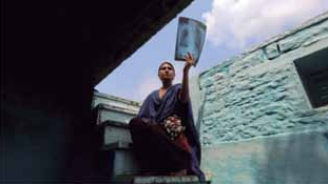
Silicosis, which kills thousands around the world, is caused by inhaling silica dust found in rock, sand, quartz and many building materials. It can lead to breathing difficulties, regular coughing, chest pains and, sometimes, tuberculosis and other chest infections.
Two years ago, at the age of 17, Urmila Yadav, from the village of Budhpura, located in the north-western state of Rajasthan, became one of the youngest certified cases of silicosis in India. Her case is singular; even in this village where mining and quarry1 work is the only occupation and silicosis is a commonplace disease that strikes almost every family, it is mostly men who are affected.
Rajasthan has been the epicentre of silicosis in India. The number of silicosis certified patients in the state, according to government data, is 8441 (the figures are available up to April 2017). Actual numbers are likely to be much higher, claim advocacy groups. It is the only state to have a monetary relief mechanism for certified patients, in place since 2013; however, the onus is on workers to get a diagnosis and prove their occupational history, which is challenging in an unregulated industry like mining in India.
For a young teenage girl like Urmila to have silicosis is “quite an unusual case”, says Dr Vinod Jangid, responsible for diagnosing silicosis at the medical college in the district of Kota. There could be more children with silicosis but the government will hesitate to certify young people. “If children are diagnosed with silicosis, it means they are either living close to the mines, or they are working in the mines, both of which are illegal.”
Urmila began to work in the stone quarries next to her village in her childhood. It is common here for men to work in mines and for women and children to supplement the family earnings by carving cobblestones by hand. Most of them work in quarries and head back there after classes. “There are many girls in Budhpura who do this work. Some are 15 or 16 years, and some even younger. I wish they can be saved from this work,” Urmila says.
(Sunaina Kumar. www.bbc.com, 09.10.2017. Adaptado.)
1 quarry: an open excavation, usually for obtaining building material.
After reading the last paragraph, we understand the term “they”, in the title, to refer to
Questão 28 242849
UEFS Caderno 1 2018/1‘I wish they could be saved’:
The victims of India’s poisonous dust
Silicosis, which kills thousands around the world, is caused by inhaling silica dust found in rock, sand, quartz and many building materials. It can lead to breathing difficulties, regular coughing, chest pains and, sometimes, tuberculosis and other chest infections.
Two years ago, at the age of 17, Urmila Yadav, from the village of Budhpura, located in the north-western state of Rajasthan, became one of the youngest certified cases of silicosis in India. Her case is singular; even in this village where mining and quarry1 work is the only occupation and silicosis is a commonplace disease that strikes almost every family, it is mostly men who are affected.
Rajasthan has been the epicentre of silicosis in India. The number of silicosis certified patients in the state, according to government data, is 8441 (the figures are available up to April 2017). Actual numbers are likely to be much higher, claim advocacy groups. It is the only state to have a monetary relief mechanism for certified patients, in place since 2013; however, the onus is on workers to get a diagnosis and prove their occupational history, which is challenging in an unregulated industry like mining in India.
For a young teenage girl like Urmila to have silicosis is “quite an unusual case”, says Dr Vinod Jangid, responsible for diagnosing silicosis at the medical college in the district of Kota. There could be more children with silicosis but the government will hesitate to certify young people. “If children are diagnosed with silicosis, it means they are either living close to the mines, or they are working in the mines, both of which are illegal.”
Urmila began to work in the stone quarries next to her village in her childhood. It is common here for men to work in mines and for women and children to supplement the family earnings by carving cobblestones by hand. Most of them work in quarries and head back there after classes. “There are many girls in Budhpura who do this work. Some are 15 or 16 years, and some even younger. I wish they can be saved from this work,” Urmila says.
(Sunaina Kumar. www.bbc.com, 09.10.2017. Adaptado.)
1 quarry: an open excavation, usually for obtaining building material.
Mark the alternative which contains a verb in the passive voice.
Questão 27 242847
UEFS Caderno 1 2018/1‘I wish they could be saved’:
The victims of India’s poisonous dust
Silicosis, which kills thousands around the world, is caused by inhaling silica dust found in rock, sand, quartz and many building materials. It can lead to breathing difficulties, regular coughing, chest pains and, sometimes, tuberculosis and other chest infections.
Two years ago, at the age of 17, Urmila Yadav, from the village of Budhpura, located in the north-western state of Rajasthan, became one of the youngest certified cases of silicosis in India. Her case is singular; even in this village where mining and quarry1 work is the only occupation and silicosis is a commonplace disease that strikes almost every family, it is mostly men who are affected.
Rajasthan has been the epicentre of silicosis in India. The number of silicosis certified patients in the state, according to government data, is 8441 (the figures are available up to April 2017). Actual numbers are likely to be much higher, claim advocacy groups. It is the only state to have a monetary relief mechanism for certified patients, in place since 2013; however, the onus is on workers to get a diagnosis and prove their occupational history, which is challenging in an unregulated industry like mining in India.
For a young teenage girl like Urmila to have silicosis is “quite an unusual case”, says Dr Vinod Jangid, responsible for diagnosing silicosis at the medical college in the district of Kota. There could be more children with silicosis but the government will hesitate to certify young people. “If children are diagnosed with silicosis, it means they are either living close to the mines, or they are working in the mines, both of which are illegal.”
Urmila began to work in the stone quarries next to her village in her childhood. It is common here for men to work in mines and for women and children to supplement the family earnings by carving cobblestones by hand. Most of them work in quarries and head back there after classes. “There are many girls in Budhpura who do this work. Some are 15 or 16 years, and some even younger. I wish they can be saved from this work,” Urmila says.
(Sunaina Kumar. www.bbc.com, 09.10.2017. Adaptado.)
1 quarry: an open excavation, usually for obtaining building material.
In the fragment from the last paragraph “There are many girls in Budhpura who do this work”, the word underlined can be correctly replaced by
Questão 26 242846
UEFS Caderno 1 2018/1‘I wish they could be saved’:
The victims of India’s poisonous dust
Silicosis, which kills thousands around the world, is caused by inhaling silica dust found in rock, sand, quartz and many building materials. It can lead to breathing difficulties, regular coughing, chest pains and, sometimes, tuberculosis and other chest infections.
Two years ago, at the age of 17, Urmila Yadav, from the village of Budhpura, located in the north-western state of Rajasthan, became one of the youngest certified cases of silicosis in India. Her case is singular; even in this village where mining and quarry1 work is the only occupation and silicosis is a commonplace disease that strikes almost every family, it is mostly men who are affected.
Rajasthan has been the epicentre of silicosis in India. The number of silicosis certified patients in the state, according to government data, is 8441 (the figures are available up to April 2017). Actual numbers are likely to be much higher, claim advocacy groups. It is the only state to have a monetary relief mechanism for certified patients, in place since 2013; however, the onus is on workers to get a diagnosis and prove their occupational history, which is challenging in an unregulated industry like mining in India.
For a young teenage girl like Urmila to have silicosis is “quite an unusual case”, says Dr Vinod Jangid, responsible for diagnosing silicosis at the medical college in the district of Kota. There could be more children with silicosis but the government will hesitate to certify young people. “If children are diagnosed with silicosis, it means they are either living close to the mines, or they are working in the mines, both of which are illegal.”
Urmila began to work in the stone quarries next to her village in her childhood. It is common here for men to work in mines and for women and children to supplement the family earnings by carving cobblestones by hand. Most of them work in quarries and head back there after classes. “There are many girls in Budhpura who do this work. Some are 15 or 16 years, and some even younger. I wish they can be saved from this work,” Urmila says.
(Sunaina Kumar. www.bbc.com, 09.10.2017. Adaptado.)
1 quarry: an open excavation, usually for obtaining building material.
In the fragment from the third paragraph “It is the only state to have a monetary relief mechanism for certified patients, in place since 2013; however, the onus is on workers to get a diagnosis and prove their occupational history”, the word underlined establishes between the two parts of the sentence a relation of
06