


![[Marketing] Questao Topo - deslogado](https://storage.estuda.com.br/banners/0_6b7ebee90b03af1c560c73bb8bcce34a_banner_deslogado_70_dias.png)
Questões de Inglês
19.971 Questões
Questão 29 301083
UDESC Manhã 2018/2TEXT 1
The Invitation
It doesn’t interest me what you do for a living, I want to know what you ache for, and if you dare to dream of meeting your heart’s longing.
It doesn’t interest me how old you are. I want to know if you will risk looking like a fool for love, for your dreams, for the adventure of being alive.
It doesn’t interest me what planets are squaring with your moon. I want to know if you have touched the center of your own sorrow, if you have been opened by life’s betrayals or have become shriveled and closed from fear of further pain. I want to know if you can sit with pain, mine or your own, without moving to hide it, or fade it or fix it. I want to know if you can be with joy, mine or even your own; if you can dance with the wilderness and let the ecstasy fill you to the tips of your fingers and toes without cautioning us to be careful, be realistic, or to remember the limitations of being a human.
It doesn´t interest me if the story you´re telling me is true. I want to know if you can risk disappointing another to be true to yourself; if you can bear the accusation of betrayal and not betray your own soul. I want to know if you can be faithless and therefore be trustworthy. I want to know if you can see beauty even when it´s not pretty every day, and if you can source your life from its presence. I want to know if you can live with failure, yours and mine, and still stand on the edge of a lake and shout to the silver of the moon, “YES”.
It doesn´t interest me to know where you live or how much money you have. I want to know if you can get up after a night of grief and despair, weary and bruised to the bone, and do what needs to be done for the children. It doesn´t matter to me who you are, how you came to be here. I want to know if you will stand in the center of the fire with me and not shrink back.
It doesn´t interest me where or what or with whom you have studied. I want to know what sustains you from the inside when all else falls away. I want to know if you can be alone with yourself; and if you truly like the company you keep in the empty moments.
(By Oriah Mountain Dreamer from the book THE INVITATION (c) 1999. Published by HarperONE, San Francisco. All rights reserved. Presented with permission of the author. www.oriah.org) (theunboundedspirit.com/start-living) Accessed on March 27th, 2018.
This invitation is about:
Questão 50 301025
UNICID 2018Examine o quadrinho.
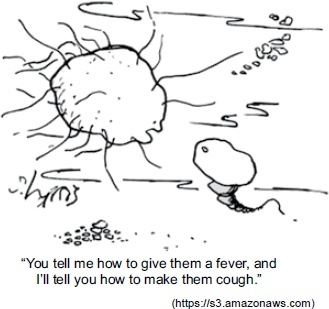
É possível inferir que o termo “them”, que ocorre duas vezes na legenda, se refere
Questão 49 301024
UNICID 2018Leia o texto para responder à questão.
Tiny viruses live in your body: what to know about viromes and what scientists are doing to protect you

Wildlife biologists have enlisted the help of mice and other creatures as they try to better understand how viruses infect humans and how to protect them. “Most of the emerging infectious diseases that arise come from wildlife reservoir hosts,” researcher Kurt Vandegrift said in a statement from Pennsylvania State University. The university added, “One key to fighting emerging diseases is finding out before they get into humans which pathogens we’re most likely to encounter — the ones that are carried by the wild creatures we’re most likely to touch, share space with, or be bitten by.” In the U.S., that includes mice and deer ticks, for example.
While studying wildlife, the scientists may find viruses that could one day evolve to infect humans. Discovering them ahead of time gives experts a leg up on observing how the viruses work, creating vaccines or taking other measures. Studying animals has another benefit: learning more about their viromes — the collections of viruses in and on them — could lead to more information about the human virome.
Human beings are full of viruses, Penn State says. “Some of your viruses are just visiting and will be gone in a week. Most are permanent tenants. A few may even find their way into your DNA.” That’s not necessarily a bad thing, as the university notes that we owe our placenta and thus our reproductive process to virus genes and evolution. We can also be invaded by a virus but never see an infection, or become barely sick at all while others are debilitated.
“We are rarely, if ever, infected by just one germ at a time,” according to Penn State, “and since pathogens change your immune system, how sick you get from a new pathogen doesn’t depend only on the ones you’re infected with now; it’s a reflection of all the infectious diseases you’ve ever had, and even in what order you had them.” The ongoing research would not be the first time animals have taught scientists a thing or two about viruses. Smallpox is now eradicated but was once a highly contagious and often deadly virus in humans.
(Elana Glowatz. www.medicaldaily.com, 10.02.2017. Adaptado.)
No trecho do quarto parágrafo “The ongoing research would not be the first time animals have taught scientists a thing or two about viruses”, os termos em destaque significam que a pesquisa
Questão 48 301023
UNICID 2018Leia o texto para responder à questão.
Tiny viruses live in your body: what to know about viromes and what scientists are doing to protect you
Wildlife biologists have enlisted the help of mice and other creatures as they try to better understand how viruses infect humans and how to protect them. “Most of the emerging infectious diseases that arise come from wildlife reservoir hosts,” researcher Kurt Vandegrift said in a statement from Pennsylvania State University. The university added, “One key to fighting emerging diseases is finding out before they get into humans which pathogens we’re most likely to encounter — the ones that are carried by the wild creatures we’re most likely to touch, share space with, or be bitten by.” In the U.S., that includes mice and deer ticks, for example.
While studying wildlife, the scientists may find viruses that could one day evolve to infect humans. Discovering them ahead of time gives experts a leg up on observing how the viruses work, creating vaccines or taking other measures. Studying animals has another benefit: learning more about their viromes — the collections of viruses in and on them — could lead to more information about the human virome.
Human beings are full of viruses, Penn State says. “Some of your viruses are just visiting and will be gone in a week. Most are permanent tenants. A few may even find their way into your DNA.” That’s not necessarily a bad thing, as the university notes that we owe our placenta and thus our reproductive process to virus genes and evolution. We can also be invaded by a virus but never see an infection, or become barely sick at all while others are debilitated.
“We are rarely, if ever, infected by just one germ at a time,” according to Penn State, “and since pathogens change your immune system, how sick you get from a new pathogen doesn’t depend only on the ones you’re infected with now; it’s a reflection of all the infectious diseases you’ve ever had, and even in what order you had them.” The ongoing research would not be the first time animals have taught scientists a thing or two about viruses. Smallpox is now eradicated but was once a highly contagious and often deadly virus in humans.
(Elana Glowatz. www.medicaldaily.com, 10.02.2017. Adaptado.)
No trecho do quarto parágrafo “and since pathogens change your immune system”, o termo em destaque equivale, em português, a
Questão 47 301022
UNICID 2018Leia o texto para responder à questão.
Tiny viruses live in your body: what to know about viromes and what scientists are doing to protect you
Wildlife biologists have enlisted the help of mice and other creatures as they try to better understand how viruses infect humans and how to protect them. “Most of the emerging infectious diseases that arise come from wildlife reservoir hosts,” researcher Kurt Vandegrift said in a statement from Pennsylvania State University. The university added, “One key to fighting emerging diseases is finding out before they get into humans which pathogens we’re most likely to encounter — the ones that are carried by the wild creatures we’re most likely to touch, share space with, or be bitten by.” In the U.S., that includes mice and deer ticks, for example.
While studying wildlife, the scientists may find viruses that could one day evolve to infect humans. Discovering them ahead of time gives experts a leg up on observing how the viruses work, creating vaccines or taking other measures. Studying animals has another benefit: learning more about their viromes — the collections of viruses in and on them — could lead to more information about the human virome.
Human beings are full of viruses, Penn State says. “Some of your viruses are just visiting and will be gone in a week. Most are permanent tenants. A few may even find their way into your DNA.” That’s not necessarily a bad thing, as the university notes that we owe our placenta and thus our reproductive process to virus genes and evolution. We can also be invaded by a virus but never see an infection, or become barely sick at all while others are debilitated.
“We are rarely, if ever, infected by just one germ at a time,” according to Penn State, “and since pathogens change your immune system, how sick you get from a new pathogen doesn’t depend only on the ones you’re infected with now; it’s a reflection of all the infectious diseases you’ve ever had, and even in what order you had them.” The ongoing research would not be the first time animals have taught scientists a thing or two about viruses. Smallpox is now eradicated but was once a highly contagious and often deadly virus in humans.
(Elana Glowatz. www.medicaldaily.com, 10.02.2017. Adaptado.)
According to the fourth paragraph,
Questão 46 301021
UNICID 2018Leia o texto para responder à questão.
Tiny viruses live in your body: what to know about viromes and what scientists are doing to protect you
Wildlife biologists have enlisted the help of mice and other creatures as they try to better understand how viruses infect humans and how to protect them. “Most of the emerging infectious diseases that arise come from wildlife reservoir hosts,” researcher Kurt Vandegrift said in a statement from Pennsylvania State University. The university added, “One key to fighting emerging diseases is finding out before they get into humans which pathogens we’re most likely to encounter — the ones that are carried by the wild creatures we’re most likely to touch, share space with, or be bitten by.” In the U.S., that includes mice and deer ticks, for example.
While studying wildlife, the scientists may find viruses that could one day evolve to infect humans. Discovering them ahead of time gives experts a leg up on observing how the viruses work, creating vaccines or taking other measures. Studying animals has another benefit: learning more about their viromes — the collections of viruses in and on them — could lead to more information about the human virome.
Human beings are full of viruses, Penn State says. “Some of your viruses are just visiting and will be gone in a week. Most are permanent tenants. A few may even find their way into your DNA.” That’s not necessarily a bad thing, as the university notes that we owe our placenta and thus our reproductive process to virus genes and evolution. We can also be invaded by a virus but never see an infection, or become barely sick at all while others are debilitated.
“We are rarely, if ever, infected by just one germ at a time,” according to Penn State, “and since pathogens change your immune system, how sick you get from a new pathogen doesn’t depend only on the ones you’re infected with now; it’s a reflection of all the infectious diseases you’ve ever had, and even in what order you had them.” The ongoing research would not be the first time animals have taught scientists a thing or two about viruses. Smallpox is now eradicated but was once a highly contagious and often deadly virus in humans.
(Elana Glowatz. www.medicaldaily.com, 10.02.2017. Adaptado.)
De acordo com as informações do terceiro parágrafo,
06