


![[Marketing] Questao Topo - deslogado](https://storage.estuda.com.br/banners/0_6b7ebee90b03af1c560c73bb8bcce34a_banner_deslogado_70_dias.png)
Questões de Inglês
19.971 Questões
Questão 28 303258
UNESP 2018/2When it comes to politics and ‘fake news,’
facts aren’t enough

The myth that vaccines cause autism has persisted,
even though the facts paint an entirely different story.
In today’s political climate, it sometimes feels like we can’t even agree on basic facts. We bombard each other with statistics and figures, hoping that more data will make a difference. A progressive person might show you the same climate change graphs over and over while a conservative person might point to the trillions of dollars of growing national debt. We’re left wondering, “Why can’t they just see? It’s so obvious!”
Certain myths are so pervasive that no matter how many experts disprove them, they only seem to grow in popularity. There’s no shortage of serious studies showing no link between autism and vaccines, for example, but these are no match for an emotional appeal to parents worried for their young children.
Tali Sharot, a cognitive neuroscientist at University College London, studies how our minds work and how we process new information. In her upcoming book, The Influential Mind, she explores why we ignore facts and how we can get people to actually listen to the truth. Tali shows that we’re open to new information – but only if it confirms our existing beliefs. We find ways to ignore facts that challenge our ideals. And as neuroscientist Bahador Bahrami and colleagues have found, we weigh all opinions as equally valid, regardless of expertise.
So, having the data on your side is not always enough. For better or for worse, Sharot says, emotions may be the key to changing minds.
(Shankar Vedantam. www.npr.org. Adaptado.)
No trecho do segundo parágrafo “but these are no match for an emotional appeal to parents worried for their young children”, o termo sublinhado refere-se a
Questão 26 303256
UNESP 2018/2When it comes to politics and ‘fake news,’
facts aren’t enough
The myth that vaccines cause autism has persisted,
even though the facts paint an entirely different story.
In today’s political climate, it sometimes feels like we can’t even agree on basic facts. We bombard each other with statistics and figures, hoping that more data will make a difference. A progressive person might show you the same climate change graphs over and over while a conservative person might point to the trillions of dollars of growing national debt. We’re left wondering, “Why can’t they just see? It’s so obvious!”
Certain myths are so pervasive that no matter how many experts disprove them, they only seem to grow in popularity. There’s no shortage of serious studies showing no link between autism and vaccines, for example, but these are no match for an emotional appeal to parents worried for their young children.
Tali Sharot, a cognitive neuroscientist at University College London, studies how our minds work and how we process new information. In her upcoming book, The Influential Mind, she explores why we ignore facts and how we can get people to actually listen to the truth. Tali shows that we’re open to new information – but only if it confirms our existing beliefs. We find ways to ignore facts that challenge our ideals. And as neuroscientist Bahador Bahrami and colleagues have found, we weigh all opinions as equally valid, regardless of expertise.
So, having the data on your side is not always enough. For better or for worse, Sharot says, emotions may be the key to changing minds.
(Shankar Vedantam. www.npr.org. Adaptado.)
No trecho do primeiro parágrafo “A progressive person might show you the same climate change graphs over and over while a conservative person might point to the trillions of dollars of growing national debt”, o termo sublinhado indica sentido de
Questão 25 303253
UNESP 2018/2When it comes to politics and ‘fake news,’
facts aren’t enough
The myth that vaccines cause autism has persisted,
even though the facts paint an entirely different story.
In today’s political climate, it sometimes feels like we can’t even agree on basic facts. We bombard each other with statistics and figures, hoping that more data will make a difference. A progressive person might show you the same climate change graphs over and over while a conservative person might point to the trillions of dollars of growing national debt. We’re left wondering, “Why can’t they just see? It’s so obvious!”
Certain myths are so pervasive that no matter how many experts disprove them, they only seem to grow in popularity. There’s no shortage of serious studies showing no link between autism and vaccines, for example, but these are no match for an emotional appeal to parents worried for their young children.
Tali Sharot, a cognitive neuroscientist at University College London, studies how our minds work and how we process new information. In her upcoming book, The Influential Mind, she explores why we ignore facts and how we can get people to actually listen to the truth. Tali shows that we’re open to new information – but only if it confirms our existing beliefs. We find ways to ignore facts that challenge our ideals. And as neuroscientist Bahador Bahrami and colleagues have found, we weigh all opinions as equally valid, regardless of expertise.
So, having the data on your side is not always enough. For better or for worse, Sharot says, emotions may be the key to changing minds.
(Shankar Vedantam. www.npr.org. Adaptado.)
De acordo com o texto, as pessoas
Questão 24 303252
UNESP 2018/2Leia os cartuns 1 e 2 para responder à questão.
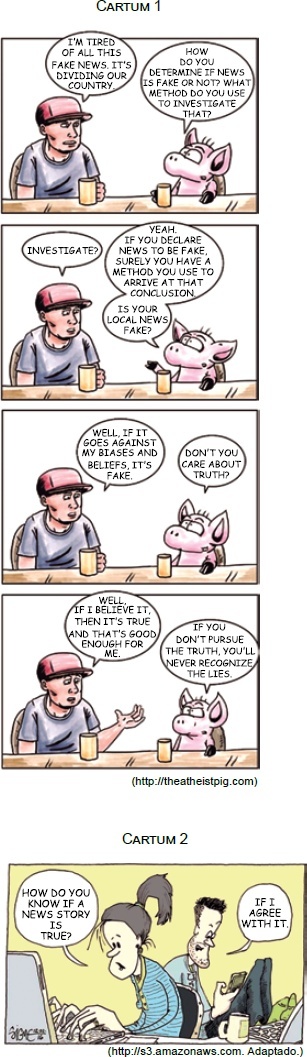
No último quadrinho do cartum 1, por meio da fala “If you don’t pursue the truth, you’ll never recognize the lies”, o personagem
Questão 23 303251
UNESP 2018/2Leia os cartuns 1 e 2 para responder à questão.
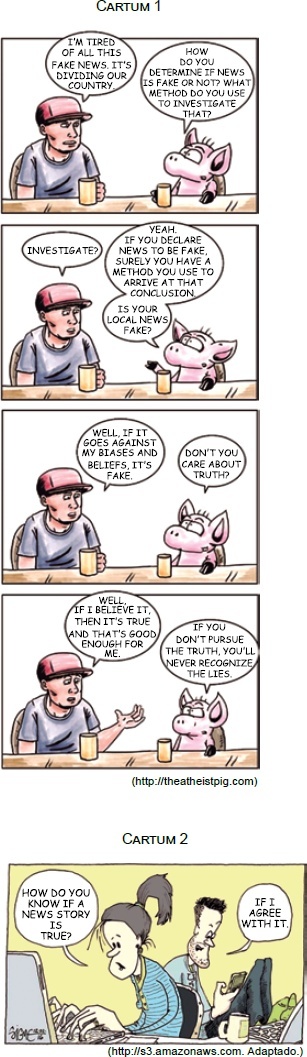
Na fala do terceiro quadrinho do cartum 1 “Well, if it goes against my biases and beliefs, it’s fake”, o termo sublinhado equivale, em português, a
Questão 22 303250
UNESP 2018/2Leia os cartuns 1 e 2 para responder à questão.
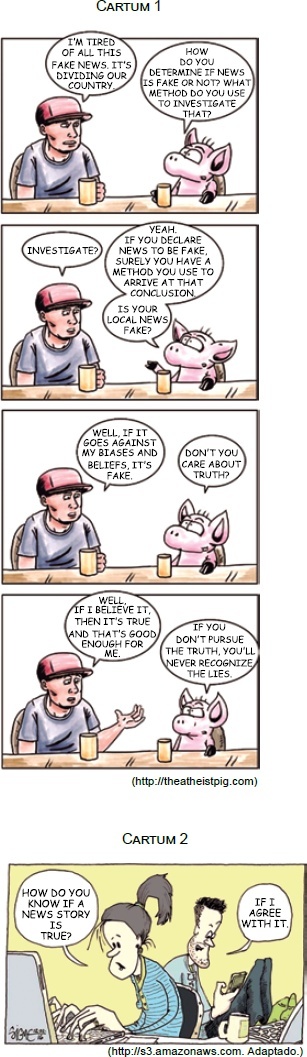
In the cartoon 1, the animal
06