


![[Marketing] Questao Topo - deslogado](https://storage.estuda.com.br/banners/0_6b7ebee90b03af1c560c73bb8bcce34a_banner_deslogado_70_dias.png)
Questões de Inglês
19.971 Questões
Questão 11 304470
FCM PB 2018/2TEXT I
“There are a trillion reasons why taking time to chill out might be the last item on your to-do list. But, here's why it should be a priority: "Being stressed will increase your susceptibility to catching a cold," says Ali. That may be because, over the long term, it leads to the ongoing release of stress hormones, such as glucocorticoids. These impede your body's ability to produce cell-signaling molecules called cytokines, which trigger a disease-fighting response from your immune system. "You're also less likely to take care of yourself — get ample sleep, eat right, exercise — when you're stressed," says Ali, which is crucial to upping your immunity.
(Adapted from: http://www.health.com/health/gallery)
Mark T (true) or F (false) according to text:
( ) Being stressed increases propensity to getting a cold.
( ) Constant restless nights might hamper immune system's capacity to function well.
( ) Moist hands do not spread bacteria, so we should keep them wet.
The correct sequence from top to bottom is:
Questão 60 303833
FPP Medicina Verão 2018Read the text.
New Ways for Poor Countries to Diagnose Infectious Diseases
This is the VOA Special English DEVELOPMENT REPORT.
Two new discoveries could offer easier ways to identify infectious diseases in developing countries.
The first involves sheep. Researchers have found that hair sheep are a good source of blood for use in tests to diagnose infectious diseases in people. […]
Ellen Yeh, from the Stanford University School of Medicine, in California, was one of the authors of the study. She explains the problems with using human blood.
ELLEN YEH: "First off, there is the infectious disease risk because if you use human blood there's a lot of transmissible diseases. In particular, in Africa, you'd be worried about things like HIV The other big problem with using human blood for making these blood agar plates is that they're actually not accurate." […]
The study found that blood from hair sheep is an excellent substitute. It produced the same results as tests using wool sheep and horses.
Also, hair sheep require less care than wool sheep. They could better handle hot, dry climates because they do not have a lot of wool. It also means they do not need to be sheared.
ELLEN YEH: "Having to shear the sheep for wool is actually very costly and labor intensive. The other advantages of hair sheep include that it's more resistant to parasites, so they're less prone to infection."
The scientists also tested an easier, cheaper way to prepare and process the blood. They found this new method effective. The blood can be collected directly into bags, much like with human donors. […]
The same journal also published a report in July on an experimental device called the CellScope. The CellScope is a cell phone microscope. Engineers at the University of California, Berkeley, developed it.
They attached small microscope lenses to a holder fitted to a mobile phone. The phone's camera was able to take color images of malaria parasites and tuberculosis bacteria in blood and sputum. The team used a special dye and special lighting to make the images bright.
The pictures could also be sent wirelessly to distant experts for diagnosis. […]
Disponível em: <http://www.manythings.org/voa/medical/5123>.html. Access on: 20.06.2017.
Read the text and choose the best alternative.
I. There are more and better ways to diagnose diseases in poor countries.
II. Hair from many animals is used to diagnose diseases in poor people.
III. Shaving wool from sheep is very expensive and hard work.
IV. An easier and cheaper way of collecting blood into bags was tested by scientists.
V. Cell phone’s camera can take pictures of diseases from blood and sputum and be sent to farther away places for diagnosis.
Questão 59 303832
FPP Medicina Verão 2018Read the text.
Sat Out of Politics for 40 Years. Now They Want in the Game.
Faith leaders whose politics fall to the left of center are getting more involved in politics to fight against President Trump’s policies.
In Nashville, a crowd of ministers carrying palm fronds occupied the governor’s office during Holy Week, demanding the expansion of Medicaid to cover more of the uninsured. In California and 16 other states, an interfaith network has organized thousands of volunteers to swoop into action when immigrants are arrested or houses of worship are vandalized.
Across the country, religious leaders whose politics fall to the left of center, and who used to shun the political arena, are getting involved — and even recruiting political candidates — to fight back against President Trump’s policies on immigration, health care, poverty, and the environment.
Some are calling the holy ruckus a “religious resistance”. Others, mindful that periodic attempts at a resurgence on the religious left have all failed, point to an even loftier ambition than taking on the current White House: after 40 years in which the Christian right has dominated the influence of organized religion on American politics — souring some people on religion altogether, studies show — left-leaning faith leaders are hungry to break the right’s grip on setting the nation’s moral agenda.
Frustrated by Christian conservatives’ focus on reversing liberal successes in legalizing abortion and same-sex marriage, those on the religious left want to turn instead to what they see as truly fundamental biblical imperatives — caring for the poor, welcoming strangers and protecting the earth — and maybe even change some minds about what it means to be a believer.
Disponível em: <https://www.nytimes.com/2017/06/10/us/politics/politics-religion-liberal-williambarber. html?hp&action=click&pgtype=Homepage&clickSource=story-heading&module=second-column-region®ion=top-news&WT.nav=top-news>. Access on: 17.06.2017.
What is the main idea of this text?
Questão 58 303831
FPP Medicina Verão 2018According to the experts, what can we learn from Prince William parenting style?
We Should All Steal This Parenting Trick From Prince William, Experts Say
If you spend a lot of time looking at photos of Prince William and his 3-year-old son, Prince George (as we most definitely do), you might have noticed that the Duke of Cambridge often kneels down while talking to his son.
When the Duke of Cambridge crouches down to Prince George's level, he's able to look into the toddler's eyes. Experts consider this to be an "active listening" technique, People reports, and it can help children feel like what they're saying really matters to their parents. Child development expert Gill Connel writes in A Moving Child Is a Learning Child that the Duke of Cambridge's gesture can "foster self-esteem in powerful ways while encouraging his children to communicate even more." And isn't that sweet?
Disponível em: <http://www.goodhousekeeping.com/life/parenting/a39536/prince-william-parenting-trick/>
Questão 56 303829
FPP Medicina Verão 2018Look at the comic strip.
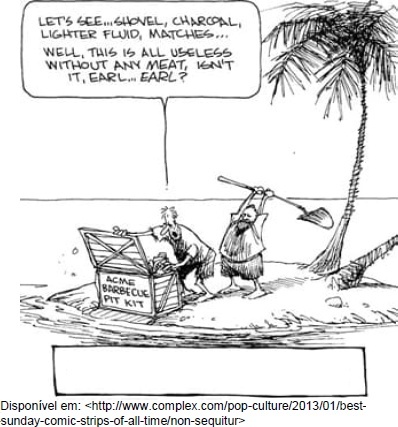
Choose the title which expresses the main idea of the comic strip:
Questão 55 303828
FPP Medicina Verão 2018Read the text.
A PNEUMONIA-DIAGNOSING JACKET CAN HELP SAVE LIVES IN A MATTER OF MINUTES
“Over 1 month of age, pneumonia is still the largest killer of children anywhere in the world,” says Shamim Ahmad Qazi, a pediatrician who works with the World Health Organization (WHO). In 2015, this figure was close to 1 million — more deaths in children under the age of 5 than malaria, measles and HIV/AIDS combined. “In most cases, it’s difficult to diagnose,” says Qazi, especially in less-developed countries where X-ray equipment isn’t widely available. In Uganda, pneumonia is often mistaken for malaria — the two share common symptoms like fever and cough — but people are quick to assume malaria because the disease has gotten greater publicity in recent years. And yet, according to UNICEF, only 2 cents go toward pneumonia for every health dollar spent globally.
To combat this “forgotten killer of children,” as the WHO calls it, the Ugandan engineers, together with their partner Besufekad Shifferaw, a fellow student from Uganda’s Makerere University, have come up with a new tool to improve diagnoses in young children. The prototype Mama-Ope is a biomedical jacket that measures vital signs that can indicate the presence of pneumonia. Once the jacket is fitted snugly over a child’s chest, it syncs with an app over Bluetooth, and in under two minutes readings flash up indicating the child’s temperature, breathing rate and an assessment of whether the lungs sound normal or not.
According to the text, we can state that
I. wearing jackets make kids warmer so they do not get pneumonia.
II. x-ray is a tool which helps diagnosing pneumonia.
III. Aat the age of 5, kids are more affected by malaria than by pneumonia.
IV. the investments to fight pneumonia are short.
V. the use of the jacket is not possible in places like Uganda since they are an undeveloped country.
06