


![[Marketing] Questao Topo - deslogado](https://storage.estuda.com.br/banners/0_6b7ebee90b03af1c560c73bb8bcce34a_banner_deslogado_70_dias.png)
Questões de Inglês
19.971 Questões
Questão 49 366808
ESPM 2018/2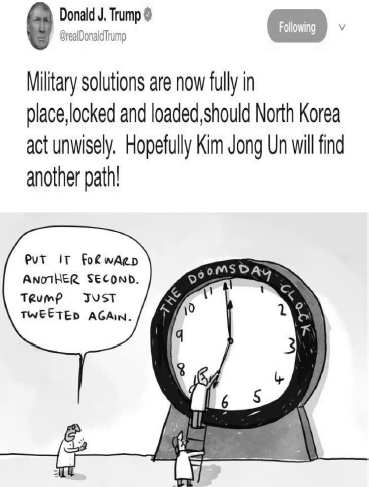
What is the relation between the images above, when related to article 1?
Questão 44 366784
ESPM 2018/2Doomsday Clock: Nearing the
stroke of madness
(By Derek Johnson)
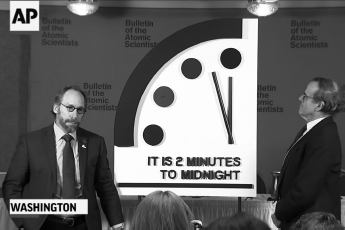
As the Bulletin of Atomic Scientists sets its Doomsday Clock ahead 30 seconds -- to two minutes before midnight -- the lesson seems clear: our time is nearly up.
It is tempting to argue the increasingly long odds of humanity’s survival correspond to the rise of an erratic celebrity apprentice to the White House. The enormous destructive capability at his fingertips -- coupled with his ignorance of international affairs and disdain for diplomacy, his fetish for violence and dehumanizing worldviews, and his consistently ballistic tendencies -- has us balanced on the razor’s edge. Rightly so.
But in truth, this problem is bigger than any one president. Even Donald Trump.
While many factors contribute to the setting of the Clock, it is the terrible prospect of nuclear conflict that lies at the heart of today’s announcement. There are still more than 15,000 nuclear weapons in the world. Beyond all reason, the United States and Russia keep thousands of them on hair-trigger alert, ready to launch at any moment. Bear in mind that a single modern warhead has more destructive force than all of the bombs detonated in World War II combined, including the atomic weapons dropped on Japan.
Confronted for the first time with multiple geopolitical hotspots that could go nuclear with little or no warning, the world is in dangerous and uncharted waters.
This parade of nuclear-tinged crises has steadily worsened over the last year: North Korea and the United States appear to be on a collision course, fueled by schoolyard taunts, missile tests and threats of “fire and fury.” NATO-Russia tensions are intensifying and are spilling over into the arms control arena, threatening to unravel vital agreements like the Intermediate-Range Nuclear Forces Treaty and New START. Nuclear arms-racing India and Pakistan are once again clashing in Kashmir, with casualties mounting on both sides. And another nuclear crisis may be brewing in the Middle East as the White House actively works to undermine the Iran deal.
Meanwhile, as you read this, all of the nuclear-armed states are marching to upgrade, expand or operationalize their arsenals. Rather than continuing decades of slow but steady progress to eradicate them, nations are sinking trillions of dollars globally into building a whole new generation of civilization-ending weaponry. “Nuclear buttons” sit on the desks of more authoritarian men than at any moment in history.
As this march continues, the role of nuclear weapons will be further cemented in national security policies and inoculated against stigmatization. And the risks that they will be used -- by accident, by unauthorized action, by mistaken launch on false warning, by deliberate decisions stemming from crisis escalation, or in a fit of pique -- will rise.
These are not the hysterical musings of armchair analysts and activists. The draft of Trump›s radical new Nuclear Posture Review leaked this month confirms just how far and how fast the United States is backsliding toward nuclear warfighting. Without urgent intervention, it only gets worse from here.
We have spent decades in comfortable and dangerous denial of the inherent risks of nuclear weapons and the fault lines buried in “red button” systems geared for first strike and quick launch. Now, thanks to Trump, it is impossible to ignore -- and not a moment too soon.
Confronting these dangers will require the relentless work of many years -- more time than we likely have if nothing changes soon. We can buy ourselves some breathing room with any number of emergency measures currently circulating in Congress, like the Restricting First Use of Nuclear Weapons Act; by starving Trump’s nuclear ambitions of the eye-popping funds they require; and by demanding diplomatic engagement with nucleararmed adversaries, first and foremost the North Koreans.
But there are only two ways this story ends: We either find the wisdom and courage to reduce and ultimately eliminate these weapons, or the Clock strikes midnight.
We are running out of time to decide which future we will live to see.
(Adapted from https://www.cnn.com, January 25, 2018)
The verb worsened, boldfaced in paragraph 6, is composed by the suffix en, added to the word to form a verb with the meaning ‘become more’. Check the alternative in which the suffix en is not used this way:
Questão 42 366775
ESPM 2018/2Doomsday Clock: Nearing the
stroke of madness
(By Derek Johnson)
As the Bulletin of Atomic Scientists sets its Doomsday Clock ahead 30 seconds -- to two minutes before midnight -- the lesson seems clear: our time is nearly up.
It is tempting to argue the increasingly long odds of humanity’s survival correspond to the rise of an erratic celebrity apprentice to the White House. The enormous destructive capability at his fingertips -- coupled with his ignorance of international affairs and disdain for diplomacy, his fetish for violence and dehumanizing worldviews, and his consistently ballistic tendencies -- has us balanced on the razor’s edge. Rightly so.
But in truth, this problem is bigger than any one president. Even Donald Trump.
While many factors contribute to the setting of the Clock, it is the terrible prospect of nuclear conflict that lies at the heart of today’s announcement. There are still more than 15,000 nuclear weapons in the world. Beyond all reason, the United States and Russia keep thousands of them on hair-trigger alert, ready to launch at any moment. Bear in mind that a single modern warhead has more destructive force than all of the bombs detonated in World War II combined, including the atomic weapons dropped on Japan.
Confronted for the first time with multiple geopolitical hotspots that could go nuclear with little or no warning, the world is in dangerous and uncharted waters.
This parade of nuclear-tinged crises has steadily worsened over the last year: North Korea and the United States appear to be on a collision course, fueled by schoolyard taunts, missile tests and threats of “fire and fury.” NATO-Russia tensions are intensifying and are spilling over into the arms control arena, threatening to unravel vital agreements like the Intermediate-Range Nuclear Forces Treaty and New START. Nuclear arms-racing India and Pakistan are once again clashing in Kashmir, with casualties mounting on both sides. And another nuclear crisis may be brewing in the Middle East as the White House actively works to undermine the Iran deal.
Meanwhile, as you read this, all of the nuclear-armed states are marching to upgrade, expand or operationalize their arsenals. Rather than continuing decades of slow but steady progress to eradicate them, nations are sinking trillions of dollars globally into building a whole new generation of civilization-ending weaponry. “Nuclear buttons” sit on the desks of more authoritarian men than at any moment in history.
As this march continues, the role of nuclear weapons will be further cemented in national security policies and inoculated against stigmatization. And the risks that they will be used -- by accident, by unauthorized action, by mistaken launch on false warning, by deliberate decisions stemming from crisis escalation, or in a fit of pique -- will rise.
These are not the hysterical musings of armchair analysts and activists. The draft of Trump›s radical new Nuclear Posture Review leaked this month confirms just how far and how fast the United States is backsliding toward nuclear warfighting. Without urgent intervention, it only gets worse from here.
We have spent decades in comfortable and dangerous denial of the inherent risks of nuclear weapons and the fault lines buried in “red button” systems geared for first strike and quick launch. Now, thanks to Trump, it is impossible to ignore -- and not a moment too soon.
Confronting these dangers will require the relentless work of many years -- more time than we likely have if nothing changes soon. We can buy ourselves some breathing room with any number of emergency measures currently circulating in Congress, like the Restricting First Use of Nuclear Weapons Act; by starving Trump’s nuclear ambitions of the eye-popping funds they require; and by demanding diplomatic engagement with nucleararmed adversaries, first and foremost the North Koreans.
But there are only two ways this story ends: We either find the wisdom and courage to reduce and ultimately eliminate these weapons, or the Clock strikes midnight.
We are running out of time to decide which future we will live to see.
(Adapted from https://www.cnn.com, January 25, 2018)
According to the article, it is correct to state that the main reason why the Doomsday Clock is moving towards midnight is:
Questão 50 363911
ESPM 2018/1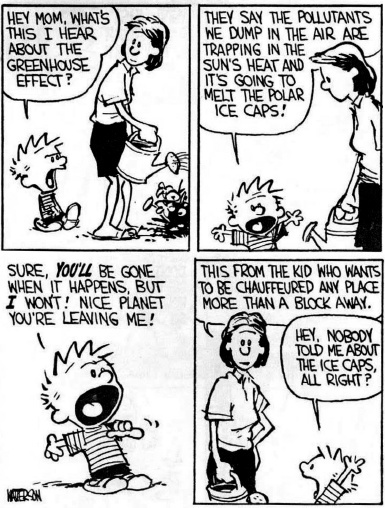
The boy’s mother:
Questão 46 363898
ESPM 2018/1Clean energy won’t save us –
only a new economic
system can
By Jason Hickel
Early in 2015 media outlets around the world announced that February had broken global temperature records by a shocking amount. March broke all the records too. In June, our screens were covered with surreal images of flooding in Paris, the Seine bursting its banks and flowing into the streets. In London, floods sent water pouring into the tube system right in the heart of Covent Garden. Roads in south-east London became rivers two metres deep.
With such extreme events becoming more commonplace, few deny climate change any longer. Finally, a consensus is crystallising around one all-important fact: fossil fuels are killing us. We need to switch to clean energy, and fast.
This growing awareness about the dangers of fossil fuels represents a crucial shift in our consciousness. But I can’t help but fear we’ve missed the point. As important as clean energy might be, the science is clear: it won’t save us from climate change.
Let’s imagine, just for argument’s sake, that we are able to get off fossil fuels and switch to 100% clean energy. There is no question this would be a vital step in the right direction, but even this bestcase scenario wouldn’t be enough to avert climate catastrophe.
Why? Because the burning of fossil fuels only accounts for about 70% of all anthropogenic greenhouse gas emissions. The remaining 30% comes from a number of causes. Deforestation is a big one. So is industrial agriculture, which degrades the soils to the point where they leach CO2. Then there’s industrial livestock farming which produces 90m tonnes of methane per year and most of the world’s anthropogenic nitrous oxide. Both of these gases are vastly more potent than CO2 when it comes to global warming. Livestock farming alone contributes more to global warming than all the cars, trains, planes and ships in the world. Industrial production of cement, steel, and plastic forms another major source of greenhouse gases, and then there are our landfills, which pump out
huge amounts of methane – 16% of the world’s total.
When it comes to climate change, the problem is not just the type of energy we are using, it’s what we’re doing with it. What would we do with 100% clean energy? Exactly what we are doing with fossil fuels: raze more forests, build more meat farms, expand industrial agriculture, produce more cement, and fill more landfill sites, all of which will pump deadly amounts of greenhouse gas into the air. We will do these things because our economic system demands endless compound growth, and for some reason we have not thought to question this.
Think of it this way. That 30% chunk of greenhouse gases that comes from nonfossil fuel sources isn’t static. It is adding more to the atmosphere each year. Scientists project that our tropical forests will be completely destroyed by 2050, releasing a 200bn tonne carbon bomb into the air. The world’s topsoils could be depleted within just 60 years, releasing more still. Emissions from the cement industry are growing at more than 9% per year. And our landfills are multiplying at an eye-watering pace: by 2100 we will be producing 11m tonnes of solid waste per day, three times more than we do now. Switching to clean energy will do nothing to slow this down.
The climate movement made an enormous mistake. We focused all our attention on fossil fuels, when we should have been pointing to something much deeper: the basic logic of our economic operating system. After all, we’re only using fossil fuels in the first place to fuel the broader imperative of GDP growth.
The root problem is the fact that our economic system demands ever-increasing levels of extraction, production and consumption. Our politicians tell us that we need to keep the global economy growing at more than 3% each year – the minimum necessary for large firms to make aggregate profits. That means every 20 years we need to double the size of the global economy – double the cars, double the fishing, double the mining, double the McFlurries and double the iPads. And then double them again over the next 20 years from their already doubled state.
Our more optimistic pundits claim that technological innovations will help us to de-couple economic growth from material throughput. But sadly there is no evidence that this is happening. Global material extraction and consumption has grown by 94% since 1980, and is still going up. Current projections show that by 2040 we will more than double the world’s shipping miles, air miles, and trucking miles – along with all the material stuff that those vehicles transport – almost exactly in keeping with the rate of GDP growth.
Clean energy, important as it is, won’t save us from this nightmare. But rethinking our economic system might. GDP growth has been sold to us as the only way to create a better world. But we now have robust evidence that it doesn’t make us any happier, it doesn’t reduce poverty, and its “externalities” produce all sorts of social ills: debt, overwork, inequality, and climate change. We need to abandon GDP growth as our primary measure of progress, and we need to do this immediately.
This is not an impossible task. A number of countries have already managed to achieve high levels of human development with very low levels of consumption. In fact Daniel O’Neill, an economist at the University of Leeds, has demonstrated that even material de-growth is not incompatible with high levels of human well-being.
Our focus on fossil fuels has lulled us into thinking we can continue with the status quo so long as we switch to clean energy, but this is a dangerously simplistic assumption. If we want to stave off the coming crisis, we need to confront its underlying cause.
(Adapted from www.theguardian.com, July 16th , 2016)
The words anthropogenic, degrades, livestock, depleted, extraction, boldfaced in the article, mean respectively:
Questão 41 363878
ESPM 2018/1Sea level warning as
Greenland darkens
by David Shukman
They say warmer conditions are encouraging algae to grow and darken the surface. Dark ice absorbs more solar radiation than clean white ice, so it warms up and melts more rapidly.
Currently the Greenland ice sheet is adding up to 1mm a year to the rise in the global average level of the oceans.
It is the largest mass of ice in the northern hemisphere covering an area about seven times the size of the United Kingdom and reaching up to 3km in thickness. This means that the average sea level would rise around the world by about seven meters, if it all melted. That is why Greenland, though remote, is a focus of research which has direct relevance to major coastal cities as far apart as Miami, London and Shanghai and lowlying areas in Bangladesh and parts of Britain.
Algae were first observed on the Greenland ice sheet more than a century ago but until recently its potential impact was ignored. Only in the last few years have researchers started to explore how the microscopically small plants could affect future melting. A five-year UK research project known as Black and Bloom is under way to investigate the different species of algae and how they might spread, and then to use this knowledge to improve computer projections of future sea level rise. The possibility of biologically inspired melting was not included in the estimates for sea level rise published by the UN’s climate panel, the IPCC, in its latest report in 2014.That study said the worst-case scenario was a rise of 98cm by the end of the century.
One concern now is that rising temperatures will allow algae to flourish not only on the slopes of the narrow margins of the ice-sheet but also on the flat areas in the far larger interior where melting could happen on a much bigger scale.
We joined the latest phase of research in which scientists set up camp on the icesheet to gather accurate measurements of the “albedo” or the amount of solar radiation reflected by the surface. White snow reflects up to 90% of solar radiation while dark patches of algae will only reflect about 35% or even as little as 1% in the blackest spots. When we flew by helicopter onto the ice sheet, the rolling landscape seemed surprisingly gray - my first impression was that it looked dirty. Prof Martyn Tranter of Bristol University, who is leading the project, told me:
“People are very worried about the possibility that the ice sheet might be melting faster and faster in the future. Our project is trying to understand just how much melting might occur.” Over the last 20 years, Greenland has been losing more ice than it gains through snowfall in winter - a change in a natural balance that normally keeps the ice-sheet stable.
Studies over the past five years have shown that the majority of the dark material covering the ice sheets may be biological with different kinds of algae turning the ice black, brown, green and even mauve. “This is a living landscape,” according to Dr Joe Cook, a glacial microbiologist at Sheffield University. “This is an extremely difficult place for anything to live but, as we look around us, all this darkness we can see on the ice surface is living - algae, microbes, living and reproducing in the ice sheet and changing its color.”
The final phase of the Black and Bloom project involves weaving the new factor of biological darkening into climate models to come up with revised estimates for future sea level rise. And, as Dr Cook explained, the retreat of the Greenland ice sheet does not need to be total to have a widespread and damaging impact.”When we say the ice sheet is melting faster, no one saying it’s all going to melt in next decade or the next 100 years or even the next 1,000 years but it doesn’t all have to melt for more people to be in danger - only a small amount has to melt to threaten millions in coastal communities around world.”
Meanwhile, another factor that may be driving the melting has been identified by an Austrian member of the team, Stefan Hofer, a PhD student at Bristol. In a paper recently published in Science Advances, he analyzed satellite imagery and found that over the past 20 years there has been a 15% decrease in cloud cover over Greenland in the summer months. “It was definitely a ‘wow’ moment,” he told me. Although temperature is an obvious driver of melting, the paper estimated that two-thirds of additional melting, above the long-term average, was attributable to clearer skies.
What is not known is how this might affect the algae. Their darker pigments are believed to be a protection from ultra violet light - so more sunshine might encourage that process of darkening or prove to be damaging to them.
The Black and Bloom project, funded by the Natural Environment Research Council (Nerc), aims to publish its new projections for sea level rise in two years’ time.
(Adapted from www.bbcnews.com/news/science-environment, 23rd July, 2017)
According to the article, scientists are worried that:
06