


![[Marketing] Questao Topo - deslogado](https://storage.estuda.com.br/banners/0_6b7ebee90b03af1c560c73bb8bcce34a_banner_deslogado_70_dias.png)
Questões de Inglês
19.971 Questões
Questão 35 413793
FDV 2018/1THE OBESITY-HUNGER PARADOX by SAM DOLNICK
When most people think of hunger in America, the images that leap to mind are of are of ragged toddlers in Appalachia or rail-thin children in dingy apartments reaching for empty bottles of milk. But a recent survey found that the most severe hungerrelated problems in the nation are in the South Bronx, one of the country’s capitals of obesity. Experts say these are not parallel problems persisting in side-by-side neighborhoods, but plagues often seen in the same households, even the same person: the hungriest people in America today, statistically speaking, may well be not sickly skinny, but excessively fat.
Call it the Bronx Paradox. “Hunger and obesity are often flip sides to the same malnutrition coin,” said Joel Berg, executive director of the New York City Coalition Against Hunger. “Hunger is certainly almost an exclusive symptom of poverty. And extra obesity is one of the symptoms of poverty.” The Bronx has the city’s highest rate of obesity, with residents facing an estimated 85 percent higher risk of being obese than people in Manhattan.
But the Bronx also faces stubborn hunger problems. According to a survey released in January by the Food Research and Action Center, nearly 37 percent of residents in the 16th Congressional District, which encompasses the South Bronx, said they lacked money to buy food at some point in the past 12 months. That is more than any other Congressional district in the country and twice the national average.
Full-service, reasonably priced supermarkets are rare in impoverished neighborhoods, and the ones that are there tend to carry more processed foods than seasonal fruits and vegetables. “When you’re just trying to get your calorie intake, you’re going to get what fills your belly,” said Mr. Berg, the author of “All You Can Eat: How Hungry Is America?” “And that may make you heavier even as you’re really struggling to secure enough food.”
Bloomberg administration officials see hunger and obesity as linked problems that can be addressed in part by making healthful food more affordable. “It’s a subtle, complicated link, but they’re very much linked, so the strategic response needs to be linked in various ways,” said Linda I. Gibbs, the deputy mayor for health and human services. “We tackle the challenge on three fronts — providing income supports, increasing healthy options and encouraging nutritious behavior.”
To that end, the city offers a Health Bucks program that encourages people to spend their food stamps at farmers’ markets by giving them an extra $2 coupon for every $5 spent there. The city has also created initiatives to send carts selling fresh fruits and vegetables to poor neighborhoods, and to draw grocery stores carrying fresh fruit and produce to low-income areas by offering them tax credits and other incentives.
But the Bronx’s hunger and obesity problems are not simply related to the lack of fresh food. Experts point to a swirling combination of factors that are tied to, and exacerbated by, poverty. Poor people “often work longer hours and work multiple jobs, so they tend to eat on the run,” said Dr. Rundle of Columbia. “They have less time to work out or exercise, so the deck is really stacked against them.” Indeed, the food insecurity study is hardly the first statistical measure in which the Bronx lands on the top — or, in reality, the bottom. The borough’s 14.1 percent unemployment rate is the highest in the state. It is one of the poorest counties in the nation. And it was recently ranked the unhealthiest of New York’s 62 counties. “If you look at rates of obesity, diabetes, poor access to grocery stores, poverty rates, unemployment and hunger measures, the Bronx lights up on all of those,” said Triada Stampas of the Food Bank for New York City. “They’re all very much interconnected.”
Http://www.nytimes.com/2010/03/14/nyregion/14hunger.html
Considering the ideas presented in the text, analyze the affirmations below
I – The lack of fresh food in the Bronx is the only cause of hunger and obesity problems.
II – Both hunger and obesity are symptoms of poverty.
III – Supermarkets in impoverished areas usually have more processed foods than seasonal fruits and vegetables.
IV - The Bronx faces stubborn hunger problems, while obesity is only present in rich areas, such as Manhattan.
Check the alternative that contains all true sentences:
Questão 18 403320
Mackenzie 2018/1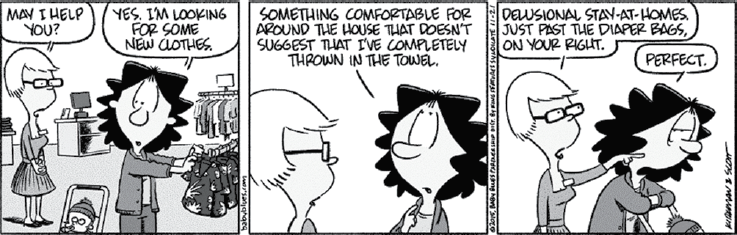
http://babyblues.com/comics/november-21-2015/
From this strip, it is possible to infer that:
Questão 17 403315
Mackenzie 2018/1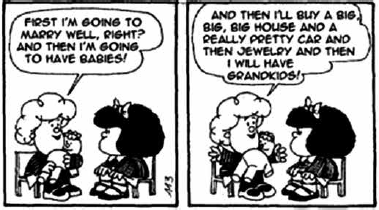
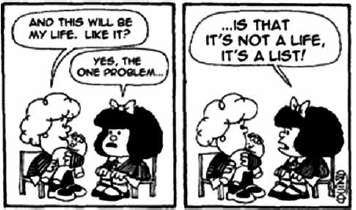
https://www.peruforless.com/blog/cultural-vibes-mafalda-the-comic-strip-character-fromargentina/
Considering the dialogues in this strip, mainly in the first and second boxes, the use of will and going to to express future can be explained by:
Questão 15 403308
Mackenzie 2018/1Spoilers
One fateful summer evening, I hurried home from work, eager to catch up on “Game of Thrones.” I don’t have cable, so I often watch my shows a day or two after they air, usually via some streaming service or an app. At the time, I had become an obsessive avoider of spoilers, the kind of person who stayed off Instagram and Twitter during live episodes of popular shows, even going so far as to turn off notifications to avoid reading about a reveal or twist that would ruin a surprise.
That night, blissfully unaware of what was to come, I switched on my television, expecting to be greeted with the medieval tones and threedimensional map of Westeros that signal the show’s start. Instead, I was confronted by a massacre: This episode was “The Rains of Castamere”, popularly known as the Red Wedding. Some friends and I shared an account, so the episode began where the previous person stopped watching, at the precise moment a pregnant character is stabbed in the stomach. I felt as if I had been stabbed in the stomach. I had invested nearly 30 hours into one of the biggest buildups of modern television only to have it — and my preciousness about spoilers — ruined.
The celebrated film critic Pauline Kael once wrote that movies function as escape pods, portals to parallel universes that can be radically different from emotional norms and societal conditioning of our own. What she meant was they parceled out freedom, allowing viewers to lose their selves in an effort to find greater connection to the self. “A good movie can make you feel alive again, in contact, not just lost in another city,” she wrote in 1969.
Since then, movies — and now, increasingly, television shows — have become even more intense and immersive, ensuring that we lose ourselves more freely in them. Today’s directors aim for attention totality in order to capture easily distracted audiences. A 2015 study conducted in part by James Cutting, a psychologist at Cornell University found that filmmakers have adapted their shooting styles to try to keep up with changes in our attention spans. And maybe it works — for adrenaline junkies. But losing myself in a film almost guarantees an anxiety attack. Most times, at the movies, my stress levels are ratcheted up so high that I can barely sit through the full production without excusing myself, clutching people next to me or crawling out of my seat, incapacitated by the unknown.
Yet I love TV and movies, so in order to keep watching, I started spoiling them for myself. Spoilers have become a virtual Xanax, triggering a relaxing sensation that envelops my entire body – luckily, the internet has made my habit easy. I’m not a total barbarian: I never divulge endings or let on that I know them. There’s even some evidence that the audience’s enjoyment is heightened when they have a sense of what’s going to happen. Once I’m clued in, I can actually let myself be spirited away, as the directors and screenwriters intended, enjoying the things I’m normally too wired to enjoy. The more films and TV shows I spoil for myself, the more I am convinced that truly interesting stories can’t be ruined — the plot thickens with the viewing like a rich sauce.
Kael wrote that “when we go to the movies, we want something good, something sustained, we don’t want to settle for just a bit of something, because we have other things to do.” This is what entertainment has most to offer. My only condition is doing it without raising my blood pressure.
Source: The NYT Magazine, Feb., 2018.
In the sentence “I felt as if I had been stabbed in the stomach”, we should understand the narrator meant that:
Questão 14 403303
Mackenzie 2018/1Spoilers
One fateful summer evening, I hurried home from work, eager to catch up on “Game of Thrones.” I don’t have cable, so I often watch my shows a day or two after they air, usually via some streaming service or an app. At the time, I had become an obsessive avoider of spoilers, the kind of person who stayed off Instagram and Twitter during live episodes of popular shows, even going so far as to turn off notifications to avoid reading about a reveal or twist that would ruin a surprise.
That night, blissfully unaware of what was to come, I switched on my television, expecting to be greeted with the medieval tones and threedimensional map of Westeros that signal the show’s start. Instead, I was confronted by a massacre: This episode was “The Rains of Castamere”, popularly known as the Red Wedding. Some friends and I shared an account, so the episode began where the previous person stopped watching, at the precise moment a pregnant character is stabbed in the stomach. I felt as if I had been stabbed in the stomach. I had invested nearly 30 hours into one of the biggest buildups of modern television only to have it — and my preciousness about spoilers — ruined.
The celebrated film critic Pauline Kael once wrote that movies function as escape pods, portals to parallel universes that can be radically different from emotional norms and societal conditioning of our own. What she meant was they parceled out freedom, allowing viewers to lose their selves in an effort to find greater connection to the self. “A good movie can make you feel alive again, in contact, not just lost in another city,” she wrote in 1969.
Since then, movies — and now, increasingly, television shows — have become even more intense and immersive, ensuring that we lose ourselves more freely in them. Today’s directors aim for attention totality in order to capture easily distracted audiences. A 2015 study conducted in part by James Cutting, a psychologist at Cornell University found that filmmakers have adapted their shooting styles to try to keep up with changes in our attention spans. And maybe it works — for adrenaline junkies. But losing myself in a film almost guarantees an anxiety attack. Most times, at the movies, my stress levels are ratcheted up so high that I can barely sit through the full production without excusing myself, clutching people next to me or crawling out of my seat, incapacitated by the unknown.
Yet I love TV and movies, so in order to keep watching, I started spoiling them for myself. Spoilers have become a virtual Xanax, triggering a relaxing sensation that envelops my entire body – luckily, the internet has made my habit easy. I’m not a total barbarian: I never divulge endings or let on that I know them. There’s even some evidence that the audience’s enjoyment is heightened when they have a sense of what’s going to happen. Once I’m clued in, I can actually let myself be spirited away, as the directors and screenwriters intended, enjoying the things I’m normally too wired to enjoy. The more films and TV shows I spoil for myself, the more I am convinced that truly interesting stories can’t be ruined — the plot thickens with the viewing like a rich sauce.
Kael wrote that “when we go to the movies, we want something good, something sustained, we don’t want to settle for just a bit of something, because we have other things to do.” This is what entertainment has most to offer. My only condition is doing it without raising my blood pressure.
Source: The NYT Magazine, Feb., 2018.
Check the alternative that only brings phrasal verbs taken from the text:
Questão 13 401758
Mackenzie 2018/1It’s less precise than Fahrenheit — but that’s what’s so great about it
A little over a decade ago, I moved to Montreal expecting, perhaps foolishly, that I would become fluent in French. It was a goal that proved elusive — I just couldn’t master the Quebecois accent, which was almost inscrutably nasal compared with the Parisian French I learned in high school. I stuttered through one quotidian exchange after another, painfully aware I was marking myself as a clumsy outsider. It was exhausting. Somewhat chastened, I gave up on French and turned my attention to a new language: Celsius.
I gravitated toward Celsius for the same reason I had wanted to learn French: to experience the world through a foreign filter. Besides, I didn’t really have a choice. Montreal is a bilingual city, but it uses just one temperature scale: Celsius. Of course, the same is true in every country aside from the United States and a few other global superpowers like the Cayman Islands and Belize. Using Fahrenheit in Canada was a sure way to brand myself not only as a recalcitrant American but also as a maniac.
My hope was to internalize Celsius, not just to learn it but to feel it in my American flesh. The first thing I did to acquaint myself with it was to memorize relative temperatures scattered throughout the scale so I could extrapolate from them. I was already aware, as most people are, that what I knew as 32 was 0, but I also came up with a few useful way stations: 10 in Celsius was 50 Fahrenheit; 21 was 70; 30 was 86. With this loose constellation of data points, I could safely guess that 15 degrees C, say, was about 60 degrees F, without constantly cross-referencing between the scales.
When I started walking around with Celsius in my head, I noticed that such minor gradations don’t really matter — it was hot, or it was cold, or it was neither. I would survive. There was something psychically soothing about that.
This was especially true in Montreal, that giant ice floe of an island whose winters are so brutal that Celsius often served, for me, as a kind of safeguard against overreaction. When I saw that it was -10 degrees C, for example, I somehow took comfort in the notion that that was really just 14 degrees F, even though each scale was measuring the same thing. The shield held for the most part, except on those rare mornings when the air temperature nose-dived to around 40 below, where Celsius and Fahrenheit finally collide.
When I moved back to the United States about seven years ago, I got an iPhone and changed my weather app to Celsius. It annoyed my friends, who thought I was being pretentious (I was). Still, I think there was more to it than that. Being around people who used Fahrenheit made me feel as if it were sort of extreme.
I don’t mean to be dramatic. I wasn’t losing my mind. Far from it. After years of compulsively checking the weather multiple times a day, what happened was I started trusting my instincts and abandoned the forecast altogether. Celsius, I came to realize, had put me in touch with nature; it had forced me to spend my time walking around feeling the temperature without feeling the scale I was using to gauge the temperature.
In my heathen state, I’ve come to believe that all temperature scales are, for daily reference, sort of useless, or at least unnecessary. They present the semblance of control over your immediate environment, and yet they also distance you from experiencing the world unfiltered by some random metric. The weather is much less worrisome, I’ve found, when you aren’t constantly taking its temperature.
Source: The NYT Magazine, Feb. 28, 2018.
In the extract “They present the semblance of control over your immediate environment (…)”, the word semblance means:
06