


![[Marketing] Questao Topo - deslogado](https://storage.estuda.com.br/banners/0_6b7ebee90b03af1c560c73bb8bcce34a_banner_deslogado_70_dias.png)
Questões de Inglês
19.971 Questões
Questão 23 800587
USF 2018/1Read the text carefully.
Glasgow School of Art project personalises prosthetic limbs
21 August 2017
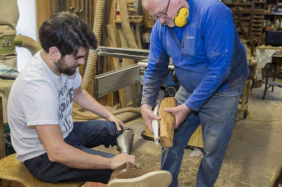
Craftspeople have been working with amputees who use artificial lower limbs to create more personalised prosthesis.
Jeroen Blom, a researcher at Glasgow School of Art's Highlands and Islands Creative Campus, ² brought the team of three artisans together.
They are Karen Collins, from Rafford, and Scott Gleed, of Relugas, both in Moray, and Roger Milton, from Auldearn in the Highlands.
They are working with three people who use prosthetic limbs.
Among the materials being used to make what are known as greaves is wood, while the skills involved include weaving.
Mr Blom said: 5"Through this project three lower limb amputees have been able to have a full involvement in the creation of something very personal and unique to them and in so doing had a much greater sense of involvement and ownership."
"For the artisans, meanwhile, this has been an opportunity to apply and showcase their skills in a new area and to create very special partnerships with their collaborators in the co-design process.
"The aesthetics of the ¹resulting greaves reflect the identity of the amputee as well as the artisanal process."
One of the amputees, Caitlin McMullan, said discussions about her use of a prosthetic limb influenced the design work.
She said: "We spoke a bit about my experience of being an amputee, and my experience of before my amputation.
"It was good to think about the design of that, and talk about how I think the design is disabilityawareness as well."
She added: 6 "I like having choice, I like changing what my prosthesis would look like.
"I don't like to cover it up. I don't really see the point in ³ trying to hide it. That's what I like about this project. It's making something really nice out of a prosthesis."
Chema Perez, who along with Carol Sloan is another of the amputees, worked with craftsman Mr Milton on a wooden greave.
Mr Perez said: "The idea Roger had about having a piece of wood which is not really nice and shiny but something that has some marks of imperfection that tells you a story, was something that I was looking for. 7Something that reflects my experience to make it more personal."
4The art school's Highlands and Islands campus is in Forres in Moray. Students and researchers use it as a base for studies in the Highlands and Islands.
Available in: http://www.bbc.com/news/uk-scotland-highlands-islands-40962175. Access in: 11/10/2017. (Adapted).
Read the text again and choose the correct alternative.
Questão 21 800535
USF 2018/1Read the Ad carefully.
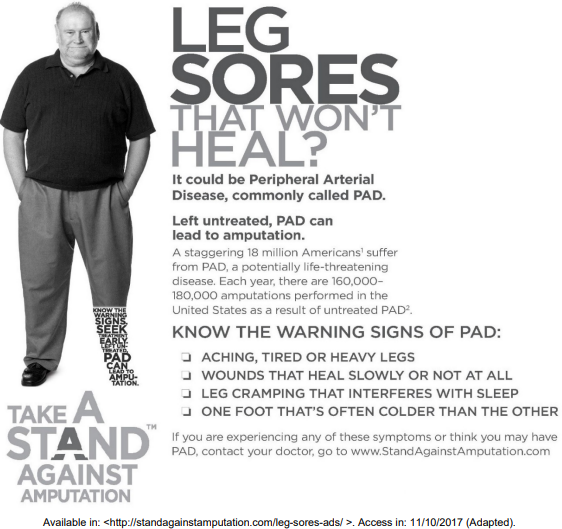
Analyze the information from the newspaper ad targeted at patients with leg sores, and choose the correct alternative.
Questão 22 800115
USF 2018/2Read the text carefully.
First human cells grown in sheep embryos in organ donation breakthrough
By Staff Reporter Sunday 18 February 2018 23:40 GMT
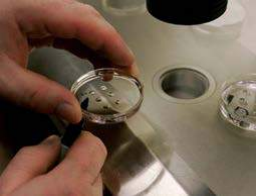
Scientists say they have grown sheep embryos containing human cells, marking a significant step towards cultivating human organs in animals.
It is hoped growing the body parts in animals could not only reduce transplant waiting lists but also lower the transplant rejection rates because they could be grown with a patient's own cells.
Scientists have long attempted to grow organs of one species inside another and have previously successfully grown a rat pancreas inside a mouse.
Last year, scientists from the University of California created human-pig hybrid embryos in which about one in every 100,000 cells was human.
The same team this week announced they had achieved similar sheep embryos, in which around one in every 10,000 cells was human.
The scientists say they are already ¹ able to genetically modify pig and sheep embryos so the animals are unable to develop a pancreas. The hope is that implanting human cells in such embryos would result in the animal growing a human pancreas.
The embryos are currently only allowed to develop for 28 days and researchers say they would like to extend the deadline to get a better idea of how the cells go on to specialize.
2 “We have already generated a mouse pancreas in rats and then transplanted those in to a diabetic mouse and were 3 able to show almost a complete cure without any immunosuppressants,” Dr Hiro Nakuachi, who is leading the research, told the American Association for the Advancement of Science in Austin, Texas.
“When it comes to human-sheep it seems more difficult. So we would like to proceed a little longer and this time use organ-deficient embryos.
“It could take five years or it could take 10 years but I think eventually we will be able to do this.”
Certain organs in pigs and sheep are similar in size to those in humans, making them suitable animals on which to carry out the tests.
Retrieved from https://www.independent.co.uk/news/science/sheep-embryos-human-cells-hybrid-organ-donation-breakthrougha8216821.html (adaptado).
Consider the statements about the text and choose the alternative in which there are only correct propositions.
I. One of the research intentions is growing human organs inside animals and reduce transplant waiting lists.
II. Dr. Hiro Nakuachi, responsible for the research, created human-pig hybrid embryos with 100,000 cells and realized the procedure will take a little longer to be approved.
III. According to the research, pigs and sheep will take from five to 10 years to be suitable animals on which to carry out the tests about the pancreas.
IV. Using the patient’s own cells to be cultivated inside another species until they become organs for transplants, makes the researchers believe that the transplant rejection rates can be lower.
Mark the correct alternative.
Questão 21 800092
USF 2018/2Read the infographic carefully.
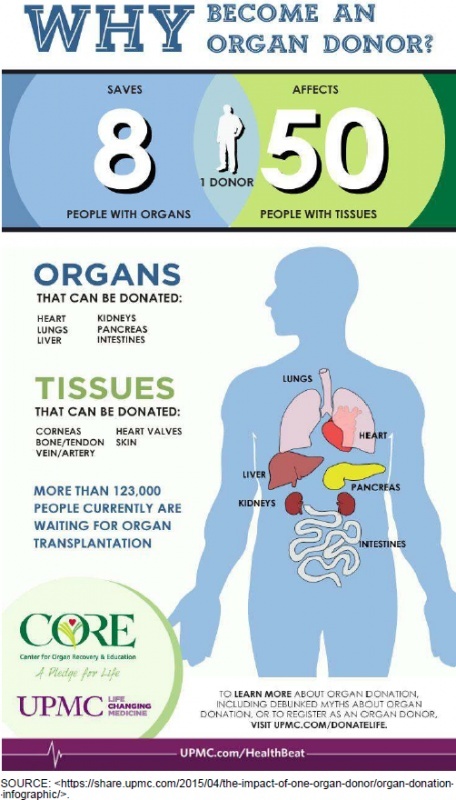
Analyze the information from the organ-donation-infographic, and choose the correct alternative.
Questão 60 792764
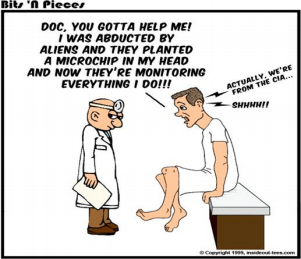
UNIPAM 2018Analyzing the comic, we can infer that
Questão 59 792750
UNIPAM 2018Read the second part of The surprising truths and myths about microchip implants and answer question.
The tech is nothing new
''It is pretty easy to pick up this kind of information on a person without an implant,'' says Kevin Warwick, a professor of cybernetics and deputy vice-chancellor at Coventry University, who became one of the first people in the world to have an RFID chip surgically implanted into his forearm in 1998. RFID technology is already attached to cargo, aeroplane baggage and products in shops. It‘s used to microchip pets. Many of us carry it around with us all day in our wallets: most modern mobile phones are equipped with RFID, as are contactless cards, many metropolitan travel cards, and e-passports.
It‘s not a huge leap from having this technology in our pockets to having it under our skin. ''The key point is it should be a choice for each individual,'' cautions Warwick. ''If a company says we will only give you a job if you have such an implant, it raises ethical issues.''
It is also worth remembering almost all of us carry a device with us every day that sends far more information about our movements and daily behaviour to companies like Google, Apple and Facebook than a RFID implant ever could.
''Mobile phones are much more dangerous to our privacy,'' says Pawel Rotter, a biomedical engineer at AGH University of Science and Technology in Kraków, Poland. ''If hacked, phones can convert into the perfect spy with microphones, cameras and GPS. Compared to them, the privacy risks from RFID are really small.''
Surveillance concerns about the chip on the back of his hand don‘t worry Dave Williams as it can only be activated if placed a few centimetres from a reader. ''Fears of GPSstyle tracking are strictly science fiction at this point,'' he says. He is also keen to emphasise that the procedure to implant it isn‘t as gruesome as some might imagine.
Williams installed his chip himself, using plenty of iodine to keep everything sterile. ''There was almost no pain at all,'' he says. ''Removing the tag will be a little harder, but with a scalpel and pair of tweezers it's not a huge job.''
Hacking and security concerns, however, are less easily hand-waved away. RFID chips can only carry a minuscule 1 kilobyte or so of data, but one researcher at Reading University‘s School of Systems Engineering, Mark Gasson, demonstrated that they are vulnerable to malware.
Gasson had an RFID tag implanted in his left hand in 2009, and tweaked it a year later so that it would pass on a computer virus. The experiment uploaded a web address to the computer connected to the reader, which would cause it to download some malware if it was online.
''It was actually a surprisingly violating experience,'' says Gasson. ''I became a danger to the building‘s systems.''
While regular workplace entry cards can be hacked too, the very attribute of an RFID implant that makes it so convenient – the fact
that it can't be forgotten or left at home – is also its biggest drawback. When a subcutaneous gadget goes wrong, the experience can be far more harrowing.
''Implantable technology can‘t be easily removed or in this case even switched off,'' Gasson says. ''I felt like the implant was a part of my body, so there was a real feeling of helplessness when things weren‘t right.''
(Adapted from: http://www.bbc.com).
In the sentence ''While regular workplace entry cards can be hacked too, the very attribute of an RFID implant that makes it so convenient – the fact that it can't be forgotten or left at home – is also its biggest drawback'', the word ''drawback'' can be replaced by
06