


![[Marketing] Questao Topo - deslogado](https://storage.estuda.com.br/banners/0_6b7ebee90b03af1c560c73bb8bcce34a_banner_deslogado_70_dias.png)
Questões de Inglês
19.971 Questões
Questão 9 961387
UEA - SIS 3ª Etapa 2018Leia o texto para responder à questão.
Plastic-eating bacteria discovered by student could help solve global pollution crisis

A student may have found a solution to one of the world’s most urgent environmental crises – breeding bacteria capable of “eating” plastic and potentially breaking it down into harmless by-products. The microbes degrade polyethylene terephthalate (PET) – one of the world’s most common plastics, used in clothing, drinks bottles and food packaging. It takes centuries to break down, in the meantime doing untold damage to its surroundings.
Morgan Vague, who is studying biology at Reed College in Oregon, said the process could play a “big part” of solutions to the planet’s plastic problem, which sees millions of tonnes dumped in landfill and oceans every year. Around 300 million tonnes of plastic is discarded each year, and only about 10 per cent of it is recycled.
She began hunting for microbes adapted to degrade plastic in the soil and water around refineries in her hometown of Houston. Taking her samples back to college in Portland, Oregon, Ms Vague began testing around 300 strains of bacteria for lipase, a fat-digesting enzyme potentially capable of breaking down plastic and making it palatable for the bacteria. She identified 20 strains of bacteria that produced lipase, and of those, three that boasted high levels of the enzyme. Next, she put the three microbes, one of which appears to have been previously undiscovered, on a forced diet of PET she cut from strips of water bottles. She was stunned to find the bacteria worked to digest the plastic.
(Tom Embury-Dennis. www.independent.co.uk, 30.06.2018. Adaptado.)
De acordo com o texto, o PET
Questão 69 928243
PUC-RS Verão 2018INSTRUÇÃO: Responder à questão com base no texto, que apresenta comentários de especialistas sobre o gráfico.
TEXT
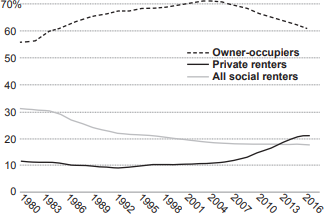
Comment 1 – (…) the proportion of the population living in their own home has gone into decline. It peaked around the middle of the last decade, at just over 70 per cent.
Comment 2 – Owner occupiers spend an average of 18 per cent on their mortgage. That average may be misleading – those who’ve paid off their mortgage will be zilch. At least they’re building up an asset.
Comment 3 – The proportion in council homes has fallen too, thanks largely to Right to Buy. As a result, the proportion renting their own home has more than doubled in the last two decades, from under 10 per cent to over 20.
Comment 4 – (…) housing which costs more than 30 per cent of your income should count as unaffordable. This is a problem faced overwhelmingly by young renters.
Comment 5 – Soon, the rates of the population living in their own home will be back under 60 per cent, for the first time since the mid 1980s.
Adapted from: http://www.citymetric.com/politics/british-housing-crisis-five-charts
Read these assertions.
I. The word “living”, in the context of comment 1, plays the same grammatical function as in How do young people make a living in London?
II. If the grammatical structure “may be misleading” (comment 2) were in reported speech, it would be: The expert said that average might mislead.
III. By reading comment 3, one can say that some people who had the opportunity to buy their houses from the council are now renting them to others.
IV. “(…) should count as unaffordable”. (comment 4) means are to be considered financially unfeasible.
V. By reading comment 5, one can say that the population living in their own home did not reach 60 per cent in 1980.
The correct assertions are only
Questão 68 928242
PUC-RS Verão 2018INSTRUÇÃO: Responder à questão com base no texto, que apresenta comentários de especialistas sobre o gráfico.
TEXT
Comment 1 – (…) the proportion of the population living in their own home has gone into decline. It peaked around the middle of the last decade, at just over 70 per cent.
Comment 2 – Owner occupiers spend an average of 18 per cent on their mortgage. That average may be misleading – those who’ve paid off their mortgage will be zilch. At least they’re building up an asset.
Comment 3 – The proportion in council homes has fallen too, thanks largely to Right to Buy. As a result, the proportion renting their own home has more than doubled in the last two decades, from under 10 per cent to over 20.
Comment 4 – (…) housing which costs more than 30 per cent of your income should count as unaffordable. This is a problem faced overwhelmingly by young renters.
Comment 5 – Soon, the rates of the population living in their own home will be back under 60 per cent, for the first time since the mid 1980s.
Adapted from: http://www.citymetric.com/politics/british-housing-crisis-five-charts
The comments conveying ideas that have a representation on the graph are only
Questão 67 928227
PUC-RS Verão 2018INSTRUÇÃO: Responder à questão com base no texto.
TEXT
London: the city that ate itself
London is a city ruled by money. The things that
make it special – the markets, pubs, high streets and
communities – are becoming unrecognisable. The
city is suffering a form of entropy whereby anything
[5] distinctive is converted into property value. Can the
capital save itself?
London is without question the most popular city
for investors,” says Gavin Sung of the international
property agents Savills. “There is a trust factor. It
[10] has a strong government, a great legal system, the
currency is relatively safe. It has a really nice lifestyle”.
There are parks, museums and nice houses. Its arts
of hedonism are reaching unprecedented levels: its
restaurants get better or at least more ambitious and
[15] its bars offer cocktails previously unknown to man. In
some ways, the city has never been better. It has a
buzz. Its population keeps growing and investment
keeps ______, both signs of its desirability. As its
mayor likes to boast: “London is to the billionaire as
[20] the jungles of Sumatra are to the orangutans. It is their
natural habitat.”
At the same time, to use a commonly heard phrase,
the city is eating itself. Most obviously, its provision of
housing is failing to ______ its popularity, with effects
[25] on price that breed bizarre reactions at the top end
of the market and misery at the bottom. Thousands
are being forced to leave London because their local
authorities can’t find them homes and people on middle
incomes can’t acquire a place where anyone would
[30] want to raise a family.
There are also effects beyond housing, although often
driven by residential property prices. The spaces for
work that are an essential part of the city’s economy
are being squeezed, its high streets diminished, its
[35] pubs and other everyday places closing. It is suffering
a form of entropy whereby the distinctive or special is
converted into property values. Its essential qualities,
which are that it was not polarised on the basis
of income, and that its best places were common
[40] property, are being eroded. (…)
This would matter less if the city were making new
places with the qualities of those now packaged up
and commodified – if the supply of good stuff _____
expanding – but it _____ not. Although the cranes
[45] swing, much of the new living zones now _____ created
range from the ho-hum to the outright catastrophic. The
skyline _____ plundered for profit, but without creating
towers to be proud of or making new neighbourhoods
with any positive qualities whatsoever. If London is an
[50] enormous party, millions of people are on the wrong
side of its velvet rope.
In the rest of Britain, a common view of London is
that it is a parasitic monster or, as Alex Salmond
put it, quoting Tony Travers of the London School of
[55] Economics: “The dark star of the economy, inexorably
sucking in resources, people and energy. Nobody quite
knows how to control it.” Both the SNP and Ukip can
be seen as anti-London parties, as expressions of a
feeling that national decisions are made in the capital,
[60] by the capital, for the capital. Those Scots who want
independence are less concerned about being part of
the same country as Middlesbrough or Ipswich than
they are about London. But these views overlook the
extent to which the city is feeding on its own.
Adapted from: https://www.theguardian.com/uk-news/2015/ jun/28/london-the-city-that-ate-itself-rowan-moore
Read paragraph 6 and mark the following sentences T (true) or F (false).
( ) Scots used to see Middlesbrough and Ipswich as Tony Travers did.
( ) The SNP and Ukip despise London’s decision power.
( ) Alex Salmond and Tony Travers do not share the same opinion.
( ) The author thinks that not all views are concerned about how much London is eating itself.
Choose the alternative that presents the correct answers, from top to bottom, for the sentences above.
Questão 66 928225
PUC-RS Verão 2018INSTRUÇÃO: Responder à questão com base no texto.
TEXT
London: the city that ate itself
London is a city ruled by money. The things that
make it special – the markets, pubs, high streets and
communities – are becoming unrecognisable. The
city is suffering a form of entropy whereby anything
[5] distinctive is converted into property value. Can the
capital save itself?
London is without question the most popular city
for investors,” says Gavin Sung of the international
property agents Savills. “There is a trust factor. It
[10] has a strong government, a great legal system, the
currency is relatively safe. It has a really nice lifestyle”.
There are parks, museums and nice houses. Its arts
of hedonism are reaching unprecedented levels: its
restaurants get better or at least more ambitious and
[15] its bars offer cocktails previously unknown to man. In
some ways, the city has never been better. It has a
buzz. Its population keeps growing and investment
keeps ______, both signs of its desirability. As its
mayor likes to boast: “London is to the billionaire as
[20] the jungles of Sumatra are to the orangutans. It is their
natural habitat.”
At the same time, to use a commonly heard phrase,
the city is eating itself. Most obviously, its provision of
housing is failing to ______ its popularity, with effects
[25] on price that breed bizarre reactions at the top end
of the market and misery at the bottom. Thousands
are being forced to leave London because their local
authorities can’t find them homes and people on middle
incomes can’t acquire a place where anyone would
[30] want to raise a family.
There are also effects beyond housing, although often
driven by residential property prices. The spaces for
work that are an essential part of the city’s economy
are being squeezed, its high streets diminished, its
[35] pubs and other everyday places closing. It is suffering
a form of entropy whereby the distinctive or special is
converted into property values. Its essential qualities,
which are that it was not polarised on the basis
of income, and that its best places were common
[40] property, are being eroded. (…)
This would matter less if the city were making new
places with the qualities of those now packaged up
and commodified – if the supply of good stuff _____
expanding – but it _____ not. Although the cranes
[45] swing, much of the new living zones now _____ created
range from the ho-hum to the outright catastrophic. The
skyline _____ plundered for profit, but without creating
towers to be proud of or making new neighbourhoods
with any positive qualities whatsoever. If London is an
[50] enormous party, millions of people are on the wrong
side of its velvet rope.
In the rest of Britain, a common view of London is
that it is a parasitic monster or, as Alex Salmond
put it, quoting Tony Travers of the London School of
[55] Economics: “The dark star of the economy, inexorably
sucking in resources, people and energy. Nobody quite
knows how to control it.” Both the SNP and Ukip can
be seen as anti-London parties, as expressions of a
feeling that national decisions are made in the capital,
[60] by the capital, for the capital. Those Scots who want
independence are less concerned about being part of
the same country as Middlesbrough or Ipswich than
they are about London. But these views overlook the
extent to which the city is feeding on its own.
Adapted from: https://www.theguardian.com/uk-news/2015/ jun/28/london-the-city-that-ate-itself-rowan-moore
The sentence that would end paragraph 4 is
Questão 65 928222
PUC-RS Verão 2018INSTRUÇÃO: Responder à questão com base no texto.
TEXT
London: the city that ate itself
London is a city ruled by money. The things that
make it special – the markets, pubs, high streets and
communities – are becoming unrecognisable. The
city is suffering a form of entropy whereby anything
[5] distinctive is converted into property value. Can the
capital save itself?
London is without question the most popular city
for investors,” says Gavin Sung of the international
property agents Savills. “There is a trust factor. It
[10] has a strong government, a great legal system, the
currency is relatively safe. It has a really nice lifestyle”.
There are parks, museums and nice houses. Its arts
of hedonism are reaching unprecedented levels: its
restaurants get better or at least more ambitious and
[15] its bars offer cocktails previously unknown to man. In
some ways, the city has never been better. It has a
buzz. Its population keeps growing and investment
keeps ______, both signs of its desirability. As its
mayor likes to boast: “London is to the billionaire as
[20] the jungles of Sumatra are to the orangutans. It is their
natural habitat.”
At the same time, to use a commonly heard phrase,
the city is eating itself. Most obviously, its provision of
housing is failing to ______ its popularity, with effects
[25] on price that breed bizarre reactions at the top end
of the market and misery at the bottom. Thousands
are being forced to leave London because their local
authorities can’t find them homes and people on middle
incomes can’t acquire a place where anyone would
[30] want to raise a family.
There are also effects beyond housing, although often
driven by residential property prices. The spaces for
work that are an essential part of the city’s economy
are being squeezed, its high streets diminished, its
[35] pubs and other everyday places closing. It is suffering
a form of entropy whereby the distinctive or special is
converted into property values. Its essential qualities,
which are that it was not polarised on the basis
of income, and that its best places were common
[40] property, are being eroded. (…)
This would matter less if the city were making new
places with the qualities of those now packaged up
and commodified – if the supply of good stuff _____
expanding – but it _____ not. Although the cranes
[45] swing, much of the new living zones now _____ created
range from the ho-hum to the outright catastrophic. The
skyline _____ plundered for profit, but without creating
towers to be proud of or making new neighbourhoods
with any positive qualities whatsoever. If London is an
[50] enormous party, millions of people are on the wrong
side of its velvet rope.
In the rest of Britain, a common view of London is
that it is a parasitic monster or, as Alex Salmond
put it, quoting Tony Travers of the London School of
[55] Economics: “The dark star of the economy, inexorably
sucking in resources, people and energy. Nobody quite
knows how to control it.” Both the SNP and Ukip can
be seen as anti-London parties, as expressions of a
feeling that national decisions are made in the capital,
[60] by the capital, for the capital. Those Scots who want
independence are less concerned about being part of
the same country as Middlesbrough or Ipswich than
they are about London. But these views overlook the
extent to which the city is feeding on its own.
Adapted from: https://www.theguardian.com/uk-news/2015/ jun/28/london-the-city-that-ate-itself-rowan-moore
Which alternative below explains the idea underlined in the sentence “This would matter less if the city were making new places with the qualities of those now packaged up and commodified...” (lines 41 to 43)?
06