


![[Marketing] Questao Topo - deslogado](https://storage.estuda.com.br/banners/0_6b7ebee90b03af1c560c73bb8bcce34a_banner_deslogado_70_dias.png)
Questões de Inglês
19.971 Questões
Questão 59 1531473
PUC-PR Inverno - Demais Cursos 2018Read the text.
Barack Obama Calls for ‘Long Overdue’ Gun Control After Florida School Shooting
By ALANA ABRAMSON
Former President Barack Obama took to Twitter Thursday, not only to offer his sympathy for the victims of Wednesday’s school shooting in Florida, but to call for stronger gun control measures — something he had unsuccessfully tried to do during his presidency.
“We are grieving with Parkland. But we are not powerless. Caring for our kids is our first job,” Obama wrote on Twitter. “And until we can honestly say that we’re doing enough to keep them safe from harm, including long overdue, common-sense gun safety laws that most Americans want, then we have to change.”
Obama’s brief statement was a contrast to that of President Trump, who addressed the nation Thursday but did not mention anything about gun control.
Obama, who was President during national tragedies like the 2012 elementary school shooting in Newtown, Connecticut and the 2015 shooting at the Emanuel AME Church in Charleston, South Carolina, repeatedly stressed the need for stronger gun control measures, but his efforts were rebuffed by Congress. In January 2016, the start of his final year in office, he unveiled a series of executive actions aimed at curbing gun violence, requiring that anyone selling firearms have a license and conduct a background check on people who want to buy them.
Available at: http://time.com/5160791/obama-florida-school-shooting/?xid=homepage. Access on: February 2018.
Read the text and check the CORRECT option:
I. President Obama believes in stronger gun control laws.
II. President Obama never tried to have stricter gun control during his presidency.
III. Obama addressed both the grieving of the American people and stricter gun control on his short statement.
IV. There were no gun shooting tragedies during his government.
V. Obama tried to impose stricter laws, but had no help from Congress.
Questão 58 1531469
PUC-PR Inverno - Demais Cursos 2018Read the text.
Fake news is still a problem. Is AI the solution?
Human fact-checkers can't keep up with the flood of fraudulent stories, images, and videos.
by David Cox
Fake news is fueled in part by advances in technology — from bots that automatically fabricate headlines and entire stories to computer software that synthesizes Donald Trump’s voice and makes him read tweets to a new video editing app that makes it possible to create authentic-looking videos in which one person’s face is stitched onto another person’s body.
But technology, in the form of artificial intelligence, may also be the key to solving the fake news problem — which has rocked the American political system and led some to doubt the veracity even of reports from long-trusted media outlets.
Experts say AI systems would help fill the gaps left by Snopes, Truth or Fiction, and other online fact-checking outlets, whose human fact-checkers lack the bandwidth to evaluate every article that appears online. These systems could also work with various fake news alert plugins available from Google’s web store, such as the browser extension, This is Fake, which uses a red banner to flag debunked news stories on your Facebook newsfeed
“All of the current systems for tracking fake news are manual, and this is something we need to change as the earlier you can highlight that a story is fake, the easier it is to prevent it going viral,” says Delip Rao, founder of the San Francisco-based AI research company Joostware and organizer of the Fake News Challenge, a competition set up within the AI community to foster development of tools that can reliably spot fake content.
Available at: https://www.nbcnews.com/mach/science/fake-news-still-problem-ai-solution-ncna848276. Access on: February 2018.
According to the text, read the options and choose the CORRECT alternative.
I. Technology with certain computer programs as bots and video editing apps fuel fake news nowadays.
II. Long-trusted media outlets and forms of artificial intelligence can solve some fake news problems.
III. Human fact-checkers are not capable to evaluate if articles are fake or not.
IV. Developing current systems, as they are still manual, will help to point out if a story is fake or not.
Questão 57 1531445
PUC-PR Inverno - Demais Cursos 2018Read the text.
Driverless Cars Coming Soon
You are driving to school. You look up to see a pretty, hot air balloon. Whoa! You almost went through a stop sign! In a driverless car, you can look at the balloon. The car 1_________ the stop sign without your help and 2________ the car. Car makers and others are already testing driverless cars or AVs (automated vehicles) in the U.S. and other countries. Some companies are working together on driverless technology. Intel (USA) is working with BMW (Germany) and Mobileye (Israel) on a driverless car. Google (USA) and Nissan (Japan) are making their own driverless cars. In the U.S. car makers can test AVs in Florida, California, Nevada, and the District of Columbia. Driverless cars may be for sale by 2025!
Google’s name for its driverless system is “chauffeur.” It’s a good name because a chauffeur is a person who 3_________ your car and takes you places. Google’s chauffeur system drives your car and 4_________ you places, but it is not a person! The Google chauffeur system takes the place of the human chauffeur.
Most cars already have some driverless technology like the Anti-Lock Braking System (ABS). When a car is slipping on an icy road, the ABS can tap the brakes quickly. The wheels turn slowly but do not stop. The driver can then steer the car to safety.
Many cars also have parallel parking technology. These cars can park themselves along a street. No driver is needed. As cars get more driverless technology, they will be safer than cars with a driver. Driverless cars can move closer together on the road than cars with drivers. This may make driving on busy roads safer. Also, AVs don’t get sleepy or text on their phones while driving. Google’s driverless cars have been on the road since 2009 without a major crash.
A driverless car can see the road better than people with the help of radar, cameras, and lasers. Radar 5__________ the car see things up to 100 meters away even in darkness or rain. Cameras help the car see objects that are close. Lasers that work like radar, called lidar, spin on the roof and build a 3D model of the world around the car.
Automated vehicles use a GPS to find the best way from one place to another. All the information from the radar, cameras, lasers, and the GPS 6_________ to the Controller Area Network bus. A bus is a network that 7__________ all those devices talk to one another. The CAN bus 8___________ the information to steer the car and to tell the car to go or stop.
There are some problems with AVs. Hackers may take over the car. There will probably be fewer jobs for people who drive taxis and trucks. A robot taxi can find you and take you to your destination without a taxi driver. AV trucks may roll along highways without a truck driver.
In the future, both vehicles with drivers and vehicles without drivers may share the road. You will have a choice. You can be the driver of your car, or you can look out the window while the car drives you.
Available at: https://www.englishclub.com/reading/driverless-cars.htm. Access on: February 2018.
Complete the blanks with the CORRECT option of the verbs.
Questão 56 1531425
PUC-PR Inverno - Demais Cursos 2018Read the text.
Fighting salt and sugar cravings, with spicy food
By Lisa Drayer, CNN
There's no magic pill that will cure you of your cravings. But there is something that may help the effort, and it's all-natural.
Research has shown that simply spicing up your diet may help you consume less salt and possibly less sugar, while potentially improving your health even beyond the reduction of salt and sugar.
There is more consistent evidence that spicy food helps curb salt cravings than sugar.
In a study involving more than 600 people from China 1whose brains were analyzed with PET/CT scans, researchers found that regions stimulated by intake of both salty and spicy foods overlapped. Because of similar activities taking place in this shared space (think of the overlapping parts of a Venn diagram), consuming spicy foods effectively enhanced one's sensitivity to salt, thereby helping people crave and consume less salt.
"We think that spicy food can trick 2our brain when tasting salty food. It makes us taste the same (level of) saltiness even when a reduced amount of salt is actually consumed," said study author Dr. Zhiming Zhu, professor and director of the Department of Hypertension and Endocrinology at the Third Military Medical University in Chongqing, China.
In fact, researchers found that people who regularly enjoy spicy foods consumed 2.5 grams less salt in a day (that's 1,000 fewer milligrams of sodium) compared with 3those who typically steer clear of spice. They also had lower blood pressure.
It remains to be seen whether the findings can be replicated in other populations outside China, said Richard David Wainford, associate professor in the Department of Pharmacology at the Boston University School of Medicine, in an accompanying editorial. Still, "a lifestyle intervention that adds taste to the diet, in the form of extra spice and flavor, versus reduction of the pleasure given by the salt we add to our food, may have more success as a public health strategy to promote population-level dietary salt reduction," 4he added.
Spice may have the potential to curb sugar cravings too, though the evidence is mixed. In one study involving 40 students from Denmark, when chili pepper was added to sweet, sour and bitter meals, 5participants experienced a greater desire to eat sweet foods compared with meals without chili added.
In another study, also from Denmark, people experienced a decreased desire for salty and spicy foods when 6they ate tomato soup with cayenne pepper compared with eating the soup without pepper. But their desire for sweet and fatty foods significantly increased when they consumed the spicy soup.
Available at: https://edition.cnn.com/2017/11/17/health/spicy-salt-sugar-food-drayer/index.html. Access on: February 2018.
According to the highlighted words they refer to:
Questão 55 1531419
PUC-PR Inverno - Demais Cursos 2018Watch an illustration.
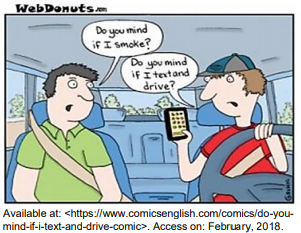
Reading the cartoon, which statement means the CORRECT option?
Questão 15 1530903
PUC-PR Medicina Inverno 2018Read the text.
World Obesity Day: Which countries have the biggest weight problem?
More than 603 million adults and 107 million children (out of a global population of around 7.5 billion) are obese, according to a report published earlier this year from the Institute of Health Metrics and Evaluation, based at the University of Washington in Seattle. That represents around five per cent of all children and 12 per cent of all adults.
But which nations have the highest levels of obesity?
Telegraph Travel took data from the CIA's World Factbook and, contrary to what some may believe, it is not the US that tops the chart, but rather American Samoa - an unincorporated territory of the US in the South Pacific - where a whopping 74.6 per cent are considered to be obese.
A slew of other South Pacific nations follow, including Nauru, Tonga, Samoa, Palau and Kiribati. In fact, Kuwait is the only country outside the region to feature in the top 10. There is a clear obesity problem in the South Pacific, with the weight of adults is increasing at four times the global average. Some have claimed the islanders are genetically predisposed to putting on weight, while a 2014 report suggested that colonial settlers, who taught them Western ways of eating - frying fish, for example, rather than eating it raw - are to blame.
http://www.telegraph.co.uk/travel/maps-and-graphics/the-most-obese-fattest-countries-in-the-world/
Assinale a alternativa que apresenta a causa fundamental apresentada pelo autor do texto para o aumento da obesidade.
06