


![[Marketing] Questao Topo - deslogado](https://storage.estuda.com.br/banners/0_6b7ebee90b03af1c560c73bb8bcce34a_banner_deslogado_70_dias.png)
Questões de Inglês
19.971 Questões
Questão 14 5342858
FAG Medicina 2018/1Text
We're living faster but are we living better?
Not Long Ago people believed that in the future we would work less, have more free time, and be more relaxed. But sadly this has not happened. Today we work harder, work longer hours, and are more stressed than ten years ago. We walk faster, talk faster, and sleep less than previous generations. And although we are obsessed with machines which save us time, we have less free time than our parents and grandparents had. But what is this doing to our health? An American journalist James Gleick in a new book, Faster: the Acceleration of just about everything, says that people who live in cities are suffering from 'hurry sickness'- we are always trying to do more things in less time. As a result, our lives are more stressful. He says that if we don't slow down, we won't live as long as our parents. For most people, faster doesn't mean better.
No time for the news
Newspaper articles today are shorter and the headlines are bigger. Most people don't have enough time to read the articles, they only read the headlines! On TV and the radio, newsreaders speak more quickly than ten years ago.
No time for stories
In the USA there is a book called One-Minute Bedtime Stories for children. These are shorter versions of traditional stories, specially written for 'busy parents' who want to save time!
No time to listen
Some answerphones now have 'quick playback' buttons so that we can re-play people's messages faster – we can't waste time listening to people speaking at normal speed!
No time to relax
Even when we relax we do everything more quickly. Ten years ago when people went to art galleries they spent ten seconds looking at each picture. Today they spend just three seconds!
No time for slow sports
In the USA the national sport, baseball, is not as popular as before because it is a slow game and matches take a long time. Nowadays many people prefer faster and more dynamic sports like basketball.
…but more time in our cars
The only thing that is slower than before is the way we drive. Our cars are faster but the traffic is worse so we drive more slowly. We spend more time sitting in our cars, feeling stressed because we are worried that we won't arrive on time. Experts predict that in ten years' time the average speed on the road in cities will be 17 km/h.
(OXFORD. NEW ENGLISH FILE, Pre-Intermediate, Student’s Book)
According to the text, mark true or false:
( ) Society are obsessed with machines which save us time and this is why we have less free time than our parents and grandparents had.
( ) In the USA, a book called One-Minute Bedtime Stories were made for 'busy parents', because they want to save time.
( ) Nowadays most people don't have enough time to read the articles. This is why the headlines are growing larger and the articles are ever smaller.
The CORRECT alternative respectively is:
Questão 13 5342849
FAG Medicina 2018/1Texto
Memória coletiva
Em 1925, quando a era das comunicações começava a se acelerar, o filósofo francês Maurice Halbwachs aventou a ideia de uma “memória coletiva”: o conjunto de lembranças que um grupo de pessoas compartilha sobre um evento marcante e que, somado a fatos e imagens de domínio público, forma um tecido muito mais extenso e bem tramado do que a simples soma das recordações individuais. Esse tecido é tão forte, aliás, que pode ser compartilhado até mesmo por gerações que não assistiram aos acontecimentos. É um fenômeno presente na maneira como os judeus lembram o Holocausto ou os americanos revivem a Guerra do Vietnã. Na vida brasileira, o ano de 1970 é um desses polarizadores da memória coletiva: o ano em que o país reuniu a mais brilhante escalação da história do futebol, em que esse time derrotou de maneira quase heroica cada um dos seus adversários [...], em que a população experimentou, na Copa do Mundo, seu primeiro grande evento de mídia – e também um ano em que a ditadura militar arrancava as pessoas de suas casas e sumia com elas, em que tudo era dito aos sussurros e em que essa euforia de uma torcida nacional foi usada como cortina de fumaça para o desgoverno e se misturou a ele. [...] E está aí, em boa medida, a beleza de O Ano em que Meus Pais Saíram de Férias (Brasil, 2006) [...]: na maneira como ele ao mesmo tempo separa e une esses dois fios da memória.
No começo de 1970, Mauro (Michel Joelsas), de 12 anos, é tirado às pressas de sua casa em Belo Horizonte e levado para o apartamento do avô, no bairro paulistano do Bom Retiro. Os pais, aflitos, dizem que estão saindo de férias e, quando puderem, voltarão para buscá-lo, de preferência a tempo de assistirem juntos à Copa. Vão-se embora sem conferir se o avô recebeu o menino em segurança. Mas ele não está em casa, nem vai voltar. Mauro vira então atribuição da vizinhança. Mora meio na casa vazia do avô, meio no apartamento ao lado, do velho Shlomo (Germano Haiut), zelador da sinagoga local – o Bom Retiro reunia então uma forte comunidade judaica, a que Mauro nem sabia pertencer. Janta com uma pessoa, almoça com outra, brinca com as crianças do bairro e, o tempo todo, mantém um olho grudado no futebol e o outro no telefone, à espera de uma ligação dos pais que não chega nunca. [...]
(BOSCOV, Isabela. Disponível em: http://arquivoetc.blogspot.com.br/2006/10/memria-coletiva.html.)
Segundo o texto, os brasileiros utilizaram a hashtag #Nessas48HorasEuVou (#Inthese48hoursIwill) para:
Questão 12 5342822
FAG Medicina 2018/1Text:
Brazil judge lifts WhatsApp suspension
A judge in Brazil has ordered that a suspension of the popular messaging application WhatsApp be lifted. Judge Xavier de Souza said the service should be re-instated immediately. A court had ordered the service be suspended for 48 hours on Thursday for failing to comply with a court order to provide investigators with information relating to a criminal court case.
Judge Souza said it was “not reasonable that millions of users be affected by the inertia of the company”. “Extreme ruling” Brazilians had complained bitterly on social media about the suspension of Whatsapp, which is a hugely popular app used by many to communicate with family, friends and colleagues both inside of Brazil and abroad. Ninety-three per cent of the country's internet population use Whatsapp, according to the TechCrunch website, with many young and poor Brazilians taking advantage of its free text message and internet telephone service.
Within hours of the suspension being coming into force, the hashtag #Nessas48HorasEuVou (#Inthese48hoursIwill) began trending on Twitter, with Brazilians joking about all the things they would do during the suspension. Impact of the WhatsApp ban - Paula K, a Brazilian living in London In a country where mobile providers charge a fortune for a monthly plan – not to mention the high cost of making international calls – the use of WhatsApp for both texts and internet calls allows expats like me to keep a direct line with family, friends or even colleagues back home.
It’s worth remembering that Brazil already has a high cost of living – services and products often cost the same price as they do in the UK – but people often only earn about a third of the wage they would here. One of my friends who works for one of the major mobile providers in Brazil said it was advising people to download alternative apps such as Viber and/or create a group on Messenger to keep the communication flowing. “I am stunned that our efforts to protect people’s data would result in such an extreme decision by a single judge to punish every person in Brazil who uses WhatsApp,” Mr. Zuckerberg wrote in a post on Facebook.
The suspension was ordered after WhatsApp failed to comply with a court order. The court which ordered the suspension gave little detail, apart from saying that the order related to a criminal case. But Brazilian media said WhatsApp had been asked to provide details of communication by a suspected gang member who is alleged to have used WhatsApp to organise illegal activity. Separately from the court case, Brazilian phone companies have urged the government to restrict the use of free voice-over-internet services offered through WhatsApp.
The phone companies argue that the rise of WhatsApp has damaged their businesses. Meanwhile other messaging services said they had benefited from the temporary absence of WhatsApp. One such company, Telegram, said on Twitter that more than 1.5 million Brazilian users had joined up since the court order was handed down.
(Disponível em: http://www.bbc.com/news/world-latin-america. Acesso em: set. 2017)
De acordo com o texto, é CORRETO afirmar:
Questão 15 5331653
UFVJM 2018.2Text:
APPLE PIE RECIPE
6 cups thinly sliced apples
3/4 cup white sugar
1 tablespoon butter
1 teaspoon ground cinnamon
1 recipe pastry for a 9-inch double-crust pie
Prepare your pastry for a two crust pie. Wipe, quarter, core, peel, and slice apples; measure to 6 cups. Combine sugar and cinnamon. The amount of sugar used depends on how tart your apples are. Arrange apples in layers in pastry lined pie plate. Sprinkle each layer with sugar and cinnamon. Dot top layer with small pieces of butter or margarine. Cover with top crust. Place on lowest rack in oven preheated to 450 degrees F (230 degrees C). Bake for 10 minutes, then reduce oven temperature to 350 degrees F (175 degrees C). Bake for 30 to 35 minutes longer. Serve warm or cold.
Source: < https://goo.gl/N6rWtZ > Date of retrieval: June 13th, 2018.
O texto pertence a um gênero textual conhecido pelo uso de verbos no modo imperativo, isto é, verbos que indicam ordens, pedidos, comandos, etc.
ASSINALE a alternativa que NÃO contém verbos no modo imperativo:
Questão 12 5331589
UFVJM 2018.2Texto
TRUMP-KIM SUMMIT: DONALD TRUMP VOWS TO 'END WAR GAMES' IN 'NEW HISTORY' WITH NORTH KOREA
TRUMP-KIM SUMMIT: DONALD TRUMP VOWS TO 'END WAR GAMES' IN 'NEW HISTORY' WITH NORTH KOREA
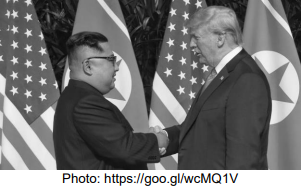
Donald Trump unexpectedly suspended "war games" on the Korean peninsula yesterday as he convinced Kim Jong-un to back "complete denuclearisation" in a written agreement. The US has been carrying out joint military exercises for years in the region as a signal of its military alliance with Seoul (South Korea), and as a show of strength against North Korean aggression.
The US president said in a press conference after the Singapore summit: "It is a very great day, it is a very great moment, in the history of the world." He predicted Kim would start denuclearise "very quickly" and revealed that the North Korean leader had already agreed to destroy a missile engine testing site.
The climax of Mr Trump‘s meeting with Kim " the first between a sitting North Korean and American leader " was the signing of a joint agreement. The 400-word statement followed more than four hours of talks, first between the leaders one-on-one and then with a wider group of advisers.
It read: "President Trump and Chairman Kim Jong-un conducted a comprehensive, in-depth, and sincere exchange of opinions on the issues related to the establishment of new United States - North Korea relations and the building of a lasting and robust peace regime on the Korean Peninsula.
The statement went on to list four specific pledges that both Mr Trump and Kim agreed to stand by: The first was that both countries would establish "new relations" in the pursuit of "peace and prosperity" — an attempt to draw a line under the insults and threats of last year. The second said that America and North Korea would "join their efforts to build a lasting and stable peace regime on the Korean Peninsula". The third said that Kim‘s regime "commits to work toward complete denuclearisation of the Korean Peninsula" — a key demand from the Americans. And the fourth promised that the remains of fallen US soldiers who died fighting in the Korean War would be repatriated to the United States.
Mr Trump said he "absolutely" would invite Kim to the White House and expressed enthusiasm for visiting North Korea, but said no dates had been set. Mr Trump also praised the leaders of Japan, South Korea and China as well as Kim himself for the progress made on the issue of denuclearisation.
Source: < https://goo.gl/dEim38> Date of retrieval: June 13th, 2018.
De acordo com o texto, o compromisso que NÃO faz parte do documento assinado é
Questão 14 5287883
UFVJM 2018.1Texto
How to make chocolate cookies

1. Melt chocolate in the microwave, stir until smooth.
2. Sift together baking powder, flour, cocoa and salt; set aside.
3. In a bowl, cream butter with brown sugar and white sugar until smooth.
4. Beat in eggs taking one at a time, then stir in vanilla and coffee granules until well blended.
5. Using a wooden spoon, stir in melted chocolate.
6. Then stir in the dry ingredients until it blends well.
7. Cover, and allow it to stand for half an hour.
8. Preheat the oven to 350 degrees F.
9. Place two cookie sheets with parchment paper.
10. Roll dough into walnut sized balls onto the prepared cookie sheets.
11. Then, bake it for ten minutes in the preheated oven. Cookies will still be very soft because of the chocolate.
12. Let the cookies cool for ten minutes before transferring to wire racks to cool completely.
Fonte: Disponível em:http://www.indobase.com/recipes/details/chocolate-cookies.php. Acesso em: 28 set. de 2018. (Adaptado)
Entre os ingredientes usados nessa receita, estão:
06