


![[Marketing] Questao Topo - deslogado](https://storage.estuda.com.br/banners/0_6b7ebee90b03af1c560c73bb8bcce34a_banner_deslogado_70_dias.png)
Questões de Inglês
19.971 Questões
Questão 16 6468497
FCMSCSP - Santa Casa 2018Leia o texto para responder à questão.
Unexpected effects of nutrition
In the late 1960s, a team of researchers began distributing a nutritional supplement to families with young children in rural Guatemala. They were testing the assumption that providing enough protein in the first few years of life would reduce the incidence of stunted growth.
It did. Children who received added nutrition grew 1 to 2 centimetres taller than those in a control group. But the benefits didn’t stop there. These children went on to score higher on reading and knowledge tests as adolescents, and when researchers returned in the early 2000s, women who had received the supplements in the first three years of life completed more years of schooling and men had higher incomes.
“Had there not been these follow-ups, this study probably would have been largely forgotten,” says Reynaldo Martorell, a specialist in maternal and child nutrition who led the followup studies. Instead, he says, the findings made financial institutions such as the World Bank think of early nutritional interventions as long-term investments in human health. Since the Guatemalan research, studies around the world — in Brazil, Peru, Jamaica, the Philippines, Kenya and Zimbabwe — have all associated poor or stunted growth in young children with lower cognitive test scores and worse school achievement. A picture slowly emerged that being too short early in life is a sign of adverse conditions — such as poor diet and regular episodes of diarrhea — and a predictor for intellectual deficits and mortality.
(Carina Storrs. www.nature.com, 12.07.2017. Adaptado.)
The study carried out in rural Guatemala aimed at
Questão 15 6468489
FCMSCSP - Santa Casa 2018Leia o texto para responder à questão.
Dawn of the pre-tiree:
What to call the time of life between work and old age?
To get the most out of longer lives, another age category is needed
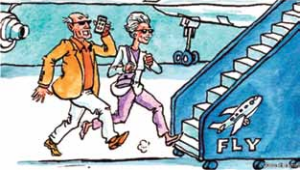
What do you call someone who is over 65 but not yet elderly? This stage of life, between work and decrepitude, lacks a name. “Geriactives” errs too much on the side of senescence1. “Nightcappers” risks being patronising. Perhaps “Nyppies” (Not Yet Past It) or “Owls” (Older, Working Less, Still earning) ring truer. Branding an age category might sound like a frivolous exercise. But life stages are primarily social constructs, and history shows that their emergence can trigger deep changes in attitudes.
Before 1800 no country in the world had an average life expectancy at birth beyond 40. Today there is not a country that does not. Since 1900, more years have been added to human life than in the rest of history combined, initially by reducing child mortality and lately by stretching lifespans. Longevity is one of humanity’s great accomplishments. Yet it is seen as one of society’s great headaches. The problem lies in the increasing dependency of the old on the young. As the world greys, growth, tax revenues and workforces will decline while spending on pensions and health care will increase. So, at least, goes the orthodoxy.
Doom-mongers2 tend to miss a bigger point, however. Those extra years of life are predominantly healthy ones. Too many governments and firms fail to recognize this fact. A more radical approach would start by acknowledging that, in the rich world at least, many of the old are still young and active. They want to work, but more flexibly. They want to spend money, too.
Declaring a new stage of life could help change perceptions. It has done so before. Today’s conception of childhood emerged in the 19th century, paving the way for child-protection laws and a golden age of children’s literature. Spotty, awkward 15-year-olds predated the 1940s, but only then did mystified adults coin the label “teenagers”, fuelling all sorts of products and services, from bobby socks to the music industry. In 1944 Life wrote that “American businessmen, many of whom have teen-age daughters, have only recently begun to realise that teen-agers make up a big and special market.” So, as life becomes longer, the word “retirement”, which literally means withdrawal to a place of seclusion, has become misleading. At 65 you are not clapped out, but pretired.
(www.economist.com, 06.07.2017. Adaptado.)
1 Senescence: the condition or process of deterioration with age.
2 Doom-monger: a person who predicts disaster.
In the excerpt from the fourth paragraph “but only then did mystified adults coin the label ‘teenagers’”, the word in bold can be replaced, without changing the meaning of the sentence, by
Questão 12 6468465
FCMSCSP - Santa Casa 2018Leia o texto para responder à questão.
Dawn of the pre-tiree:
What to call the time of life between work and old age?
To get the most out of longer lives, another age category is needed
What do you call someone who is over 65 but not yet elderly? This stage of life, between work and decrepitude, lacks a name. “Geriactives” errs too much on the side of senescence1. “Nightcappers” risks being patronising. Perhaps “Nyppies” (Not Yet Past It) or “Owls” (Older, Working Less, Still earning) ring truer. Branding an age category might sound like a frivolous exercise. But life stages are primarily social constructs, and history shows that their emergence can trigger deep changes in attitudes.
Before 1800 no country in the world had an average life expectancy at birth beyond 40. Today there is not a country that does not. Since 1900, more years have been added to human life than in the rest of history combined, initially by reducing child mortality and lately by stretching lifespans. Longevity is one of humanity’s great accomplishments. Yet it is seen as one of society’s great headaches. The problem lies in the increasing dependency of the old on the young. As the world greys, growth, tax revenues and workforces will decline while spending on pensions and health care will increase. So, at least, goes the orthodoxy.
Doom-mongers2 tend to miss a bigger point, however. Those extra years of life are predominantly healthy ones. Too many governments and firms fail to recognize this fact. A more radical approach would start by acknowledging that, in the rich world at least, many of the old are still young and active. They want to work, but more flexibly. They want to spend money, too.
Declaring a new stage of life could help change perceptions. It has done so before. Today’s conception of childhood emerged in the 19th century, paving the way for child-protection laws and a golden age of children’s literature. Spotty, awkward 15-year-olds predated the 1940s, but only then did mystified adults coin the label “teenagers”, fuelling all sorts of products and services, from bobby socks to the music industry. In 1944 Life wrote that “American businessmen, many of whom have teen-age daughters, have only recently begun to realise that teen-agers make up a big and special market.” So, as life becomes longer, the word “retirement”, which literally means withdrawal to a place of seclusion, has become misleading. At 65 you are not clapped out, but pretired.
(www.economist.com, 06.07.2017. Adaptado.)
1 Senescence: the condition or process of deterioration with age.
2 Doom-monger: a person who predicts disaster.
Assinale a alternativa cuja afirmação corresponde, de forma mais próxima, ao conteúdo da ilustração que introduz o texto.
Questão 11 6468436
FCMSCSP - Santa Casa 2018Leia o texto para responder à questão.
Dawn of the pre-tiree:
What to call the time of life between work and old age?
To get the most out of longer lives, another age category is needed
What do you call someone who is over 65 but not yet elderly? This stage of life, between work and decrepitude, lacks a name. “Geriactives” errs too much on the side of senescence1. “Nightcappers” risks being patronising. Perhaps “Nyppies” (Not Yet Past It) or “Owls” (Older, Working Less, Still earning) ring truer. Branding an age category might sound like a frivolous exercise. But life stages are primarily social constructs, and history shows that their emergence can trigger deep changes in attitudes.
Before 1800 no country in the world had an average life expectancy at birth beyond 40. Today there is not a country that does not. Since 1900, more years have been added to human life than in the rest of history combined, initially by reducing child mortality and lately by stretching lifespans. Longevity is one of humanity’s great accomplishments. Yet it is seen as one of society’s great headaches. The problem lies in the increasing dependency of the old on the young. As the world greys, growth, tax revenues and workforces will decline while spending on pensions and health care will increase. So, at least, goes the orthodoxy.
Doom-mongers2 tend to miss a bigger point, however. Those extra years of life are predominantly healthy ones. Too many governments and firms fail to recognize this fact. A more radical approach would start by acknowledging that, in the rich world at least, many of the old are still young and active. They want to work, but more flexibly. They want to spend money, too.
Declaring a new stage of life could help change perceptions. It has done so before. Today’s conception of childhood emerged in the 19th century, paving the way for child-protection laws and a golden age of children’s literature. Spotty, awkward 15-year-olds predated the 1940s, but only then did mystified adults coin the label “teenagers”, fuelling all sorts of products and services, from bobby socks to the music industry. In 1944 Life wrote that “American businessmen, many of whom have teen-age daughters, have only recently begun to realise that teen-agers make up a big and special market.” So, as life becomes longer, the word “retirement”, which literally means withdrawal to a place of seclusion, has become misleading. At 65 you are not clapped out, but pretired.
(www.economist.com, 06.07.2017. Adaptado.)
1 Senescence: the condition or process of deterioration with age.
2 Doom-monger: a person who predicts disaster.
The article puts forward the idea that
Questão 40 6461269
CUSC Medicina 1° Semestre 2018Leia o texto para responder à questão.
Do insects feel emotions?
Charles Darwin once wrote in his book The Expression of Emotions in Man and Animals that insects “express anger, terror, jealousy and love.” That was in 1872. Now, nearly 150 years later, researchers have discovered more evidence that Darwin might have been onto something. Bumblebees seem to have a “positive emotionlike state,” according to a study published in Science. In other words, they may experience something akin to happiness. To some, the idea is still controversial, however.
Unlike humans, you can’t simply ask a bee to interrogate its own emotions and describe them. Instead, researchers have to look for evidence that the insects have the cognitive, behavioral and physiological building blocks that, when combined, can give rise to a complex phenomenon like emotion.
Biologist Clint Perry of Queen Mary, University of London devised an experiment to do just that. He and his colleagues trained bumblebees to distinguish between a blue flower placed on the left side of a container and a green one on the right. When the bees explored the blue flower, they found a 30 percent sugar solution. But when they explored the green one, they slurped up plain, unsweetened water. Eventually, the bees learned to associate the blue flower with a tasty reward.
Then the researchers tested the bees on ambiguously colored flowers at intermediate locations. Half of the insects were given a 60 percent sugar solution prior to the test, and those bees flew faster toward the ambiguous blue-green flower. The remaining bees that were not given the sugar flew more slowly.
The assumption that an ambiguous stimulus contains a reward despite the lack of evidence is called an optimism bias. Perry’s experiment suggests that a bit of sugar amped up the bees into a positive emotional state, making them more optimistic that the flower would contain a sugary treat.
Sound familiar? Something similar is true in humans – newborn infants cry less if they’ve been offered a sweet snack, and a bit of candy increases feelings of positivity and improves bad moods in adults, too. “Many of us view the world in a better way when we have a nice piece of dark chocolate,” Perry says.
There is no intrinsic reason that insects shouldn’t experience emotions. Feelings, on the other hand, are a separate issue. Even though we use the two terms interchangeably in common parlance, scientists use them differently. “Emotions are collections of actions, and numerous species have emoted,” says neuroscientist and philosopher Antonio Damasio of the University of Southern California, “though we can not be certain that they felt their emotings.” In other words, emotions are the body’s adaptive response to external events or stimuli. Feelings are the subjective experience of them.
(Jason G. Goldman. www.scientificamerican.com, 30.09.2016. Adaptado.)
A partir das informações apresentadas pelo texto, a resposta mais adequada à pergunta “Do insects feel emotions?”, presente no título, seria
Questão 39 6461264
CUSC Medicina 1° Semestre 2018Leia o trecho inicial do romance A cidade e as serras, de Eça de Queirós, para responder à questão.
O meu amigo Jacinto nasceu num palácio, com cento e nove contos de renda em terras de semeadura, de vinhedo, de cortiça e de olival.
[…]
Seu avô, aquele gordíssimo e riquíssimo Jacinto a quem chamavam em Lisboa o D. Galião, descendo uma tarde pela travessa da Trabuqueta, rente dum muro de quintal que uma parreira toldava, escorregou numa casca de laranja e desabou no lajedo. Da portinha da horta saía nesse momento um homem moreno, escanhoado1, de grosso casaco de baetão2 verde e botas altas de picador, que, galhofando3 e com uma força fácil, levantou o enorme Jacinto – até lhe apanhou a bengala de castão de ouro que rolara para o lixo. Depois, demorando nele os olhos pestanudos e pretos:
– Ó Jacinto Galião, que andas tu aqui, a estas horas, a rebolar pelas pedras?
E Jacinto, aturdido e deslumbrado, reconheceu o Sr. Infante D. Miguel!
Desde essa tarde amou aquele bom Infante como nunca amara, apesar de tão guloso, o seu ventre, e, apesar de tão devoto, o seu Deus! Na sala nobre da sua casa (à Pampulha) pendurou sobre os damascos4 o retrato do “seu Salvador”, enfeitado de palmitos como um retábulo5 e, por baixo, a bengala que as magnânimas mãos reais tinham erguido do lixo.
(A cidade e as serras, 2013. Adaptado.)
1 escanhoado: com barba feita.
2 baetão: agasalho de lã bem grossa.
3 galhofar: debochar, caçoar.
4 damasco: tecido de seda para enfeite.
5 retábulo: parte de um altar.
A expressão “on the other hand”, no sétimo parágrafo, pode ser entendida como
06