


![[Marketing] Questao Topo - deslogado](https://storage.estuda.com.br/banners/0_6b7ebee90b03af1c560c73bb8bcce34a_banner_deslogado_70_dias.png)
Questões de Inglês
19.971 Questões
Questão 34 6813835
FEMA 2018Texto para a questão.
A DEADLY BLAZE IN LONDON
A tower-block fire prompts claims of government negligence

Britain
Jun 14th 2017
THE fire began in the early hours of June 14th on the second floor of Grenfell Tower, a building erected to provide social housing as part of Kensington and Chelsea’s slum-clearance programme in the 1970s. Its 24 floors were consumed by flames as inhabitants attempted to escape. By dawn the tower was a smouldering wreck; smoke drifted across the capital’s pink-hued sky. Twelve were confirmed to have died and more than 70 treated in hospital. Police said that the number of casualties would rise.
Experts were astonished by the fire, since modern building technology ought to have protected against such a disaster. Some escapees said they were not woken by smoke alarms, that there were no sprinklers to dampen the flames and that recently installed cladding had seemed particularly flammable. Local councils normally advise residents of tower blocks to stay put in the event of a fire, since the buildings are designed to contain the flames until the emergency services arrive. As the fire was not contained, that advice may have put people in danger.
A residents’ group had previously complained to the Kensington and Chelsea Tower Management Organisation (KCTMO), which runs the tower, about the building’s vulnerability to such a fire. In 2013 they warned that safety equipment had not been tested; last year they protested that the landlords had been slow to clear household debris from the exit of the block of flats. They say their complaints were not investigated. KCTMO says it is aware that concerns had been raised, and that they will form part of its investigation into what happened.
The ramifications could reach the prime minister’s office. In 2009 a fire killed six people in a socialhousing block in south London. An MPs’ investigation concluded that the government ought to review fire regulations in towers. Gavin Barwell, who was recently appointed Theresa May’s chief of staff, said when housing minister in October last year that his department had “publicly committed” to looking at fire safety regulation, but a review had not been published by the time he lost his seat at the general election.
In 1968 the partial collapse of Ronan Point Tower in Newham, east London, following a gas explosion, led to a far-reaching overhaul of building regulations. Grenfell Tower was among the first to be subject to the new rules. It is now sure to inspire a new inquiry of its own.
(Adapted from <<http://www.economist.com/news/britain/21723382- tower-block-fire-prompts-claims-government-negligence-deadlyblaze-london>>)
Em “Its 24 floors were consumed by flames as inhabitants attempted to escape.”
Podemos substituir, sem alteração de sentido, a palavra em negrito por:
Questão 33 6813773
FEMA 2018Texto para a questão.
A DEADLY BLAZE IN LONDON
A tower-block fire prompts claims of government negligence
Britain
Jun 14th 2017
THE fire began in the early hours of June 14th on the second floor of Grenfell Tower, a building erected to provide social housing as part of Kensington and Chelsea’s slum-clearance programme in the 1970s. Its 24 floors were consumed by flames as inhabitants attempted to escape. By dawn the tower was a smouldering wreck; smoke drifted across the capital’s pink-hued sky. Twelve were confirmed to have died and more than 70 treated in hospital. Police said that the number of casualties would rise.
Experts were astonished by the fire, since modern building technology ought to have protected against such a disaster. Some escapees said they were not woken by smoke alarms, that there were no sprinklers to dampen the flames and that recently installed cladding had seemed particularly flammable. Local councils normally advise residents of tower blocks to stay put in the event of a fire, since the buildings are designed to contain the flames until the emergency services arrive. As the fire was not contained, that advice may have put people in danger.
A residents’ group had previously complained to the Kensington and Chelsea Tower Management Organisation (KCTMO), which runs the tower, about the building’s vulnerability to such a fire. In 2013 they warned that safety equipment had not been tested; last year they protested that the landlords had been slow to clear household debris from the exit of the block of flats. They say their complaints were not investigated. KCTMO says it is aware that concerns had been raised, and that they will form part of its investigation into what happened.
The ramifications could reach the prime minister’s office. In 2009 a fire killed six people in a socialhousing block in south London. An MPs’ investigation concluded that the government ought to review fire regulations in towers. Gavin Barwell, who was recently appointed Theresa May’s chief of staff, said when housing minister in October last year that his department had “publicly committed” to looking at fire safety regulation, but a review had not been published by the time he lost his seat at the general election.
In 1968 the partial collapse of Ronan Point Tower in Newham, east London, following a gas explosion, led to a far-reaching overhaul of building regulations. Grenfell Tower was among the first to be subject to the new rules. It is now sure to inspire a new inquiry of its own.
(Adapted from <<http://www.economist.com/news/britain/21723382- tower-block-fire-prompts-claims-government-negligence-deadlyblaze-london>>)
Ao lermos o texto podemos inferir que:
Questão 32 6813692
FEMA 2018Texto para a questão.
A DEADLY BLAZE IN LONDON
A tower-block fire prompts claims of government negligence
Britain
Jun 14th 2017
THE fire began in the early hours of June 14th on the second floor of Grenfell Tower, a building erected to provide social housing as part of Kensington and Chelsea’s slum-clearance programme in the 1970s. Its 24 floors were consumed by flames as inhabitants attempted to escape. By dawn the tower was a smouldering wreck; smoke drifted across the capital’s pink-hued sky. Twelve were confirmed to have died and more than 70 treated in hospital. Police said that the number of casualties would rise.
Experts were astonished by the fire, since modern building technology ought to have protected against such a disaster. Some escapees said they were not woken by smoke alarms, that there were no sprinklers to dampen the flames and that recently installed cladding had seemed particularly flammable. Local councils normally advise residents of tower blocks to stay put in the event of a fire, since the buildings are designed to contain the flames until the emergency services arrive. As the fire was not contained, that advice may have put people in danger.
A residents’ group had previously complained to the Kensington and Chelsea Tower Management Organisation (KCTMO), which runs the tower, about the building’s vulnerability to such a fire. In 2013 they warned that safety equipment had not been tested; last year they protested that the landlords had been slow to clear household debris from the exit of the block of flats. They say their complaints were not investigated. KCTMO says it is aware that concerns had been raised, and that they will form part of its investigation into what happened.
The ramifications could reach the prime minister’s office. In 2009 a fire killed six people in a socialhousing block in south London. An MPs’ investigation concluded that the government ought to review fire regulations in towers. Gavin Barwell, who was recently appointed Theresa May’s chief of staff, said when housing minister in October last year that his department had “publicly committed” to looking at fire safety regulation, but a review had not been published by the time he lost his seat at the general election.
In 1968 the partial collapse of Ronan Point Tower in Newham, east London, following a gas explosion, led to a far-reaching overhaul of building regulations. Grenfell Tower was among the first to be subject to the new rules. It is now sure to inspire a new inquiry of its own.
(Adapted from <<http://www.economist.com/news/britain/21723382- tower-block-fire-prompts-claims-government-negligence-deadlyblaze-london>>)
De acordo com o texto, o que contribuiu para que o incêndio se transformasse em tragédia?
Questão 19 6608622
FACISB 2018Read the text to answer question.
Exercising… but how?
We all know that, for optimal health, we need to move. But research and anecdotal experience indicate that people rarely exercise if they do not enjoy it. Workouts, for many, are something like possessions: If they don’t spark joy, they tend to be discarded.
Most experts agree that a workout’s intensity and its duration have the greatest influence on our feelings about it. In recent years, attention has been focused on short, intense workouts, typically called high-intensity interval training, because the duration is so slight, lessening the likelihood that people will be too busy to exercise. But while many people who take up high-intensity interval training report being pleased by the workouts’ brevity, they often also say that the intensity is not fun for them, which, over the long term, could discourage them from continuing.
In a new study, researchers at the University of Innsbruck in Austria decided to investigate whether emphasizing a workout´s length while playing down its intensity might increase people’s enjoyment and, potentially, participation. To find out, they recruited about 40 healthy men and women and asked them to complete a series of detailed questionnaires about their moods and level of anxiety, both at that moment and in general. Then they asked each volunteer to complete several prolonged workouts.
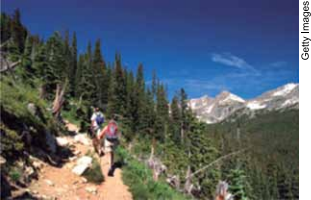
One of these involved hiking in the mountains. Wearing heart rate monitors, the volunteers walked in groups of three or four along a popular mountain trail that climbs sinuously and persistently; they were told to move at a brisk but not punishing pace, so that they were breathing rapidly but could converse with one another. Midway through the hike, they stopped and told researchers how strenuous the walking had felt, on a scale of 1 to 20, before descending and repeating the questionnaires about their moods. The entire walk lasted about three hours.
On a separate day, each volunteer completed virtually the same workout on a treadmill at a gym. The machines’ inclines were set to simulate the uphill hike for the first half of the workout, with flat walking after that (since the machines could not be set for negative altitude gain). Volunteers walked next to one another and were encouraged to chat. They all also completed the estimations of effort and mood.
Then on a final day, as a control session, they all sat for about three hours in a communal room at the university equipped with computers, magazines and couches, where they could surf or talk and, before and after, assess their moods. At the end, the scientists compared their mood scores and other assessments.
Although the mountain hiking turned out to have been, objectively, the most strenuous of the workouts, interestingly, almost all the participants reported that the outdoor effort had felt less strenuous to them than their time on the treadmill. And their mood scores were much higher after the outdoor hike than the treadmill workout. On the other hand, the long walk in the gym had left them almost uniformly happier and more relaxed than after sitting and using a computer or chatting for several hours. These results could have particular resonance for people who have tried brief, intense workouts and disliked them. But, of course, this study looked only at a single instance of each workout: it did not follow people to see if they would voluntarily keep walking or measure the extent to which the prolonged hikes affected their health and fitness.
(Gretchen Reynolds. www.nytimes.com, 28.06.2017. Adaptado.)
One of the findings described in the last paragraph was that
Questão 18 6608605
FACISB 2018Read the text to answer question.
Exercising… but how?
We all know that, for optimal health, we need to move. But research and anecdotal experience indicate that people rarely exercise if they do not enjoy it. Workouts, for many, are something like possessions: If they don’t spark joy, they tend to be discarded.
Most experts agree that a workout’s intensity and its duration have the greatest influence on our feelings about it. In recent years, attention has been focused on short, intense workouts, typically called high-intensity interval training, because the duration is so slight, lessening the likelihood that people will be too busy to exercise. But while many people who take up high-intensity interval training report being pleased by the workouts’ brevity, they often also say that the intensity is not fun for them, which, over the long term, could discourage them from continuing.
In a new study, researchers at the University of Innsbruck in Austria decided to investigate whether emphasizing a workout´s length while playing down its intensity might increase people’s enjoyment and, potentially, participation. To find out, they recruited about 40 healthy men and women and asked them to complete a series of detailed questionnaires about their moods and level of anxiety, both at that moment and in general. Then they asked each volunteer to complete several prolonged workouts.
One of these involved hiking in the mountains. Wearing heart rate monitors, the volunteers walked in groups of three or four along a popular mountain trail that climbs sinuously and persistently; they were told to move at a brisk but not punishing pace, so that they were breathing rapidly but could converse with one another. Midway through the hike, they stopped and told researchers how strenuous the walking had felt, on a scale of 1 to 20, before descending and repeating the questionnaires about their moods. The entire walk lasted about three hours.
On a separate day, each volunteer completed virtually the same workout on a treadmill at a gym. The machines’ inclines were set to simulate the uphill hike for the first half of the workout, with flat walking after that (since the machines could not be set for negative altitude gain). Volunteers walked next to one another and were encouraged to chat. They all also completed the estimations of effort and mood.
Then on a final day, as a control session, they all sat for about three hours in a communal room at the university equipped with computers, magazines and couches, where they could surf or talk and, before and after, assess their moods. At the end, the scientists compared their mood scores and other assessments.
Although the mountain hiking turned out to have been, objectively, the most strenuous of the workouts, interestingly, almost all the participants reported that the outdoor effort had felt less strenuous to them than their time on the treadmill. And their mood scores were much higher after the outdoor hike than the treadmill workout. On the other hand, the long walk in the gym had left them almost uniformly happier and more relaxed than after sitting and using a computer or chatting for several hours. These results could have particular resonance for people who have tried brief, intense workouts and disliked them. But, of course, this study looked only at a single instance of each workout: it did not follow people to see if they would voluntarily keep walking or measure the extent to which the prolonged hikes affected their health and fitness.
(Gretchen Reynolds. www.nytimes.com, 28.06.2017. Adaptado.)
In the excerpt from the seventh paragraph “the mountain hiking turned out to have been, objectively, the most strenuous of the workouts”, the word in bold means
Questão 15 6608552
FACISB 2018Read the text to answer question.
Exercising… but how?
We all know that, for optimal health, we need to move. But research and anecdotal experience indicate that people rarely exercise if they do not enjoy it. Workouts, for many, are something like possessions: If they don’t spark joy, they tend to be discarded.
Most experts agree that a workout’s intensity and its duration have the greatest influence on our feelings about it. In recent years, attention has been focused on short, intense workouts, typically called high-intensity interval training, because the duration is so slight, lessening the likelihood that people will be too busy to exercise. But while many people who take up high-intensity interval training report being pleased by the workouts’ brevity, they often also say that the intensity is not fun for them, which, over the long term, could discourage them from continuing.
In a new study, researchers at the University of Innsbruck in Austria decided to investigate whether emphasizing a workout´s length while playing down its intensity might increase people’s enjoyment and, potentially, participation. To find out, they recruited about 40 healthy men and women and asked them to complete a series of detailed questionnaires about their moods and level of anxiety, both at that moment and in general. Then they asked each volunteer to complete several prolonged workouts.
One of these involved hiking in the mountains. Wearing heart rate monitors, the volunteers walked in groups of three or four along a popular mountain trail that climbs sinuously and persistently; they were told to move at a brisk but not punishing pace, so that they were breathing rapidly but could converse with one another. Midway through the hike, they stopped and told researchers how strenuous the walking had felt, on a scale of 1 to 20, before descending and repeating the questionnaires about their moods. The entire walk lasted about three hours.
On a separate day, each volunteer completed virtually the same workout on a treadmill at a gym. The machines’ inclines were set to simulate the uphill hike for the first half of the workout, with flat walking after that (since the machines could not be set for negative altitude gain). Volunteers walked next to one another and were encouraged to chat. They all also completed the estimations of effort and mood.
Then on a final day, as a control session, they all sat for about three hours in a communal room at the university equipped with computers, magazines and couches, where they could surf or talk and, before and after, assess their moods. At the end, the scientists compared their mood scores and other assessments.
Although the mountain hiking turned out to have been, objectively, the most strenuous of the workouts, interestingly, almost all the participants reported that the outdoor effort had felt less strenuous to them than their time on the treadmill. And their mood scores were much higher after the outdoor hike than the treadmill workout. On the other hand, the long walk in the gym had left them almost uniformly happier and more relaxed than after sitting and using a computer or chatting for several hours. These results could have particular resonance for people who have tried brief, intense workouts and disliked them. But, of course, this study looked only at a single instance of each workout: it did not follow people to see if they would voluntarily keep walking or measure the extent to which the prolonged hikes affected their health and fitness.
(Gretchen Reynolds. www.nytimes.com, 28.06.2017. Adaptado.)
The study described in paragraphs 3 to 6
06