


![[Marketing] Questao Topo - deslogado](https://storage.estuda.com.br/banners/0_6b7ebee90b03af1c560c73bb8bcce34a_banner_deslogado_70_dias.png)
Questões de Inglês
19.971 Questões
Questão 31 11587125
Anhembi Morumbi Medicina 2018Leia o texto para responder à questão.
How nature is good for our health and happiness
We all intrinsically think that nature must be good for our health and happiness. A recent analysis of a large-scale nature challenge scientifically shows how important feeling part of nature is to our physical and mental health. There are a growing number of studies and campaigns putting forward evidence that a connection with nature makes us healthier and happier people, something that few of us nature lovers would argue with.
And now a recent evaluation of the UK’s first month-long nature challenge, which took place last year and involved people “doing something wild” every day for 30 consecutive days, shows scientifically and statistically how significant it really is. The study was conducted by the University of Derby and The Wildlife Trusts to try and measure the impact of last year’s “30 Days Wild” campaign, run by the charity.
“Intuitively we knew that nature was good for us as humans, but the results were beyond brilliant,” said Lucy McRobert, nature matters campaigns manager for The Wildlife Trusts. “Nature isn’t a miracle cure for diseases,” says McRobert, “But by interacting with it, spending time in it, experiencing it and appreciating it we can reap the benefits of feeling happier and healthier as a result.”
(Jeremy Coles. www.bbc.co.uk, 20.04.2016. Adaptado.)
According to the text, the contact with nature can contribute to
Questão 60 11529972
APMBB 2018How cities can better prevent fires
August 29, 2018
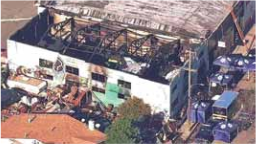
America’s deadliest building fire for more than a decade struck Oakland, California, on December 2nd 2016, killing 36 people attending a dance party in a warehouse that had become a cluttered artist collective. The disaster highlights an open secret: many cities lack resources to inspect for fire risk all the structures that they should. Even though the Oakland building had no fire sprinklers and at least ten people lived there illegally, no inspector had visited in about 30 years. How might cities make better use of the inspectors they do have?
A handful of American cities have begun to seek help from a new type of analytics software. By crunching diverse data collected by government bodies and utilities, the software works out which buildings are most likely to catch fire and should therefore be inspected first. Plenty of factors play a role. Older, wooden buildings, unsurprisingly, pose more risk, as do those close to past fires and leaks of gas or oil. Poverty also pushes up fire risk, especially if lots of children, who may be attracted to mischief, live nearby. More telling are unpaid taxes, foreclosure proceedings and recorded complaints of mould, rats, crumbling plaster, accumulating rubbish, and domestic fights, all of which hint at property neglect. A building’s fire risk also increases the further it is from its owner’s residence.
Predictive software designed at Harvard that Portland, Oregon, will soon begin using will do that. Perhaps more importantly, the city’s fire chief noticed that buildings marked as being the biggest risks are clustered in areas lacking good schools, public transport, health care and food options. Healthier, happier people start fewer fires, he concluded. He now lobbies officials to reduce Portland’s pockets of deteriorated areas.
(The Economist. www.economist.com/the-economist-explains /2018/08/29/how-cities-can-better-prevent-fires. Adaptado)
According to the last paragraph, Portland’s fire chief believes that
Questão 59 11529968
APMBB 2018How cities can better prevent fires
August 29, 2018
America’s deadliest building fire for more than a decade struck Oakland, California, on December 2nd 2016, killing 36 people attending a dance party in a warehouse that had become a cluttered artist collective. The disaster highlights an open secret: many cities lack resources to inspect for fire risk all the structures that they should. Even though the Oakland building had no fire sprinklers and at least ten people lived there illegally, no inspector had visited in about 30 years. How might cities make better use of the inspectors they do have?
A handful of American cities have begun to seek help from a new type of analytics software. By crunching diverse data collected by government bodies and utilities, the software works out which buildings are most likely to catch fire and should therefore be inspected first. Plenty of factors play a role. Older, wooden buildings, unsurprisingly, pose more risk, as do those close to past fires and leaks of gas or oil. Poverty also pushes up fire risk, especially if lots of children, who may be attracted to mischief, live nearby. More telling are unpaid taxes, foreclosure proceedings and recorded complaints of mould, rats, crumbling plaster, accumulating rubbish, and domestic fights, all of which hint at property neglect. A building’s fire risk also increases the further it is from its owner’s residence.
Predictive software designed at Harvard that Portland, Oregon, will soon begin using will do that. Perhaps more importantly, the city’s fire chief noticed that buildings marked as being the biggest risks are clustered in areas lacking good schools, public transport, health care and food options. Healthier, happier people start fewer fires, he concluded. He now lobbies officials to reduce Portland’s pockets of deteriorated areas.
(The Economist. www.economist.com/the-economist-explains /2018/08/29/how-cities-can-better-prevent-fires. Adaptado)
De acordo com o segundo parágrafo, algumas cidades estadunidenses
Questão 57 11529955
APMBB 2018How cities can better prevent fires
August 29, 2018
America’s deadliest building fire for more than a decade struck Oakland, California, on December 2nd 2016, killing 36 people attending a dance party in a warehouse that had become a cluttered artist collective. The disaster highlights an open secret: many cities lack resources to inspect for fire risk all the structures that they should. Even though the Oakland building had no fire sprinklers and at least ten people lived there illegally, no inspector had visited in about 30 years. How might cities make better use of the inspectors they do have?
A handful of American cities have begun to seek help from a new type of analytics software. By crunching diverse data collected by government bodies and utilities, the software works out which buildings are most likely to catch fire and should therefore be inspected first. Plenty of factors play a role. Older, wooden buildings, unsurprisingly, pose more risk, as do those close to past fires and leaks of gas or oil. Poverty also pushes up fire risk, especially if lots of children, who may be attracted to mischief, live nearby. More telling are unpaid taxes, foreclosure proceedings and recorded complaints of mould, rats, crumbling plaster, accumulating rubbish, and domestic fights, all of which hint at property neglect. A building’s fire risk also increases the further it is from its owner’s residence.
Predictive software designed at Harvard that Portland, Oregon, will soon begin using will do that. Perhaps more importantly, the city’s fire chief noticed that buildings marked as being the biggest risks are clustered in areas lacking good schools, public transport, health care and food options. Healthier, happier people start fewer fires, he concluded. He now lobbies officials to reduce Portland’s pockets of deteriorated areas.
(The Economist. www.economist.com/the-economist-explains /2018/08/29/how-cities-can-better-prevent-fires. Adaptado)
In the fragment from the second paragraph “Poverty also pushes up fire risk”, the expression in bold means
Questão 56 11529945
APMBB 2018How cities can better prevent fires
August 29, 2018
America’s deadliest building fire for more than a decade struck Oakland, California, on December 2nd 2016, killing 36 people attending a dance party in a warehouse that had become a cluttered artist collective. The disaster highlights an open secret: many cities lack resources to inspect for fire risk all the structures that they should. Even though the Oakland building had no fire sprinklers and at least ten people lived there illegally, no inspector had visited in about 30 years. How might cities make better use of the inspectors they do have?
A handful of American cities have begun to seek help from a new type of analytics software. By crunching diverse data collected by government bodies and utilities, the software works out which buildings are most likely to catch fire and should therefore be inspected first. Plenty of factors play a role. Older, wooden buildings, unsurprisingly, pose more risk, as do those close to past fires and leaks of gas or oil. Poverty also pushes up fire risk, especially if lots of children, who may be attracted to mischief, live nearby. More telling are unpaid taxes, foreclosure proceedings and recorded complaints of mould, rats, crumbling plaster, accumulating rubbish, and domestic fights, all of which hint at property neglect. A building’s fire risk also increases the further it is from its owner’s residence.
Predictive software designed at Harvard that Portland, Oregon, will soon begin using will do that. Perhaps more importantly, the city’s fire chief noticed that buildings marked as being the biggest risks are clustered in areas lacking good schools, public transport, health care and food options. Healthier, happier people start fewer fires, he concluded. He now lobbies officials to reduce Portland’s pockets of deteriorated areas.
(The Economist. www.economist.com/the-economist-explains /2018/08/29/how-cities-can-better-prevent-fires. Adaptado)
No trecho do primeiro parágrafo “Even though the Oakland building had no fire sprinklers”, a expressão em destaque equivale, em português, a
Questão 15 10741860
USCS Medicina e Odontologia 2018/2Leia o texto para responder à questão.
Sickle cell anemia1 – past and present stories
Thousands of years ago, a special child was born in the Sahara. At the time, this was not a desert; it was a green belt of savannas, woodlands, lakes and rivers. Bands of hunter-gatherers prospered there, catching fish and hippos. A genetic mutation had altered the child’s hemoglobin, the molecule in red blood cells that carries oxygen through the body. It was not harmful; there are two copies of every gene, and the child’s other hemoglobin gene was normal. The child survived, had a family and passed down the mutation to future generations.
As the greenery turned to desert, the descendants of the hunter-gatherers became farmers, and moved to other parts of Africa. The mutation endured over generations, and for good reason. People who carried one mutated gene were protected against one of the biggest threats to humans in the region: malaria.
There was just one problem with this genetic advantage: From time to time, two descendants of that child would meet and start a family. Some of their children inherited two copies of the mutant hemoglobin gene instead of one. These children could no longer produce normal hemoglobin; as a result, their red cells became defective and blocked their blood vessels. The condition, now known as ‘sickle cell anemia’, leads to extreme pain, difficulty with breathing, kidney failure and even strokes.
Today, over 250 generations later, the mutation has been inherited by millions of people. While the majority of carriers live in Africa, many others live in southern Europe, the Near East and India. Those carriers have about 300,000 children each year with sickle cell anemia.
How humans got the sickle cell mutation is a saga that emerges from new research carried out at the Center for Research on Genomics and Global Health. The researchers analyzed the genomes of nearly 3,000 people to reconstruct the genetic history of the disease. They conclude that the mutation arose roughly 7,300 years ago in West Africa. Later, migrants spread the mutation across much of Africa and then to other parts of the world. Wherever people suffered from malaria, the protective gene developed thrived — but brought sickle cell anemia with it.
Today, sickle cell anemia remains a heavy burden on public health. In many poor countries, most children with the disease still die young. In the United States, the average life span of sufferers has been extended into the early 40s. According to the researchers, an improved understanding of the history of sickle cell anemia could lead to better medical care at a global level.
(Carl Zimmer. www.nytimes.com, 08.03.2018. Adaptado.)
1sickle cell anemia: anemia falciforme.
No trecho do penúltimo parágrafo “migrants spread the mutation across much of Africa and then to other parts of the world”, o termo sublinhado equivale, em português, a
06