


![[Marketing] Questao Topo - deslogado](https://storage.estuda.com.br/banners/0_6b7ebee90b03af1c560c73bb8bcce34a_banner_deslogado_70_dias.png)
Questões de Inglês
19.971 Questões
Questão 44 603972
FMC 2019/1Fake news: What exactly is it – and how can you spot it?
By: James Carson, 28 sep 2018
"Fake news" was not a term many people used two years ago, but it is now seen as one of the greatest threats to democracy, free debate and the Western order.
As well as being a favourite term of Donald Trump, it was also named 2017's word of the year, raising tensions between nations, and may lead to regulation of social media.
And yet, nobody can agree on what it is, the extent of the problem, and what to do about it.
How do you spot it?
Spotting fake news isn't easy: a Stanford study last year found that students were shockingly bad at distinguishing between different types of material online, whether paid for, fake or legitimate.
Facebook has a useful list of ways to spot fake news, which include checking other sources and a site's URL.
Facebook’s tips for spotting fake news
1. Be sceptical of headlines. The headlines of fake news stories are often catchy, and contain lots of capital letters and exclamation marks. If claims in the headline sound unbelievable, they may well be.
2. Look closely at the URL. Many false news stories mimic authentic news sources by making small changes to the URL. You can go to the site to compare the URL to established sources.
3. Check the source. Ensure the story comes from a source with a reputation for accuracy. If the story comes from a site you have not heard of, check their “About” section to learn more.
4. Watch for unusual formatting. Many false news stories often contain spelling and grammar errors, as well as an awkward looking layout.
5. Check the photos. False news stories often contain manipulated images or videos. Sometimes the photo may be authentic, but taken out of context. You can do an internet search of the image to find out where it came from.
6. Check the dates. Fake news stories may contain timelines that make no sense, or event dates which are wrong or have been altered.
7. Check the evidence. Check the author‟s sources to confirm they are accurate. Lack of evidence, or a reliance on unnamed experts may indicate false news.
8. Look at other reports. If no other news source is reporting the same story, it could indicate that it is false.
9. Is the story a joke? Sometimes false news stories can be hard to distinguish from humourous articles. Check whether the source is known for parody, and whether the story‟s details and tone suggest it may be just for fun.
10. Some stories are intentionally false. Think critically about the stories that you read, and only share articles which you know to be credible. News stories are often described as so good you couldn't make it up, which is often what makes them great news stories. But it's worth expressing scepticism about everything: could this really happen?
Disponível em: . Access: 23 Oct, 2018. Adapted.
Glossary: threats: ameaças; sceptical: cético; mimic: copiar; awkward: estranho.
The author‟s view on the spread of fake news shows
Questão 43 603963
FMC 2019/1Fake news: What exactly is it – and how can you spot it?
By: James Carson, 28 sep 2018
"Fake news" was not a term many people used two years ago, but it is now seen as one of the greatest threats to democracy, free debate and the Western order.
As well as being a favourite term of Donald Trump, it was also named 2017's word of the year, raising tensions between nations, and may lead to regulation of social media.
And yet, nobody can agree on what it is, the extent of the problem, and what to do about it.
How do you spot it?
Spotting fake news isn't easy: a Stanford study last year found that students were shockingly bad at distinguishing between different types of material online, whether paid for, fake or legitimate.
Facebook has a useful list of ways to spot fake news, which include checking other sources and a site's URL.
Facebook’s tips for spotting fake news
1. Be sceptical of headlines. The headlines of fake news stories are often catchy, and contain lots of capital letters and exclamation marks. If claims in the headline sound unbelievable, they may well be.
2. Look closely at the URL. Many false news stories mimic authentic news sources by making small changes to the URL. You can go to the site to compare the URL to established sources.
3. Check the source. Ensure the story comes from a source with a reputation for accuracy. If the story comes from a site you have not heard of, check their “About” section to learn more.
4. Watch for unusual formatting. Many false news stories often contain spelling and grammar errors, as well as an awkward looking layout.
5. Check the photos. False news stories often contain manipulated images or videos. Sometimes the photo may be authentic, but taken out of context. You can do an internet search of the image to find out where it came from.
6. Check the dates. Fake news stories may contain timelines that make no sense, or event dates which are wrong or have been altered.
7. Check the evidence. Check the author‟s sources to confirm they are accurate. Lack of evidence, or a reliance on unnamed experts may indicate false news.
8. Look at other reports. If no other news source is reporting the same story, it could indicate that it is false.
9. Is the story a joke? Sometimes false news stories can be hard to distinguish from humourous articles. Check whether the source is known for parody, and whether the story‟s details and tone suggest it may be just for fun.
10. Some stories are intentionally false. Think critically about the stories that you read, and only share articles which you know to be credible. News stories are often described as so good you couldn't make it up, which is often what makes them great news stories. But it's worth expressing scepticism about everything: could this really happen?
Disponível em: . Access: 23 Oct, 2018. Adapted.
Glossary: threats: ameaças; sceptical: cético; mimic: copiar; awkward: estranho.
The aim of James Carson‟s article is:
Questão 30 603332
UNICENTRO 2019Calvin and Hobbes by Bill Watterson
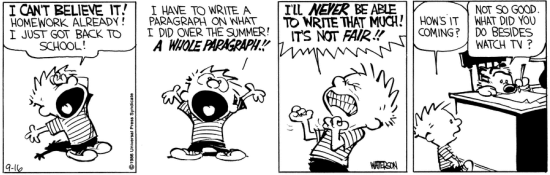
Disponível em: https://www.gocomics.com/calvinandhobbes/1986/09/16. Acesso em 20 de jul. 2018.
What can’t Calvin believe?
Questão 29 603329
UNICENTRO 2019Calvin and Hobbes by Bill Watterson
Disponível em: https://www.gocomics.com/calvinandhobbes/1986/09/16. Acesso em 20 de jul. 2018.
How’s it coming could be replaced in this context by
Questão 27 603327
UNICENTRO 2019Calvin and Hobbes by Bill Watterson
Disponível em: https://www.gocomics.com/calvinandhobbes/1986/09/16. Acesso em 20 de jul. 2018.
From the cartoon, we can assume that
Questão 26 603325
UNICENTRO 2019The President is Missing
By Bill Clinton and James Patterson
When Tom Wolfe noted that “the problem with fiction” is that “it has to be plausible,” he may have had efforts like this one in mind. Bill Clinton and James Patterson’s ambitious and wildly readable new novel, “The President Is Missing,” arches more closely toward plausibility in its geopolitical subplots — threats against the Saudi king, malicious Russian meddling in world affairs — than its main story line of a president who ditches his handlers and goes rogue from the White House, convinced he is the only one who can foil a huge cyberterror plot.
The book opens with a charged scene in which President Jonathan Duncan is participating in a mock hearing to prepare for a congressional inquiry investigating the botched attempt to capture a terrorist. When the president loses his temper, he vindicates the advisers who have cautioned him not to appear before the actual committee. It’s a satisfying outcome for the former senior staffer in me — but unrealistic, considering the picture of the president that unfolds on the subsequent pages.
Disponível em . Acesso em 20 de jul. 2018.
When the president loses his temper, could be replaced by
06