


![[Marketing] Questao Topo - deslogado](https://storage.estuda.com.br/banners/0_6b7ebee90b03af1c560c73bb8bcce34a_banner_deslogado_70_dias.png)
Questões de Inglês
19.971 Questões
Questão 27 604933
FATEC 2019/1Leia o texto para responder à questão.
The Skills You Need To Succeed In 2020
By Avil Beckford – Aug 6, 2018.
The World Economic Forum reports that you need ten skills to thrive in 2020: complex problem solving; critical thinking; creativity; people management; coordinating with others; emotional intelligence; judgement and decision making; service orientation; negotiation; cognitive flexibility.
The ten skills on this list make sense for the age that we are living in. Of these, you want to focus on creative work, because that is where you are likely to remain employable. Every professional can be creative in the work she does.
You might have started to realize that you will need more than the ten skills listed earlier. Alvin Tofler once said, “The illiterate of the 21st century will not be those who cannot read and write, but those who cannot learn, unlearn, and relearn.”
In some instances, relearning could be adapting what you know to a new reality. Take cell phones as an example. When they first came out, they were used solely as communications devices. Convergence happened, and now our smartphones are minicomputers. People had to relearn how to use a phone.
In terms of work, you will have to adapt some of your skills to the jobs of the future, and you will also have to learn new skills. Here are some of the additional skills that you will need to succeed in 2020.
Learning how to learn. Since skills are constantly changing, you have to learn how to learn.
Analyzing information. When you take good and detailed notes, you can review them to pick out the big ideas, understand, and make sense of information.
Spotting patterns and trends. I recommend that you combine ideas from the diferent books that you read. By doing this, you may be able to spot ideas and trends.
Communicating – written and oral. You can combine ideas that once seemed unrelated to communicate them to influencers, who can help you to shape and implement them.
Understanding and leveraging technology. Technology is changing at an unprecedented pace, so you need to understand and keep on top of it.
<https://tinyurl.com/y7pahnqf> Acesso em: 15.10.2018. Adaptado.
Na oração The illiterate of the 21st century will not be those who cannot read and write, but those who cannot learn, unlearn, and relearn, presente no terceiro parágrafo do texto, Toffler afirma que, no século 21, serão consideradas letradas as pessoas que souberem
Questão 26 604932
FATEC 2019/1Leia o texto para responder à questão.
The Skills You Need To Succeed In 2020
By Avil Beckford – Aug 6, 2018.
The World Economic Forum reports that you need ten skills to thrive in 2020: complex problem solving; critical thinking; creativity; people management; coordinating with others; emotional intelligence; judgement and decision making; service orientation; negotiation; cognitive flexibility.
The ten skills on this list make sense for the age that we are living in. Of these, you want to focus on creative work, because that is where you are likely to remain employable. Every professional can be creative in the work she does.
You might have started to realize that you will need more than the ten skills listed earlier. Alvin Tofler once said, “The illiterate of the 21st century will not be those who cannot read and write, but those who cannot learn, unlearn, and relearn.”
In some instances, relearning could be adapting what you know to a new reality. Take cell phones as an example. When they first came out, they were used solely as communications devices. Convergence happened, and now our smartphones are minicomputers. People had to relearn how to use a phone.
In terms of work, you will have to adapt some of your skills to the jobs of the future, and you will also have to learn new skills. Here are some of the additional skills that you will need to succeed in 2020.
Learning how to learn. Since skills are constantly changing, you have to learn how to learn.
Analyzing information. When you take good and detailed notes, you can review them to pick out the big ideas, understand, and make sense of information.
Spotting patterns and trends. I recommend that you combine ideas from the diferent books that you read. By doing this, you may be able to spot ideas and trends.
Communicating – written and oral. You can combine ideas that once seemed unrelated to communicate them to influencers, who can help you to shape and implement them.
Understanding and leveraging technology. Technology is changing at an unprecedented pace, so you need to understand and keep on top of it.
<https://tinyurl.com/y7pahnqf> Acesso em: 15.10.2018. Adaptado.
De acordo com o texto, dentre as dez habilidades apontadas como necessárias para os profissionais prosperarem em 2020, a habilidade que apresenta maior probabilidade para que uma pessoa se mantenha empregada é
Questão 25 604931
FATEC 2019/1Leia o texto para responder à questão.
The Skills You Need To Succeed In 2020
By Avil Beckford – Aug 6, 2018.
The World Economic Forum reports that you need ten skills to thrive in 2020: complex problem solving; critical thinking; creativity; people management; coordinating with others; emotional intelligence; judgement and decision making; service orientation; negotiation; cognitive flexibility.
The ten skills on this list make sense for the age that we are living in. Of these, you want to focus on creative work, because that is where you are likely to remain employable. Every professional can be creative in the work she does.
You might have started to realize that you will need more than the ten skills listed earlier. Alvin Tofler once said, “The illiterate of the 21st century will not be those who cannot read and write, but those who cannot learn, unlearn, and relearn.”
In some instances, relearning could be adapting what you know to a new reality. Take cell phones as an example. When they first came out, they were used solely as communications devices. Convergence happened, and now our smartphones are minicomputers. People had to relearn how to use a phone.
In terms of work, you will have to adapt some of your skills to the jobs of the future, and you will also have to learn new skills. Here are some of the additional skills that you will need to succeed in 2020.
Learning how to learn. Since skills are constantly changing, you have to learn how to learn.
Analyzing information. When you take good and detailed notes, you can review them to pick out the big ideas, understand, and make sense of information.
Spotting patterns and trends. I recommend that you combine ideas from the diferent books that you read. By doing this, you may be able to spot ideas and trends.
Communicating – written and oral. You can combine ideas that once seemed unrelated to communicate them to influencers, who can help you to shape and implement them.
Understanding and leveraging technology. Technology is changing at an unprecedented pace, so you need to understand and keep on top of it.
<https://tinyurl.com/y7pahnqf> Acesso em: 15.10.2018. Adaptado.
Na frase, The World Economic Forum reports that you need ten skills to thrive in 2020…, presente no primeiro parágrafo do texto, a palavra thrive pode ser substituída por
Questão 2 604623
FATEC 2019/1Analise a charge.
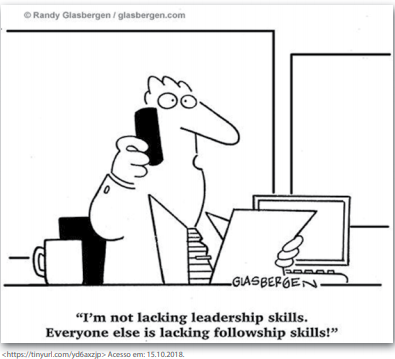
As expressões I’m not lacking leadership e Everyone else is lacking, para expressar o sarcasmo da charge, demonstram que o profissional em questão
Questão 20 604542
FCM PB 2019/1TEXTO
Engaging Doctors in the Health Care Revolution
Despite wondrous advances in medicine and technology, health care regularly fails at the fundamental job of any business: to reliably deliver what its customers need. In the face of ever-increasing complexity, the hard work and best intentions of individual physicians can no longer guarantee efficient, high-quality care. Fixing health care will require a radical transformation, moving from a system organized around individual physicians to a team-based approach focused on patients. Doctors, of course, must be central players in the transformation: Any ambitious strategy that they do not embrace is doomed.
And yet, many physicians are deeply anxious about the changes under way and are mourning real or anticipated losses of autonomy, respect, and income. They are being told that they must accept new organizational structures, ways of working, payment models, and performance goals. They struggle to care for the endless stream of patients who want to be seen, but they constantly hear that much of what they do is waste. They’re moving at various rates through the stages of grief: A few are still in denial, but many are in the second stage—anger. Bursts of rage over relatively small issues are common.
Given doctors’ angst, how can leaders best engage them in redesigning care? In our roles in senior management of two large U.S. health care systems, and as observers and partners of many others, we have seen firsthand that winning physicians’ support takes more than simple incentives. Leaders at all levels must draw on reserves of optimism, courage, and resilience. They must develop an understanding of behavioral economics and social capital and be ready to part company with clinicians who refuse to work with their colleagues to improve outcomes and efficiency.
To help health care leaders engage physicians in the pursuit of their organizations’ greater goals, we suggest a framework based on the writings of the economist and sociologist Max Weber, who described four motivations that drive social action (that is, action in response to others’ behavior). Adapted for health care professionals, these are: shared purpose, self-interest, respect, and tradition. Leaders can use these levers to earn doctors’ buy-in and bring about the change the system so urgently needs.
(Adapted from www.hbr.org)
Choose the proper question tag for the following sentence adapted from the text:
“They are being told that they must accept new organizational structures, ___________”.
Questão 19 604541
FCM PB 2019/1TEXTO
Engaging Doctors in the Health Care Revolution
Despite wondrous advances in medicine and technology, health care regularly fails at the fundamental job of any business: to reliably deliver what its customers need. In the face of ever-increasing complexity, the hard work and best intentions of individual physicians can no longer guarantee efficient, high-quality care. Fixing health care will require a radical transformation, moving from a system organized around individual physicians to a team-based approach focused on patients. Doctors, of course, must be central players in the transformation: Any ambitious strategy that they do not embrace is doomed.
And yet, many physicians are deeply anxious about the changes under way and are mourning real or anticipated losses of autonomy, respect, and income. They are being told that they must accept new organizational structures, ways of working, payment models, and performance goals. They struggle to care for the endless stream of patients who want to be seen, but they constantly hear that much of what they do is waste. They’re moving at various rates through the stages of grief: A few are still in denial, but many are in the second stage—anger. Bursts of rage over relatively small issues are common.
Given doctors’ angst, how can leaders best engage them in redesigning care? In our roles in senior management of two large U.S. health care systems, and as observers and partners of many others, we have seen firsthand that winning physicians’ support takes more than simple incentives. Leaders at all levels must draw on reserves of optimism, courage, and resilience. They must develop an understanding of behavioral economics and social capital and be ready to part company with clinicians who refuse to work with their colleagues to improve outcomes and efficiency.
To help health care leaders engage physicians in the pursuit of their organizations’ greater goals, we suggest a framework based on the writings of the economist and sociologist Max Weber, who described four motivations that drive social action (that is, action in response to others’ behavior). Adapted for health care professionals, these are: shared purpose, self-interest, respect, and tradition. Leaders can use these levers to earn doctors’ buy-in and bring about the change the system so urgently needs.
(Adapted from www.hbr.org)
What option best fits the fragment “doomed” on the first paragraph from the text.
“Any ambitious strategy that they do not embrace is _______________”.
06