


![[Marketing] Questao Topo - deslogado](https://storage.estuda.com.br/banners/0_6b7ebee90b03af1c560c73bb8bcce34a_banner_deslogado_70_dias.png)
Questões de Inglês
19.971 Questões
Questão 71 640323
FAMP 2019/1Text - Air Pollution
Scientists have revealed that air pollution is responsible for a significant reduction in intelligence. Research conducted for the World Health Organization (WHO) in China showed that air pollution was responsible for notable falls in student test scores for languages and arithmetic. The Chinese study is called, "The impact of exposure to air pollution on cognitive performance". It was published in a journal called, "Proceedings of the National Academy of Sciences". The study took place over a period of four years. Researchers analyzed verbal and arithmetic tests taken by 20.000 people of all ages. They said: "Polluted air blocks cognitive ability as people become older." Researchers say their study is a warning to the rest of the world, especially to those who live in cities. The WHO says over 91 per cent of the world population live in areas with toxic air. Air pollution is currently the fourth highest cause of deaths worldwide. The researchers discovered that the longer people were exposed to polluted air, the greater was the damage to their intelligence. They likened the impact of air pollution to losing a year's worth of education. For those aged over 60, this could be the equivalent of several years of lost education. Researcher Dr. Xi Chen warned: "There is no shortcut to solve this issue. Governments really need to take concrete measures to reduce air pollution."
Source: www.independent.co.uk (adapted)
According to the text I about “Air Pollution”, choose the incorrect alternative.
Questão 24 638654
CESMAC Medicina 1° Dia 2019/1Read the graph below and answer the following question.
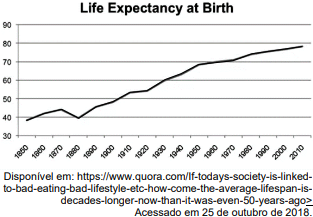
According to the graph above we can assert that
Questão 23 638652
CESMAC Medicina 1° Dia 2019/1Read the graph below and answer the following question.
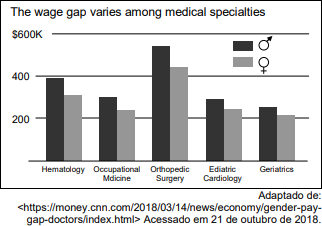
According to the graph above it is true to assert that
Questão 22 638646
CESMAC Medicina 1° Dia 2019/1Read the text below and answer the following question.
Is it time you went on a social media detox?
In today's world, social media is central to our lives. It helps us to stay in touch with our friends, promote our work, and follow the latest news. How do these networks impact our mental and physical health?
A number of studies have linked social media use with increased levels of depression, anxiety, and isolation.
Social media lovers have twice the risk of depression, compared with their less enthusiastic peers.
Research has revealed that younger and older users alike are in danger of breaking under the pressure of unachievable standards of beauty and success.
Among young adult users, social media notably increases the incidence of anxiety and depression, according to the results of a sizeable study conducted in 2016.
In fact, the researchers saw that users who frequently checked their accounts had a more than twice as high a risk of depression than their less social media-oriented peers.
This may partly be due to the fact that social networks create an artificial need to be available 24/7, to respond to messages and emoji reactions instantly. But this attitude creates an unnecessary amount of low-key stress that takes its toll on our emotional well-being.
And, despite the fact that such platforms are supposed to enhance our sense of connectedness with other people, research has found that they actually have the opposite effect: they render dedicated users lonelier and more isolated.
However, this shouldn't really surprise us. The hyperconnectedness takes place at a superficial level, eliminating all of the extra elements that make communication more valuable and psychologically constructive.
Such elements include eye contact, body language, the possibility of listening for changes in our interlocutor's tone of voice, or the possibility of physical touch.
An over-active social media presence can leave its mark not just on our mental health, but also on our physical health — particularly by altering our sleep patterns.
Lastly, researchers have proven that our commitment to social media platforms can negatively affect our commitment to our own creative and professional lives in complex ways.
Adaptado de: < https://www.medicalnewstoday.com/articles/321498.php?sr> Acessado em 19 de outubro de 2018.
The pernicious effects of social media
Questão 21 638641
CESMAC Medicina 1° Dia 2019/1Read the text below and answer the following question.
Is it time you went on a social media detox?
In today's world, social media is central to our lives. It helps us to stay in touch with our friends, promote our work, and follow the latest news. How do these networks impact our mental and physical health?
A number of studies have linked social media use with increased levels of depression, anxiety, and isolation.
Social media lovers have twice the risk of depression, compared with their less enthusiastic peers.
Research has revealed that younger and older users alike are in danger of breaking under the pressure of unachievable standards of beauty and success.
Among young adult users, social media notably increases the incidence of anxiety and depression, according to the results of a sizeable study conducted in 2016.
In fact, the researchers saw that users who frequently checked their accounts had a more than twice as high a risk of depression than their less social media-oriented peers.
This may partly be due to the fact that social networks create an artificial need to be available 24/7, to respond to messages and emoji reactions instantly. But this attitude creates an unnecessary amount of low-key stress that takes its toll on our emotional well-being.
And, despite the fact that such platforms are supposed to enhance our sense of connectedness with other people, research has found that they actually have the opposite effect: they render dedicated users lonelier and more isolated.
However, this shouldn't really surprise us. The hyperconnectedness takes place at a superficial level, eliminating all of the extra elements that make communication more valuable and psychologically constructive.
Such elements include eye contact, body language, the possibility of listening for changes in our interlocutor's tone of voice, or the possibility of physical touch.
An over-active social media presence can leave its mark not just on our mental health, but also on our physical health — particularly by altering our sleep patterns.
Lastly, researchers have proven that our commitment to social media platforms can negatively affect our commitment to our own creative and professional lives in complex ways.
Adaptado de: < https://www.medicalnewstoday.com/articles/321498.php?sr> Acessado em 19 de outubro de 2018.
Not so enthusiastic social media users
Questão 20 638617
CESMAC Medicina 1° Dia 2019/1Read the text below and answer the following question.
Is it time you went on a social media detox?
In today's world, social media is central to our lives. It helps us to stay in touch with our friends, promote our work, and follow the latest news. How do these networks impact our mental and physical health?
A number of studies have linked social media use with increased levels of depression, anxiety, and isolation.
Social media lovers have twice the risk of depression, compared with their less enthusiastic peers.
Research has revealed that younger and older users alike are in danger of breaking under the pressure of unachievable standards of beauty and success.
Among young adult users, social media notably increases the incidence of anxiety and depression, according to the results of a sizeable study conducted in 2016.
In fact, the researchers saw that users who frequently checked their accounts had a more than twice as high a risk of depression than their less social media-oriented peers.
This may partly be due to the fact that social networks create an artificial need to be available 24/7, to respond to messages and emoji reactions instantly. But this attitude creates an unnecessary amount of low-key stress that takes its toll on our emotional well-being.
And, despite the fact that such platforms are supposed to enhance our sense of connectedness with other people, research has found that they actually have the opposite effect: they render dedicated users lonelier and more isolated.
However, this shouldn't really surprise us. The hyperconnectedness takes place at a superficial level, eliminating all of the extra elements that make communication more valuable and psychologically constructive.
Such elements include eye contact, body language, the possibility of listening for changes in our interlocutor's tone of voice, or the possibility of physical touch.
An over-active social media presence can leave its mark not just on our mental health, but also on our physical health — particularly by altering our sleep patterns.
Lastly, researchers have proven that our commitment to social media platforms can negatively affect our commitment to our own creative and professional lives in complex ways.
Adaptado de: < https://www.medicalnewstoday.com/articles/321498.php?sr> Acessado em 19 de outubro de 2018.
The use of social media
06