


![[Marketing] Questao Topo - deslogado](https://storage.estuda.com.br/banners/0_6b7ebee90b03af1c560c73bb8bcce34a_banner_deslogado_70_dias.png)
Questões de Inglês
19.971 Questões
Questão 51 640961
IFRR Superior 2019/1TEXT
As recent as the mid-2000s, when it came to be used in relation to satirical TV shows such as The Daily Show (which has been airing since 1996) and The Colbert Report (2005- 2014), the term ‘fake news’ even had a mildly progressive ring to it. Mimicking the spin and double-speak of politicians and corporations, which often goes unchallenged on mainstream news media, this TV format has been credited with “conveying real messages”: “As fake news, it satirizes traditional news by reporting in a style similar to network and cable TV news, but it amplifies their biases, mistakes, and deficiencies to ensure that viewers hear them loud and clear” (Gettings 2007, pp. 26- 27). Throughout, “various cues let the audience draw the line pretty clearly between the fake and the real, and the moderately attentive viewer leaves the show better informed about the world, especially the political climate and current state of the media” (ibid.). In satirizing the shortcomings of traditional news media, the “fake news” of The Daily Show “necessitates assumptions about some kind of authentic or legitimate set of news practices” (Baym 2005, p. 262); in other words, it presupposes a certain level of media literacy on the part of its viewers. Instead, it has come to be associated with (often anonymous) sources that spread falsehoods by manipulating their consumers’ emotions and tapping into deeply held partisan beliefs. Indeed, legitimate concerns about the trustworthiness of (putative) news sources, which originally motivated the introduction of the term ‘fake news’, are at risk of being drowned out by tactical usage of the phrase in order to cast aspersions on legitimate news organizations. Thus, as Matthew Dentith has recently argued, “the threat that is accusations of ‘That’s just fake news’ comes out of worries that it is […] merely a rhetorical device used by the powerful to crush dissent” (2017, p. 65). Dentith even goes so far as to define fake news as “an allegation that some story is misleading” (p. 66; italics added). On this account, ‘fake news’ would refer not to the misleading claim itself, but to an appeal to the allegedly misleading nature of a claim—that is, it would be a rhetorical device for undermining a given claim’s authoritative status by alleging that it “lacks some context or additional piece of information which, when revealed, undermines either its truth value, or saliency to some broader claim” (ibid). While I find Dentith’s suggestion intriguing, I do believe it puts the cart before the horse: arguably, both historically and as a sociocultural phenomenon, the emergence of fake news as a genre of purported factual assertions preceded the emergence of the epithet ‘fake news’ as a tactical way of slandering one’s opponents. I shall briefly return to this point in Section 5. For now, in what follows, the main focus will be on fake news as a class of purportedly factual claims that are epistemically deficient (in a way that needs to be specified), rather than as an accusatory speech act.
(Fragment from “Fake News: A Definition”, by Exel Gelfert, Informal Logic, Vol.38, N°.1, pp. 84-117, 2018. URL: http://ojs.uwindsor.ca/ojs/leddy/index.php/informal_logic/article)
Choose the only INCORRECT alternative about the text ideas:
Questão 50 640957
IFRR Superior 2019/1TEXT
As recent as the mid-2000s, when it came to be used in relation to satirical TV shows such as The Daily Show (which has been airing since 1996) and The Colbert Report (2005- 2014), the term ‘fake news’ even had a mildly progressive ring to it. Mimicking the spin and double-speak of politicians and corporations, which often goes unchallenged on mainstream news media, this TV format has been credited with “conveying real messages”: “As fake news, it satirizes traditional news by reporting in a style similar to network and cable TV news, but it amplifies their biases, mistakes, and deficiencies to ensure that viewers hear them loud and clear” (Gettings 2007, pp. 26- 27). Throughout, “various cues let the audience draw the line pretty clearly between the fake and the real, and the moderately attentive viewer leaves the show better informed about the world, especially the political climate and current state of the media” (ibid.). In satirizing the shortcomings of traditional news media, the “fake news” of The Daily Show “necessitates assumptions about some kind of authentic or legitimate set of news practices” (Baym 2005, p. 262); in other words, it presupposes a certain level of media literacy on the part of its viewers. Instead, it has come to be associated with (often anonymous) sources that spread falsehoods by manipulating their consumers’ emotions and tapping into deeply held partisan beliefs. Indeed, legitimate concerns about the trustworthiness of (putative) news sources, which originally motivated the introduction of the term ‘fake news’, are at risk of being drowned out by tactical usage of the phrase in order to cast aspersions on legitimate news organizations. Thus, as Matthew Dentith has recently argued, “the threat that is accusations of ‘That’s just fake news’ comes out of worries that it is […] merely a rhetorical device used by the powerful to crush dissent” (2017, p. 65). Dentith even goes so far as to define fake news as “an allegation that some story is misleading” (p. 66; italics added). On this account, ‘fake news’ would refer not to the misleading claim itself, but to an appeal to the allegedly misleading nature of a claim—that is, it would be a rhetorical device for undermining a given claim’s authoritative status by alleging that it “lacks some context or additional piece of information which, when revealed, undermines either its truth value, or saliency to some broader claim” (ibid). While I find Dentith’s suggestion intriguing, I do believe it puts the cart before the horse: arguably, both historically and as a sociocultural phenomenon, the emergence of fake news as a genre of purported factual assertions preceded the emergence of the epithet ‘fake news’ as a tactical way of slandering one’s opponents. I shall briefly return to this point in Section 5. For now, in what follows, the main focus will be on fake news as a class of purportedly factual claims that are epistemically deficient (in a way that needs to be specified), rather than as an accusatory speech act.
(Fragment from “Fake News: A Definition”, by Exel Gelfert, Informal Logic, Vol.38, N°.1, pp. 84-117, 2018. URL: http://ojs.uwindsor.ca/ojs/leddy/index.php/informal_logic/article)
Choose the only alternative which shows what it is CORRECT to say about the text:
Questão 23 640492
USF 2019/1Read the text carefully.
New Sema4 DNA test screens your child for 193 genetic diseases
Rich Haridy | February 8th, 2018
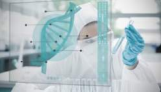
A DNA test has just been launched allowing parents to screen their newborn babies and children for a variety of childhood-onset diseases. Offered by genomic testing company Sema4, the test involves gathering a DNA sample via a simple cheek swab that is then mailed back to the company for sequencing.
Newborns in the United States are currently screened for around 34 genetic conditions. This new test, the Sema4 Natalis, is designed to identify 193 different disorders that are all designated as childhood-onset diseases.
"Until now, families have been likely to be caught off-guard by these early-onset diseases, and prognosis is often poor by the time symptoms have manifested," says CEO of Sema4, Eric Schadt. "Thanks to breakthroughs in science and medicine, we can now identify babies at risk for these broader set of diseases and deliver interventions – sometimes as simple as vitamin supplements – in time to make a real difference."
Sema4 suggests that all conditions covered by the test have associated medical interventions, meaning the results have directly actionable outcomes either through medication or dietary interventions. The test also screens for variants in 10 genes associated with side effects or sensitivity to 38 different commonly prescribed medications. The company suggests this information can help guide parents and doctors in avoiding incorrect doses or adverse effects from medications.
These kind of DNA tests are often engulfed in controversy, as simply testing positive for a genetic mutation doesn't necessarily mean one will actually develop the associated condition. While Sema4 would suggest this information helps parents care for their children in the best possible way, critics claim these tests can lead to unnecessary medical tests and anxiety in parents.
"You put parents in a terrible position, because they don't know if they should wait until the child is sick to do in some cases draconian treatments," geneticist Laura Hercher told MIT Technology Review.
In a clear attempt to get ahead of these ethical concerns Sema4 has joined up with a network of doctors and genetic counselors to help guide parents through the test results. Included in the US$649 test price is one consultation with a genetic counselor following the delivery of the results.
While direct-to-consumer genetic testing is a burgeoning market, ¹these tests are still generally required to go through a doctor to help make sure patients understand the consequences of their results. Every order placed through Sema4 is reviewed by a doctor in order to fulfil the federal requirements for this kind of personal genetic testing.
Last year, 23andme became the first direct-to-consumer genetic test to receive FDA approval for DNA testing without a doctor's supervision. The test was limited to 10 specific conditions only and cost $199.
Retrieved from: https://newatlas.com/sema4-baby-dna-testing/53314/
Consider the statements extracted from the text and choose the alternative in which there are only correct propositions.
I. In the sentence, “… these tests are still generally required to go through a doctor …” (ref.1) the adverb generally can be replaced, maintaining its meaning, by the adverb commonly.
II. The Direct Speech form of the sixth paragraph would be “Geneticist Laura Hercher told MIT Technology Review that you put parents in a terrible position, because they didn’t know if they should wait until the child is sick to do in some cases draconian treatments.”
III. In the present perfect sentence “A DNA test has just been launched allowing parents to screen their newborn babies and children for a variety of childhood-onset diseases”, we could replace the verb been by gone without changing the meaning of the sentence.
IV. The underlined pronouns they and their respectively refer to: parents and tests.
Questão 21 640475
USF 2019/1Read the infographic carefully.
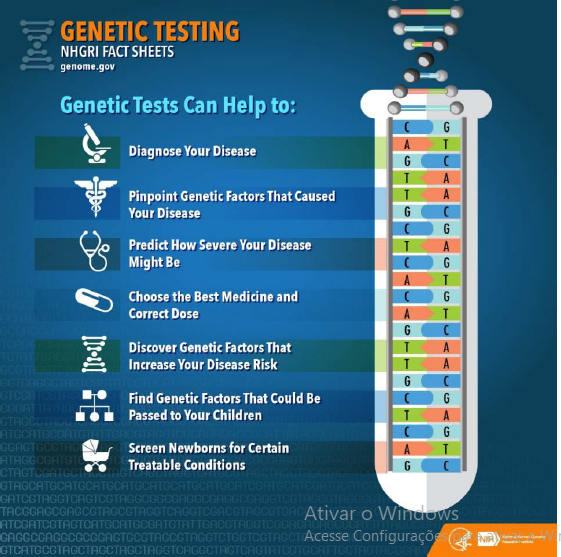
Retrieved from: <https://www.genome.gov/19516567/faq-about-genetic-testing/>.
Analyze the Genetic Testing infographic, and choose the information, which is not mentioned in the infographic.
Questão 79 640336
FAMP 2019/1Text - Are countries trying to end US dollar's power?
Russia's Foreign Minister Sergei Lavrov has suggested that the U.S. dollar could be losing its status as the world's most important currency. Mr. Lavrov said that because the U.S. has imposed economic sanctions on countries like Iran, Turkey and Russia, these countries could start conducting international business in their own national currencies instead of the dollar. In addition, countries that have had trade tariffs imposed on them by the U.S. could also do trade in their own currencies. This could include the global economic superpower China dropping the dollar. China has already established trade deals in its own currency.
Experts say the U.S. dollar could lose its position as the international reserve currency. The U.S. dollar replaced the British pound as the international reserve currency in the 1920s. Since then, most international trade has taken place using the dollar. This means more U.S. dollars flow out of the U.S. than flow in. The effect of this is the U.S. has a currency deficit as its dollars are in the bank accounts of other countries. Mr. Lavrov said: "I'm confident that the grave abuse of the role of the U.S. dollar as a global reserve currency will result over time in the weakening and demise of its role." China's currency the yuan is emerging as an alternative trading currency. Africa's most populous nation Nigeria has already started trading using the yuan.
Source: https://www.forbes.com (adapted)
Which sentence is correctly written?
Questão 78 640335
FAMP 2019/1Text - Are countries trying to end US dollar's power?
Russia's Foreign Minister Sergei Lavrov has suggested that the U.S. dollar could be losing its status as the world's most important currency. Mr. Lavrov said that because the U.S. has imposed economic sanctions on countries like Iran, Turkey and Russia, these countries could start conducting international business in their own national currencies instead of the dollar. In addition, countries that have had trade tariffs imposed on them by the U.S. could also do trade in their own currencies. This could include the global economic superpower China dropping the dollar. China has already established trade deals in its own currency.
Experts say the U.S. dollar could lose its position as the international reserve currency. The U.S. dollar replaced the British pound as the international reserve currency in the 1920s. Since then, most international trade has taken place using the dollar. This means more U.S. dollars flow out of the U.S. than flow in. The effect of this is the U.S. has a currency deficit as its dollars are in the bank accounts of other countries. Mr. Lavrov said: "I'm confident that the grave abuse of the role of the U.S. dollar as a global reserve currency will result over time in the weakening and demise of its role." China's currency the yuan is emerging as an alternative trading currency. Africa's most populous nation Nigeria has already started trading using the yuan.
Source: https://www.forbes.com (adapted)
Select the correct alternative for Passive Voice.
06