


![[Marketing] Questao Topo - deslogado](https://storage.estuda.com.br/banners/0_6b7ebee90b03af1c560c73bb8bcce34a_banner_deslogado_70_dias.png)
Questões de Inglês
19.971 Questões
Questão 32 1289773
CUSC 2019Leia o texto para responder à questão.
Worshiping the false idols of wellness
Before we go further, I’d like to clear something up: wellness is not the same as medicine. Medicine is the science of reducing death and disease, and increasing long and healthy lives. Wellness used to mean a blend of health and happiness. Something that made you feel good or brought joy and was not medically harmful — perhaps a massage or a walk along the beach. But it has become a false antidote to the fear of modern life and death.
The wellness industry takes medical terminology, such as “inflammation” or “free radicals,” and polishes it to the point of incomprehension. The resulting product is a “Do It Yourself” medicine for longevity that comes with a confidence that science can only aspire to achieve.
Let’s take the trend of adding a pinch of activated charcoal to your food or drink. While the black color is strikingly unexpected and alluring, it’s sold as a supposed “detox.” Guess what? It has the same efficacy as a spell from the local witch. Maybe it’s a matter of aesthetics. Wellness potions in beautiful jars with untested ingredients of unknown purity are practically packaged for Instagram.
Medicine and religion have long been deeply intertwined, and it’s only relatively recently that they have separated. The wellness-industrial complex seeks to resurrect that connection. It’s like a medical throwback, as if the idyllic days of health were 5,000 years ago. Ancient cleansing rituals with a modern twist — supplements, useless products and scientifically unsupported tests.
The dietary supplements that are the backbone of wellness make up a $30 billion a year business despite studies showing they have no value for longevity (only a few vitamins have proven medical benefits, like folic acid before and during pregnancy and vitamin D for older people at risk of falling). Modern medicine wants you to get your micronutrients from your diet, which is inarguably the most natural source.
Yet the wellness-industrial complex has managed to pervert that narrative and make supplements a necessary tool for nonsensical practices, such as boosting the immune system or fighting the war on inflammation. The resulting fluorescent yellow urine from multivitamins may provide a false sense of efficacy, but it’s a fool’s gold (and the consequence of excessive B2 that couldn’t possibly be absorbed). So what’s the harm of spending money on charcoal for non-existent toxins or vitamins for expensive urine? Here’s what: the placebo effect or “trying something natural” can lead people with serious illnesses to postpone effective medical care. However, I admit that doctors can learn something from wellness. It’s clear that some people are looking for healers, so we must find ways to serve that need that are medically ethical.
(Jen Gunter. www.nytimes.com, 01.08.2018. Adaptado.)
O trecho inicial do primeiro parágrafo “Before we go further” tem sentido equivalente, em português, a
Questão 31 1289772
CUSC 2019Leia o texto para responder à questão.
Worshiping the false idols of wellness
Before we go further, I’d like to clear something up: wellness is not the same as medicine. Medicine is the science of reducing death and disease, and increasing long and healthy lives. Wellness used to mean a blend of health and happiness. Something that made you feel good or brought joy and was not medically harmful — perhaps a massage or a walk along the beach. But it has become a false antidote to the fear of modern life and death.
The wellness industry takes medical terminology, such as “inflammation” or “free radicals,” and polishes it to the point of incomprehension. The resulting product is a “Do It Yourself” medicine for longevity that comes with a confidence that science can only aspire to achieve.
Let’s take the trend of adding a pinch of activated charcoal to your food or drink. While the black color is strikingly unexpected and alluring, it’s sold as a supposed “detox.” Guess what? It has the same efficacy as a spell from the local witch. Maybe it’s a matter of aesthetics. Wellness potions in beautiful jars with untested ingredients of unknown purity are practically packaged for Instagram.
Medicine and religion have long been deeply intertwined, and it’s only relatively recently that they have separated. The wellness-industrial complex seeks to resurrect that connection. It’s like a medical throwback, as if the idyllic days of health were 5,000 years ago. Ancient cleansing rituals with a modern twist — supplements, useless products and scientifically unsupported tests.
The dietary supplements that are the backbone of wellness make up a $30 billion a year business despite studies showing they have no value for longevity (only a few vitamins have proven medical benefits, like folic acid before and during pregnancy and vitamin D for older people at risk of falling). Modern medicine wants you to get your micronutrients from your diet, which is inarguably the most natural source.
Yet the wellness-industrial complex has managed to pervert that narrative and make supplements a necessary tool for nonsensical practices, such as boosting the immune system or fighting the war on inflammation. The resulting fluorescent yellow urine from multivitamins may provide a false sense of efficacy, but it’s a fool’s gold (and the consequence of excessive B2 that couldn’t possibly be absorbed). So what’s the harm of spending money on charcoal for non-existent toxins or vitamins for expensive urine? Here’s what: the placebo effect or “trying something natural” can lead people with serious illnesses to postpone effective medical care. However, I admit that doctors can learn something from wellness. It’s clear that some people are looking for healers, so we must find ways to serve that need that are medically ethical.
(Jen Gunter. www.nytimes.com, 01.08.2018. Adaptado.)
According to the first paragraph, medicine and wellness
Questão 60 1265137
UVV 2019/1Picture
The question refer to the text below.
What is workplace diversity?
Workplace diversity is understanding, accepting, and valuing differences among people, including those:
• of different races, ethnicities, genders, ages, religions, disabilities, and sexual orientations;
• with differences in education, personalities, views, skill sets, experiences, and knowledge bases.
Interestingly, research by Deloitte finds that diversity is perceived differently by generations. Millennials view workplace diversity as the combining of different backgrounds, experiences, and perspectives, and they believe taking advantage of these differences is what leads to innovation.
Gen Xers and Boomers, on the other hand, view workplace diversity as equal and fair representation regardless of demographics without necessarily considering diversity’s relationship with business results.
Available in: ideal.com - Access in: 12/07/2018.
In the last paragraph – “Gen Xers and Boomers, on the other hand, view workplace diversity as equal and fair representation regardless of demographics without necessarily considering diversity’s relationship with business results” – the word in bold is synonymous with
Questão 59 1265131
UVV 2019/1Picture
The question refer to the text below.
What is workplace diversity?
Workplace diversity is understanding, accepting, and valuing differences among people, including those:
• of different races, ethnicities, genders, ages, religions, disabilities, and sexual orientations;
• with differences in education, personalities, views, skill sets, experiences, and knowledge bases.
Interestingly, research by Deloitte finds that diversity is perceived differently by generations. Millennials view workplace diversity as the combining of different backgrounds, experiences, and perspectives, and they believe taking advantage of these differences is what leads to innovation.
Gen Xers and Boomers, on the other hand, view workplace diversity as equal and fair representation regardless of demographics without necessarily considering diversity’s relationship with business results.
Available in: ideal.com - Access in: 12/07/2018.
According to the text, workplace diversity values several differences among people, EXCEPT:
Questão 57 1265120
UVV 2019/1The question refer to the comic strip below.
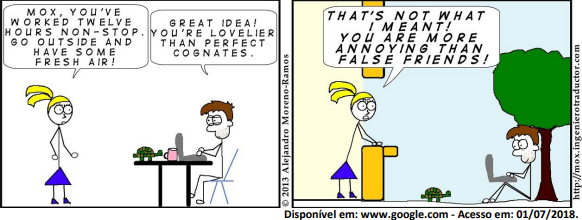
Mox’s assertion – “You’re lovelier than perfect cognates.” – conveys the idea of
Questão 15 1259133
FGV-SP Economia - 1ºFase - LEI/FIS/QUI/LPO - BLOCO 02 2019Read the text in order to answer question.
How to fix inequality

Introduction
In an age of widening inequality, the Stanford professor Walter Scheidel believes he has cracked the code on how to overcome it in his book “The Great Leveler”. The Economist’s Open Future initiative asked Mr Scheidel to reply to a number of questions.
1. The Economist: Is society incapable of tackling income inequality peacefully?
Walter Scheidel: No, but history shows that there are limits. There is a big difference between maintaining existing arrangements that successfully check inequality — Scandinavia is a good example — and significantly reducing it. The latter requires real change and that is always much harder to do: think of America or Britain, not to mention Brazil, China or India. The modern welfare state does a reasonably good job of compensating for inequality before taxes and transfers. However, for more substantial levelling to occur, the established order needs to be shaken up: the greater the shock to the system, the easier it becomes to reduce privilege at the top.
2. The Economist: Are we really living in an implacable period of wealth inequality — or was the relatively equal society that followed the Second World War the real aberration?
Walter Scheidel: When we view history over the long run, we can see that this experience was certainly a novelty. We now know that modernisation as such does not reliably reduce inequality. Many things had to come together to make this happen, such as very high income and estate taxes, strong labour unions, and intrusive regulations and controls. Since the 1980s, liberalisation and globalisation have allowed inequality to rise again. Even so, wealth concentration in Europe is nowhere near as high as it was a century ago. Like Europe, America, meanwhile, is getting there — which shows that it all depends on where you look.
3. The Economist: How do artificial intelligence and automation fit in to your thinking? Will they be a calamity for employment and thus for equality? Or might they unleash extraordinary productivity and improvements in living standards that actually narrow inequality?
Walter Scheidel: Ideally, we would like education to keep up with technological change to make sure workers have the skills they need to face this challenge. But in practice, there will always be losers, and even basic-income schemes can take us only so far. At the end of the day, someone owns the robots. As long as the capitalist world system is in place, it is hard to see how even huge productivity gains from greater automation would benefit society evenly instead of funnelling even more income and wealth to those who are in the best position to pocket these gains.
(The Economist. http://bit.do/eysic. Adaptado)
In the excerpt from Walter Scheidel’s third answer “gains from greater automation would benefit society evenly instead of funnelling even more income and wealth”, the word in bold means
06