


![[Marketing] Questao Topo - deslogado](https://storage.estuda.com.br/banners/0_6b7ebee90b03af1c560c73bb8bcce34a_banner_deslogado_70_dias.png)
Questões de Inglês
19.971 Questões
Questão 59 1291300
CESUPA 2019READ THE TEXT BELOW, ANSWER THE FOLLOWING QUESTION.
Jupiter’s moons and the possibility of life in outer space
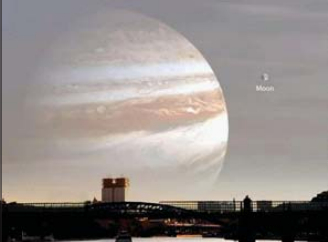
A new study seeking evidence of water vestiges on the surface of Jupiter’s moon Europa demonstrates that, even now, Galileo, a spacecraft sent by NASA nearly 15 years ago, is still providing valuable information.
Since Galileo’s end, the Hubble Space Telescope has periodically observed the Jovian system. Sometimes, when the telescope has looked, it has observed water vapor emissions coming from the surface of Europa. This could indicate the existence of periodic jets of water emanating from the moon’s interior.
The prospect of the water gushing from the moon’s interior has tantalized scientists, as that warm, vast interior ocean is thought to be one of the best places in the Solar System beyond Earth—if not the best—to look for extant life. Since the ice sheet covering Europa is thought to be at least several kilometers thick, being able to sample the ocean from space or the moon’s surface would greatly aid this search.
The Hubble findings were tentative and intriguing, so a team of US astronomers went back and took a second look at data collected by the Galileo spacecraft during its eight-year stay in the Jovian system. To their delight, the images provided by the telescope and the data provided by the Galileo were related, which have given them the authority to say that Europa is really sending plumes of water into space.
(Source: https://arstechnica.com/science/2018/05/twenty-years-ago-the-galileo-spacecraft-flewthrough-a-plume-on-europa/)
Glossary
Jovian: joviano, referente à Júpiter.
Gushing: esguichando.
Extant: existente.
Thick: denso.
The prospect provided by the study about the Jovian system may
Questão 58 1291298
CESUPA 2019READ THE TEXT BELOW, ANSWER THE FOLLOWING QUESTION.
Jupiter’s moons and the possibility of life in outer space
A new study seeking evidence of water vestiges on the surface of Jupiter’s moon Europa demonstrates that, even now, Galileo, a spacecraft sent by NASA nearly 15 years ago, is still providing valuable information.
Since Galileo’s end, the Hubble Space Telescope has periodically observed the Jovian system. Sometimes, when the telescope has looked, it has observed water vapor emissions coming from the surface of Europa. This could indicate the existence of periodic jets of water emanating from the moon’s interior.
The prospect of the water gushing from the moon’s interior has tantalized scientists, as that warm, vast interior ocean is thought to be one of the best places in the Solar System beyond Earth—if not the best—to look for extant life. Since the ice sheet covering Europa is thought to be at least several kilometers thick, being able to sample the ocean from space or the moon’s surface would greatly aid this search.
The Hubble findings were tentative and intriguing, so a team of US astronomers went back and took a second look at data collected by the Galileo spacecraft during its eight-year stay in the Jovian system. To their delight, the images provided by the telescope and the data provided by the Galileo were related, which have given them the authority to say that Europa is really sending plumes of water into space.
(Source: https://arstechnica.com/science/2018/05/twenty-years-ago-the-galileo-spacecraft-flewthrough-a-plume-on-europa/)
Glossary
Jovian: joviano, referente à Júpiter.
Gushing: esguichando.
Extant: existente.
Thick: denso.
The Hubble Space Telescope has
Questão 57 1291291
CESUPA 2019READ THE TEXT BELOW, ANSWER THE FOLLOWING QUESTION.
Jupiter’s moons and the possibility of life in outer space
A new study seeking evidence of water vestiges on the surface of Jupiter’s moon Europa demonstrates that, even now, Galileo, a spacecraft sent by NASA nearly 15 years ago, is still providing valuable information.
Since Galileo’s end, the Hubble Space Telescope has periodically observed the Jovian system. Sometimes, when the telescope has looked, it has observed water vapor emissions coming from the surface of Europa. This could indicate the existence of periodic jets of water emanating from the moon’s interior.
The prospect of the water gushing from the moon’s interior has tantalized scientists, as that warm, vast interior ocean is thought to be one of the best places in the Solar System beyond Earth—if not the best—to look for extant life. Since the ice sheet covering Europa is thought to be at least several kilometers thick, being able to sample the ocean from space or the moon’s surface would greatly aid this search.
The Hubble findings were tentative and intriguing, so a team of US astronomers went back and took a second look at data collected by the Galileo spacecraft during its eight-year stay in the Jovian system. To their delight, the images provided by the telescope and the data provided by the Galileo were related, which have given them the authority to say that Europa is really sending plumes of water into space.
(Source: https://arstechnica.com/science/2018/05/twenty-years-ago-the-galileo-spacecraft-flewthrough-a-plume-on-europa/)
Glossary
Jovian: joviano, referente à Júpiter.
Gushing: esguichando.
Extant: existente.
Thick: denso.
According to the first paragraph, the goal of the new study is to
Questão 56 1291285
CESUPA 2019READ THE TEXT BELOW, ANSWER THE FOLLOWING QUESTION.
Jupiter’s moons and the possibility of life in outer space
A new study seeking evidence of water vestiges on the surface of Jupiter’s moon Europa demonstrates that, even now, Galileo, a spacecraft sent by NASA nearly 15 years ago, is still providing valuable information.
Since Galileo’s end, the Hubble Space Telescope has periodically observed the Jovian system. Sometimes, when the telescope has looked, it has observed water vapor emissions coming from the surface of Europa. This could indicate the existence of periodic jets of water emanating from the moon’s interior.
The prospect of the water gushing from the moon’s interior has tantalized scientists, as that warm, vast interior ocean is thought to be one of the best places in the Solar System beyond Earth—if not the best—to look for extant life. Since the ice sheet covering Europa is thought to be at least several kilometers thick, being able to sample the ocean from space or the moon’s surface would greatly aid this search.
The Hubble findings were tentative and intriguing, so a team of US astronomers went back and took a second look at data collected by the Galileo spacecraft during its eight-year stay in the Jovian system. To their delight, the images provided by the telescope and the data provided by the Galileo were related, which have given them the authority to say that Europa is really sending plumes of water into space.
(Source: https://arstechnica.com/science/2018/05/twenty-years-ago-the-galileo-spacecraft-flewthrough-a-plume-on-europa/)
Glossary
Jovian: joviano, referente à Júpiter.
Gushing: esguichando.
Extant: existente.
Thick: denso.
About 15 years ago, NASA
Questão 40 1289796
CUSC 2019Leia a tirinha e o quadrinho para responder à questão.

Na última fala da tira “I hate him, but I also love him”, os termos sublinhados referem-se
Questão 39 1289790
CUSC 2019Leia a tirinha e o quadrinho para responder à questão.
Uma interpretação tanto da tira quanto do quadrinho pode ser expressa pelo seguinte ditado popular:
06