


![[Marketing] Questao Topo - deslogado](https://storage.estuda.com.br/banners/0_6b7ebee90b03af1c560c73bb8bcce34a_banner_deslogado_70_dias.png)
Questões de Inglês
19.971 Questões
Questão 35 1330512
FAMEMA 2019Leia o texto para responder à questão.
At Hwaban, Mihyun Han with her husband, Key Kim, will present their take on Korean fare, traditional and personalized with modern touches. The serene, neutral-toned dining room with pale brick walls, accented by dark furniture, is the setting for their varied menu. Some of the small plates to start are shrimp or scallop, an organic egg with king crab in a pine nut sauce, and pan-seared zucchini with shrimp in a soy sauce. More substantial dishes include poached lemon sole with vegetables, chicken with root vegetables, and grilled New York strip steak with Korean mountain greens and mustard dressing. Classics like bibimbap, kimchi stew with pork belly, and galbi (short ribs) are also served, and there is a set array of dishes called Hwaban Table. The name of the restaurant means “as beautiful as a flower,” and there are floral elements in the dining room and on some plates.
(Florence Fabricant. www.nytimes.com, 14.08.2018. Adaptado.)
According to the text, the name Hwaban stands for
Questão 34 1330509
FAMEMA 2019Leia o texto para responder à questão.
At Hwaban, Mihyun Han with her husband, Key Kim, will present their take on Korean fare, traditional and personalized with modern touches. The serene, neutral-toned dining room with pale brick walls, accented by dark furniture, is the setting for their varied menu. Some of the small plates to start are shrimp or scallop, an organic egg with king crab in a pine nut sauce, and pan-seared zucchini with shrimp in a soy sauce. More substantial dishes include poached lemon sole with vegetables, chicken with root vegetables, and grilled New York strip steak with Korean mountain greens and mustard dressing. Classics like bibimbap, kimchi stew with pork belly, and galbi (short ribs) are also served, and there is a set array of dishes called Hwaban Table. The name of the restaurant means “as beautiful as a flower,” and there are floral elements in the dining room and on some plates.
(Florence Fabricant. www.nytimes.com, 14.08.2018. Adaptado.)
The dining area of the restaurant is described as
Questão 33 1330504
FAMEMA 2019Leia o texto para responder à questão.
Fake news can distort people’s beliefs even after being debunked. A study recently published in the journal Intelligence suggests that some people may have an especially difficult time rejecting misinformation. Asked to rate a fictitious person on a range of character traits, people who scored low on a test of cognitive ability continued to be influenced by damaging information about the person even after they were explicitly told the information was false. The study is significant because it identifies what may be a major risk factor for vulnerability to fake news.
One possible explanation for this finding is based on the theory that a person’s cognitive ability reflects how well they can regulate the contents of working memory – their “mental workspace” for processing information. First proposed by the cognitive psychologists Lynn Hasher and Rose Zacks, this theory holds that some people are more prone to “mental clutter” than other people. In other words, some people are less able to discard (or “inhibit”) information from their working memory that is no longer relevant to the task at hand, or information that has been discredited. Research on cognitive aging indicates that, in adulthood, this ability declines considerably with advancing age, suggesting that older adults may also be especially vulnerable to fake news. Another reason why cognitive ability may predict vulnerability to fake news is that it correlates highly with education. Through education, people may develop meta-cognitive skills – strategies for monitoring and regulating one’s own thinking – that can be used to combat the effects of misinformation.
(www.scientificamerican.com, 06.02.2018. Adaptado.)
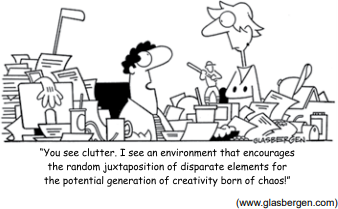
A partir da associação entre o texto e o cartum, depreende-se que a expressão “mental clutter”, empregada no segundo parágrafo do texto, significa
Questão 32 1330499
FAMEMA 2019Leia o texto para responder à questão.
Fake news can distort people’s beliefs even after being debunked. A study recently published in the journal Intelligence suggests that some people may have an especially difficult time rejecting misinformation. Asked to rate a fictitious person on a range of character traits, people who scored low on a test of cognitive ability continued to be influenced by damaging information about the person even after they were explicitly told the information was false. The study is significant because it identifies what may be a major risk factor for vulnerability to fake news.
One possible explanation for this finding is based on the theory that a person’s cognitive ability reflects how well they can regulate the contents of working memory – their “mental workspace” for processing information. First proposed by the cognitive psychologists Lynn Hasher and Rose Zacks, this theory holds that some people are more prone to “mental clutter” than other people. In other words, some people are less able to discard (or “inhibit”) information from their working memory that is no longer relevant to the task at hand, or information that has been discredited. Research on cognitive aging indicates that, in adulthood, this ability declines considerably with advancing age, suggesting that older adults may also be especially vulnerable to fake news. Another reason why cognitive ability may predict vulnerability to fake news is that it correlates highly with education. Through education, people may develop meta-cognitive skills – strategies for monitoring and regulating one’s own thinking – that can be used to combat the effects of misinformation.
(www.scientificamerican.com, 06.02.2018. Adaptado.)
Considere o trecho do segundo parágrafo “Research on cognitive aging indicates that, in adulthood, this ability declines considerably”.
O termo sublinhado é empregado com o mesmo sentido em:
Questão 31 1330494
FAMEMA 2019Leia o texto para responder à questão.
Fake news can distort people’s beliefs even after being debunked. A study recently published in the journal Intelligence suggests that some people may have an especially difficult time rejecting misinformation. Asked to rate a fictitious person on a range of character traits, people who scored low on a test of cognitive ability continued to be influenced by damaging information about the person even after they were explicitly told the information was false. The study is significant because it identifies what may be a major risk factor for vulnerability to fake news.
One possible explanation for this finding is based on the theory that a person’s cognitive ability reflects how well they can regulate the contents of working memory – their “mental workspace” for processing information. First proposed by the cognitive psychologists Lynn Hasher and Rose Zacks, this theory holds that some people are more prone to “mental clutter” than other people. In other words, some people are less able to discard (or “inhibit”) information from their working memory that is no longer relevant to the task at hand, or information that has been discredited. Research on cognitive aging indicates that, in adulthood, this ability declines considerably with advancing age, suggesting that older adults may also be especially vulnerable to fake news. Another reason why cognitive ability may predict vulnerability to fake news is that it correlates highly with education. Through education, people may develop meta-cognitive skills – strategies for monitoring and regulating one’s own thinking – that can be used to combat the effects of misinformation.
(www.scientificamerican.com, 06.02.2018. Adaptado.)
O tema central do texto é
Questão 48 1315057
AFA 2019Instruction: Answer the question according to the text.
TEXT
WHY DO SUPERVILLAINS FASCINATE US? A PSYCHOLOGICAL PERSPECTIVE
Why are we fascinated by supervillains? Posing
the question is much like asking why evil itself intrigues
us, but there's much more to our continued interest in
supervillains than meets the eye.
[5] Not only do Lex Luthor, Dracula and the Red Skull
run unconstrained by conventional morality, they exist
outside the limits of reality itself. Their evil, even at its
most realistic, retains a touch of the unreal.
But is our fascination with fantastic fiends1
[10] healthy? From a psychological perspective, views vary
on what drives our enduring interest in superhuman bad
guys.
Shadow confrontation: Psychiatrist Carl Jung
believed we need to confront and understand our own
[15] hidden nature to grow as human beings. Healthy
confrontation with our shadow selves can unearth new
strengths (e.g., Bruce Wayne creating his Dark Knight
persona to fight crime), whereas unhealthy attempts at
confrontation may involve dwelling on or unleashing the
[20] worst parts of ourselves.
Wish fulfillment: Sigmund Freud viewed human
nature as inherently antisocial, biologically driven by the
undisciplined id's pleasure principle to get what we
want when we want it – born to be bad but held back by
[25] society. Even if the psyche fully develops its ego
(source of self-control) and superego (conscience),
Freudians say the id still dwells2
underneath, and it
wishes for many selfish things – so it would love to be
supervillainous.
[30] Hierarchy of needs: Humanistic psychologist
Abraham Maslow held that people who haven't met
their most basic needs will have difficulty maturing. If
starved for food, you're unlikely to feel secure. If
starved for love and companionship, you'll have trouble
[35] building self-esteem. People who dwell on their deficits
may envy and resent others who have more than they
do. Some people who are unable to overcome social
shortcomings fantasize about obtaining any means,
good or bad, to satisfy every need and greed.
[40] Conditioning: Ivan Pavlov would say we can learn
to associate supervillains with other things we value –
like entertainment, strength, freedom or the heroes
themselves. Behaviorist B.F. Skinner would likely argue
that we can find it reinforcing to watch or read about
[45] supervillains, but without knowing what's reinforcing
about them, that's a bit like saying it's rewarding
because it's rewarding.
Our Motivations for Seeking Out Supervillains
Throughout history, humans have been captivated
[50] by stories of heroes facing off against superhuman
foes3. But what specific rewards, needs, wishes and
dark dreams do supervillains satisfy?
Freedom: Superpowered characters enjoy
freedoms the rest of us don't. Nobody can arrest
[55] Superman unless he lets them (at least not without
kryptonite handcuffs). As much time as supervillains
spend locked up, they seem to escape as often as they
please, to run unconstrained by rules and regulations.
Cosplayers who dress like Wonder Woman and
[60] Captain America can't do any crazy thing that crosses
their minds without seeming to mock and insult our
heroes, whereas those dressed as villains get to go
wild. Supervillainy feels liberating.
Power: Maybe you envy the power these evil
[65] characters wield4 .While that's also a reason to adore
superheroes, good guys don't ache to dominate.
Stories like Watchmen and Kingdom Come show how
heroes become menaces5 when they try to take over.
So when dreaming of superpowers, maybe you relate
[70] to characters who dream of power as well, from the
Scarecrow (who controls individuals' fears) to Doctor
Doom (who's perpetually out to dominate the world).
Better villain than victim: Physiologically, anger
activates us and feels better than anxiety or fear. One
[75] who feels victimized and cannot figure out constructive
ways to stand up, be strong or become heroic might
twist the need for self-assertion into destruction.
Alternately, a healthy person simply might focus on how
all characters assert themselves in any given story.
[80] Better villain equals better hero: A hero only
appears as heroic as the challenge he or she must
overcome. Great heroes require great villains. Without
supercriminals, the world's finest heroes seem like
overpowered brutes nabbing thugs6unworthy of them.
[85] Through myths, legends and lore across time, we have
needed heroes who rise to the occasion, overcome
great odds7 and take down giants.
Facing our fears: Instead of dreading the
darkness, you might reduce that dread by shining a
[90] light and seeing what's out there. Fiction can help us
feel empowered and enlightened without literally
traipsing into mob hangouts8and poorly lit alleyways9.
Exploring the unknown: Our need to challenge
the unknown has driven the human race to cover the
[95] globe. This powerful curiosity makes us wonder about
everything that baffles10 us, including the world's worst
fiends. Knowledge is power, or at least feels like it.
When gritty details repulse us, exploring evil through the
filter of fiction can help us contemplate humanity's
[100] worst without turning away or dwelling almost
voyeuristically on real human tragedy. Even when the
fiction is about improbable people doing impossible
things, the story's fantastic nature reassures us that this
cannot happen – and therefore we don't have to turn
[105] away.
Supervillains' Ultimate Purpose
In the end, our interest in supervillains can be
healthy or unhealthy. Even the more maladaptive
reasons for such fascination tend to arise from
[110] motivations that were originally healthy and natural –
frustrated drives that went the wrong way.
Remember, though, that superheroic fiction
ultimately begins and ends with the heroes. Comic book
writers and artists create supervillains, who move in and
[115] out as guest stars and supporting cast, first and
foremost to reveal how heroic the comics' stars can be.
(Adapted from https://www.wired.com/2012/07/why-do-supervillainsfascinate-us/)
Glossary:
1. fiend – an evil and cruel person
2. to dwell – remain
3. foe – an enemy
4. to wield – influence, use power
5. menace – threat
6. to nab thugs – arrest criminals
7. odds – probability
8. to traipse into mob hangouts – walk among places where gangs, criminals meet
9. poorly lit alleyways – narrow road or path with little light
10. to baffle – confuse somebody completely
The author concludes that
06