


![[Marketing] Questao Topo - deslogado](https://storage.estuda.com.br/banners/0_6b7ebee90b03af1c560c73bb8bcce34a_banner_deslogado_70_dias.png)
Questões de Inglês
19.971 Questões
Questão 23 3289812
UEL 2° Fase 2019Leia o texto a seguir e responda à questão.
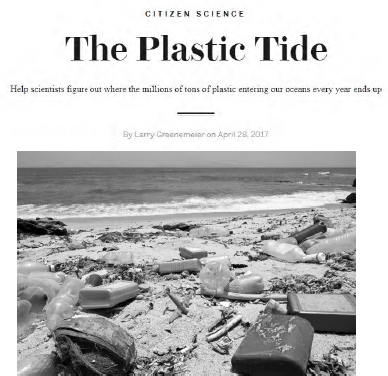
PROJECT DETAILS
* PRINCIPAL SCIENTIST: Peter Kohler, founder and director of The Plastic Tide
* SCIENTIST AFFILIATION: The Scientific Exploration Society and the Royal Geographical Society
* DATES: Ongoing
* PROJECT TYPE: Data Processing
* COST: Free
* GRADE LEVEL: All Ages
* TIME COMMITMENT: variable
* HOW TO JOIN:
REGISTER AT THE ZOONIVERSE WEB SITE. THEN USE YOUR COMPUTER OR MOBILE DEVICE TO ANALYZE IMAGES IN THE PLASTIC TIDE’S DATABASE FOR PLASTICS AND LITTER. TAG EACH PIECE OF PLASTIC YOU SPOT BY DRAWING A RECTANGLE AROUND IT ON YOUR SCREEN AND IDENTIFY IT AS FRAGMENTS, FISHING LINE, DRINK BOTTLES OR SOME OTHER TYPE OF PLASTIC WASTE.
Estimates are currently at trillions of pieces and counting, with over 60 percent of the oceans being heavily contaminated with plastics. With each piece of plastic taking over 400 years to degrade, our oceans, all marine life, and even our own health and livelihoods are in real danger of drowning. Despite this and the 8 million tons of plastics entering our ocean each year, researchers can account for only one percent of that ends up: our ocean surface. Where is the missing 99 percent?
The answer can be found on the seafloor, in marine life, and on our coastlines. The Zooniverse Plastic Tide citizen science project harnesses drone imagery from a series of beaches and the power of computer programs, or machine learning algorithms for the more technically minded, to eventually create a program that can autodetect, measure and monitor the levels of plastics and marine litter washing up on our beaches. Eventually helping us to track where plastics and litter go in our oceans, revealing where the missing 99 percent is in our ocean goes.
By tagging plastics and litter in the images we take with our drone, citizen scientists directly teach our computer program to autodetect, measure and monitor plastics to help researchers answer how much of the missing 99 percent ends up on our beaches. The more you tag, the better the computer program gets at identifying plastics!
GREENEMEIER, L. The Plastic Tide. In: Scientific American (online) Citizen Science. 28 abr. 2018. Disponível em www.scientificamerican.com
Com relação à pesquisa, atribua V (verdadeiro) ou F (falso) às afirmativas a seguir.
( ) O objetivo geral da pesquisa é descobrir o paradeiro dos rejeitos plásticos despejados nos oceanos.
( ) Com o auxílio do banco de dados gerado pela pesquisa, cientistas já conseguem identificar o paradeiro de 1% dos rejeitos plásticos.
( ) Os resíduos plásticos que representam uma ameaça urgente são as linhas de pesca e as garrafas plásticas.
( ) O trabalho dos voluntários com as fotografias auxilia o computador a identificar diferentes tipos de resíduos plásticos.
( ) Segundo estimativas, os resíduoas plásticos contaminam mais da metade dos oceanos.
Assinale a alternativa que contém, de cima para baixo, a sequência correta.
Questão 22 3289729
UEL 2° Fase 2019Leia o texto a seguir e responda à questão.
PROJECT DETAILS
* PRINCIPAL SCIENTIST: Peter Kohler, founder and director of The Plastic Tide
* SCIENTIST AFFILIATION: The Scientific Exploration Society and the Royal Geographical Society
* DATES: Ongoing
* PROJECT TYPE: Data Processing
* COST: Free
* GRADE LEVEL: All Ages
* TIME COMMITMENT: variable
* HOW TO JOIN:
REGISTER AT THE ZOONIVERSE WEB SITE. THEN USE YOUR COMPUTER OR MOBILE DEVICE TO ANALYZE IMAGES IN THE PLASTIC TIDE’S DATABASE FOR PLASTICS AND LITTER. TAG EACH PIECE OF PLASTIC YOU SPOT BY DRAWING A RECTANGLE AROUND IT ON YOUR SCREEN AND IDENTIFY IT AS FRAGMENTS, FISHING LINE, DRINK BOTTLES OR SOME OTHER TYPE OF PLASTIC WASTE.
Estimates are currently at trillions of pieces and counting, with over 60 percent of the oceans being heavily contaminated with plastics. With each piece of plastic taking over 400 years to degrade, our oceans, all marine life, and even our own health and livelihoods are in real danger of drowning. Despite this and the 8 million tons of plastics entering our ocean each year, researchers can account for only one percent of that ends up: our ocean surface. Where is the missing 99 percent?
The answer can be found on the seafloor, in marine life, and on our coastlines. The Zooniverse Plastic Tide citizen science project harnesses drone imagery from a series of beaches and the power of computer programs, or machine learning algorithms for the more technically minded, to eventually create a program that can autodetect, measure and monitor the levels of plastics and marine litter washing up on our beaches. Eventually helping us to track where plastics and litter go in our oceans, revealing where the missing 99 percent is in our ocean goes.
By tagging plastics and litter in the images we take with our drone, citizen scientists directly teach our computer program to autodetect, measure and monitor plastics to help researchers answer how much of the missing 99 percent ends up on our beaches. The more you tag, the better the computer program gets at identifying plastics!
GREENEMEIER, L. The Plastic Tide. In: Scientific American (online) Citizen Science. 28 abr. 2018. Disponível em www.scientificamerican.com
De acordo com o texto, considere as afirmativas a seguir.
I. A coleta de dados para a pesquisa está em progresso e a participação é isenta de restrições.
II. As fotografias tiradas pelos drones alimentam o banco de dados da pesquisa.
III. Os participantes do projeto auxiliam na catalogação dos resíduos plásticos fotografados, presentes no banco de dados.
IV. Por meio de um aplicativo nos telefones celulares, os participantes enviam fotos de rejeitos plásticos encontrados nas praias.
Assinale a alternativa correta.
Questão 72 3252272
UFRR Módulo 3 2019TEXT

Text presents an interaction between a father and his child in which they talk about reasons for supporting candidates in politics.
The expression “should” in the girl’s question and in her father’s answer indicates:
Questão 71 3252267
UFRR Módulo 3 2019Considere o texto a seguir para responder à questão.
TEXT
Emergency after 70,000 Venezuelan migrants cross Brazil border
A state of “social emergency” has been declared in Brazil in response to the massive influx of Venezuelan migrants fleeing economic meltdown at home. President Temer said that funds could be immediately transferred to the northern state of Roraima, which shares a border with Venezuela, and that troops patrolling the border would be doubled to 200. About 70,000 Venezuelans have crossed into Roraima in recent months, with at least 40,000 settling in Boa Vista, the state capital, according to migration authorities. Many arrive on foot with almost nothing, lacking enough money to pay for food and shelter. […]
Adaptado de: https://www.thetimes.co.uk/article/brazil-declares-state-ofemergency-on-venezuela-border-over-migrant-influx-52fnsb7wg Acesso em: 12 out. 2018.
O TEXT retrata uma situação em andamento nas fronteiras da região Norte do Brasil.
A alternativa que o uso da partícula “ING” NÃO indica a forma de gerúndio e, portanto, não é uma ação em progresso é:
Questão 70 3252251
UFRR Módulo 3 2019Considere o texto a seguir para responder à questão.
TEXT
Emergency after 70,000 Venezuelan migrants cross Brazil border
A state of “social emergency” has been declared in Brazil in response to the massive influx of Venezuelan migrants fleeing economic meltdown at home. President Temer said that funds could be immediately transferred to the northern state of Roraima, which shares a border with Venezuela, and that troops patrolling the border would be doubled to 200. About 70,000 Venezuelans have crossed into Roraima in recent months, with at least 40,000 settling in Boa Vista, the state capital, according to migration authorities. Many arrive on foot with almost nothing, lacking enough money to pay for food and shelter. […]
Adaptado de: https://www.thetimes.co.uk/article/brazil-declares-state-ofemergency-on-venezuela-border-over-migrant-influx-52fnsb7wg Acesso em: 12 out. 2018.
Nesse texto é possível observar uma preocupação social com tal movimento migratório, salientada pelo trecho A state of “social emergency” has been declared in Brazil(...).
Esse fragmento está estruturado na voz passiva, cuja voz ativa corresponde a:
Questão 69 3252243
UFRR Módulo 3 2019Considere o texto a seguir para responder à questão.
TEXT

The following words are highlighted in bold in text: BUT – ALIEN – TOP SECRET – FUNNY.
The alternative that describes their function as well as correspondent words that keep their original meaning in the contexts are:
06