


![[Marketing] Questao Topo - deslogado](https://storage.estuda.com.br/banners/0_6b7ebee90b03af1c560c73bb8bcce34a_banner_deslogado_70_dias.png)
Questões de Inglês
19.971 Questões
Questão 19 6557994
FACISB 2019Read the text to answer question.
Ethics Questions in Medical School Interviews
The medical school interview1 frequently involves questions about ethical issues. You may be asked to state your position on topics such as euthanasia, abortion or stem cell research, all of which have ethical implications. Alternatively, you may be given a hypothetical ethical scenario and asked to make a decision.
Medical schools ask these questions because they are interested in the critical-thinking process you employ to arrive at a decision or state your position. Navigating through ethical scenarios can be challenging if you aren’t equipped with the right tools. One important approach that can help you successfully work your way through such scenarios is the development of a logical construct.
Before the interview, develop a set of guiding principles – or logical construct – that you can apply in every ethical scenario or question you face. These guiding principles could be to minimize pain and suffering, to cause the least harm, to take into account the wishes of those affected or to always be fair. Once you have defined these guiding principles, you can apply them to myriad situations. The interviewer wants to see how you arrive at your decision more so than knowing what decision you would ultimately make.
A logical construct can serve as the “how” that gets you to your position. Make sure you discuss the different guiding principles with your interviewer as you apply each to an ethical scenario. In so doing, you will show your interviewer that you are capable of thinking critically.
(Ali Lotfi, M.D. www.usnews.com, 20.06.2017. Adaptado.)
1 Personal interviews are required for admission at essentially all medical schools in the United States.
In the fragment of the first paragraph, “you may be given a hypothetical ethical scenario”, the expression underlined means the same as
Questão 18 6557978
FACISB 2019Read the text to answer question.
Ethics Questions in Medical School Interviews
The medical school interview1 frequently involves questions about ethical issues. You may be asked to state your position on topics such as euthanasia, abortion or stem cell research, all of which have ethical implications. Alternatively, you may be given a hypothetical ethical scenario and asked to make a decision.
Medical schools ask these questions because they are interested in the critical-thinking process you employ to arrive at a decision or state your position. Navigating through ethical scenarios can be challenging if you aren’t equipped with the right tools. One important approach that can help you successfully work your way through such scenarios is the development of a logical construct.
Before the interview, develop a set of guiding principles – or logical construct – that you can apply in every ethical scenario or question you face. These guiding principles could be to minimize pain and suffering, to cause the least harm, to take into account the wishes of those affected or to always be fair. Once you have defined these guiding principles, you can apply them to myriad situations. The interviewer wants to see how you arrive at your decision more so than knowing what decision you would ultimately make.
A logical construct can serve as the “how” that gets you to your position. Make sure you discuss the different guiding principles with your interviewer as you apply each to an ethical scenario. In so doing, you will show your interviewer that you are capable of thinking critically.
(Ali Lotfi, M.D. www.usnews.com, 20.06.2017. Adaptado.)
1 Personal interviews are required for admission at essentially all medical schools in the United States.
According to the text, as far as ethical issues are concerned, what medical schools most want from their applicants is that they
Questão 17 6557946
FACISB 2019Read the text to answer question.
Ethics Questions in Medical School Interviews
The medical school interview1 frequently involves questions about ethical issues. You may be asked to state your position on topics such as euthanasia, abortion or stem cell research, all of which have ethical implications. Alternatively, you may be given a hypothetical ethical scenario and asked to make a decision.
Medical schools ask these questions because they are interested in the critical-thinking process you employ to arrive at a decision or state your position. Navigating through ethical scenarios can be challenging if you aren’t equipped with the right tools. One important approach that can help you successfully work your way through such scenarios is the development of a logical construct.
Before the interview, develop a set of guiding principles – or logical construct – that you can apply in every ethical scenario or question you face. These guiding principles could be to minimize pain and suffering, to cause the least harm, to take into account the wishes of those affected or to always be fair. Once you have defined these guiding principles, you can apply them to myriad situations. The interviewer wants to see how you arrive at your decision more so than knowing what decision you would ultimately make.
A logical construct can serve as the “how” that gets you to your position. Make sure you discuss the different guiding principles with your interviewer as you apply each to an ethical scenario. In so doing, you will show your interviewer that you are capable of thinking critically.
(Ali Lotfi, M.D. www.usnews.com, 20.06.2017. Adaptado.)
1 Personal interviews are required for admission at essentially all medical schools in the United States.
The text is mainly about
Questão 14 6557903
FACISB 2019Read the text to answer question.
What night lights can tell us
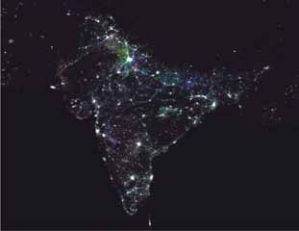
Are night lights on earth captured by satellites from outer space a good way to measure inequality? Economists Praveen Chakravarty and Vivek Dehejia, from the Mumbai-based think tank IDFC Institute, certainly believe so. They acquired images grabbed by satellites from the US Air Force Defence Meteorological Satellite Programme. These satellites circle the earth 14 times a day and record lights from the earth’s surface at night with sensors.
Using data generated by the night lights, they studied 387 of 640 districts in 12 states in India. These districts account for 85% of India’s population and 80% of its GDP1 . Some 87% of parliamentary seats are in these districts. Using the novel methodology, the economists documented income divergence in India.
Most of India is dark at night because there is little economic activity going on. But the delicate tracery of lights as seen from space also showed that the states are becoming more unequal between and within them. And the ratio has worsened between 1992 – a year after India embraced economic reforms – and 2013.
While the pre-1991 years show a modest trend towards convergence of income between different states, the years after show widening divergence. “What we find is that both across states and across districts within each state, this is a wide, and widening disparity in economic activity. No, it is not that the rich are getting richer and the poor getting poorer, but that the poor are not getting richer fast enough to close the gap with the already rich,” says Dr Dehejia. So why are disparities within India rising even as standards of living are going up? Some economists believe it could be due to poor governance and lack of adequate skills for jobs in poorer areas. But, in the end, it remains a puzzle.
(Soutik Biswas. www.bbc.com, 27.05.2018. Adaptado.)
1 GDP: Gross Domestic Product, one of the primary indicators of the state of a country’s economy.
According to the fourth paragraph, studies about economic indicators in India have not been able to answer the question why
Questão 13 6557894
FACISB 2019Read the text to answer question.
What night lights can tell us
Are night lights on earth captured by satellites from outer space a good way to measure inequality? Economists Praveen Chakravarty and Vivek Dehejia, from the Mumbai-based think tank IDFC Institute, certainly believe so. They acquired images grabbed by satellites from the US Air Force Defence Meteorological Satellite Programme. These satellites circle the earth 14 times a day and record lights from the earth’s surface at night with sensors.
Using data generated by the night lights, they studied 387 of 640 districts in 12 states in India. These districts account for 85% of India’s population and 80% of its GDP1 . Some 87% of parliamentary seats are in these districts. Using the novel methodology, the economists documented income divergence in India.
Most of India is dark at night because there is little economic activity going on. But the delicate tracery of lights as seen from space also showed that the states are becoming more unequal between and within them. And the ratio has worsened between 1992 – a year after India embraced economic reforms – and 2013.
While the pre-1991 years show a modest trend towards convergence of income between different states, the years after show widening divergence. “What we find is that both across states and across districts within each state, this is a wide, and widening disparity in economic activity. No, it is not that the rich are getting richer and the poor getting poorer, but that the poor are not getting richer fast enough to close the gap with the already rich,” says Dr Dehejia. So why are disparities within India rising even as standards of living are going up? Some economists believe it could be due to poor governance and lack of adequate skills for jobs in poorer areas. But, in the end, it remains a puzzle.
(Soutik Biswas. www.bbc.com, 27.05.2018. Adaptado.)
1 GDP: Gross Domestic Product, one of the primary indicators of the state of a country’s economy.
The words underlined in “Some 87% of parliamentary seats are in these districts” (2nd paragraph) and “Most of India is dark at night” (3nd paragraph) mean, respectively,
Questão 12 6557887
FACISB 2019Read the text to answer question.
What night lights can tell us
Are night lights on earth captured by satellites from outer space a good way to measure inequality? Economists Praveen Chakravarty and Vivek Dehejia, from the Mumbai-based think tank IDFC Institute, certainly believe so. They acquired images grabbed by satellites from the US Air Force Defence Meteorological Satellite Programme. These satellites circle the earth 14 times a day and record lights from the earth’s surface at night with sensors.
Using data generated by the night lights, they studied 387 of 640 districts in 12 states in India. These districts account for 85% of India’s population and 80% of its GDP1 . Some 87% of parliamentary seats are in these districts. Using the novel methodology, the economists documented income divergence in India.
Most of India is dark at night because there is little economic activity going on. But the delicate tracery of lights as seen from space also showed that the states are becoming more unequal between and within them. And the ratio has worsened between 1992 – a year after India embraced economic reforms – and 2013.
While the pre-1991 years show a modest trend towards convergence of income between different states, the years after show widening divergence. “What we find is that both across states and across districts within each state, this is a wide, and widening disparity in economic activity. No, it is not that the rich are getting richer and the poor getting poorer, but that the poor are not getting richer fast enough to close the gap with the already rich,” says Dr Dehejia. So why are disparities within India rising even as standards of living are going up? Some economists believe it could be due to poor governance and lack of adequate skills for jobs in poorer areas. But, in the end, it remains a puzzle.
(Soutik Biswas. www.bbc.com, 27.05.2018. Adaptado.)
1 GDP: Gross Domestic Product, one of the primary indicators of the state of a country’s economy.
According to the second and third paragraphs, economists Praveen Chakravarty and Vivek Dehejia employed the methodology and discovered that, in India,
06