


![[Marketing] Questao Topo - deslogado](https://storage.estuda.com.br/banners/0_6b7ebee90b03af1c560c73bb8bcce34a_banner_deslogado_70_dias.png)
Questões de Inglês
19.971 Questões
Questão 18 6853978
FEMA Medicina 2019/1Leia o texto para responder à questão.
Is alkaline water really better for you?
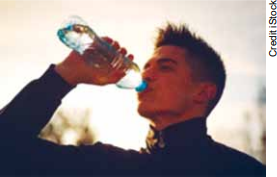
Despite the claims, there’s no evidence that water marketed as alkaline is better for your health than tap water. “It’s all about marketing,” said Tanis Fenton, a registered dietitian and epidemiologist at Cumming School of Medicine at the University of Calgary. “There is no science to back it up.”
The pH scale indicates whether a liquid is more acidic (lower pH) or alkaline (higher pH). Pure water has a neutral pH of 7, while tap water has some natural variation depending on its mineral content. Most bottled waters are slightly acidic, and sodas and juices are even more so. Bottled waters marketed as being alkaline typically claim to have a pH between 8 and 10. Some are from springs or artesian wells and are naturally alkaline because of dissolved minerals. Others are made with an ionizing process, and water ionizing machines are also marketed for home use.
Alkaline water companies make vague claims that it will “energize” and “detoxify” the body and lead to “superior hydration.” And some claim that ionized water can prevent everything from headaches to cancer. Nevertheless, there’s no evidence that drinking water with a higher pH can change the pH of your body, or even that this outcome would provide benefits. Blood is tightly regulated at around pH 7.4, while the stomach, which secretes hydrochloric acid to digest proteins and kill food-borne pathogens, is very acidic, with a pH of 1.5 to 3.5. If you drink water that is slightly alkaline, Dr. Fenton said, the hydrochloric acid in the stomach quickly neutralizes it before it’s absorbed into the blood.
Several small studies funded by companies that sell alkaline water suggest that it could improve hydration in athletes, but any potential benefits were modest, and an easier way to improve hydration is just to drink more water. And a 2016 review of research by Dr. Fenton and a colleague found no evidence that alkaline water or an alkaline diet could treat or prevent cancer.
A study published last year found that adopting a plantbased diet and drinking alkaline water worked as well as medications to alleviate the symptoms of laryngopharyngeal reflux, a severe form of acid reflux in which stomach acid travels all the way up to the throat. “I think that it can be a helpful tool for patients to help with their symptoms while they’re transitioning to a more plant-based diet,” said Dr. Craig Zalvan, the study’s lead author and a laryngologist at Phelps Hospital in Sleepy Hollow, N.Y. But he believes that most of the improvement in his patients comes from dietary changes rather than alkaline water. Once symptoms improve, he says there’s no need to keep drinking alkaline water.
(Alice Callahan. www.nytimes.com, 27.04.2018. Adaptado.)
O trecho do quinto parágrafo “a severe form of acid reflux in which stomach acid travels all the way up to the throat”, configura, em relação à expressão “laryngopharyngeal reflux”, uma
Questão 16 6853968
FEMA Medicina 2019/1Leia o texto para responder à questão.
Is alkaline water really better for you?
Despite the claims, there’s no evidence that water marketed as alkaline is better for your health than tap water. “It’s all about marketing,” said Tanis Fenton, a registered dietitian and epidemiologist at Cumming School of Medicine at the University of Calgary. “There is no science to back it up.”
The pH scale indicates whether a liquid is more acidic (lower pH) or alkaline (higher pH). Pure water has a neutral pH of 7, while tap water has some natural variation depending on its mineral content. Most bottled waters are slightly acidic, and sodas and juices are even more so. Bottled waters marketed as being alkaline typically claim to have a pH between 8 and 10. Some are from springs or artesian wells and are naturally alkaline because of dissolved minerals. Others are made with an ionizing process, and water ionizing machines are also marketed for home use.
Alkaline water companies make vague claims that it will “energize” and “detoxify” the body and lead to “superior hydration.” And some claim that ionized water can prevent everything from headaches to cancer. Nevertheless, there’s no evidence that drinking water with a higher pH can change the pH of your body, or even that this outcome would provide benefits. Blood is tightly regulated at around pH 7.4, while the stomach, which secretes hydrochloric acid to digest proteins and kill food-borne pathogens, is very acidic, with a pH of 1.5 to 3.5. If you drink water that is slightly alkaline, Dr. Fenton said, the hydrochloric acid in the stomach quickly neutralizes it before it’s absorbed into the blood.
Several small studies funded by companies that sell alkaline water suggest that it could improve hydration in athletes, but any potential benefits were modest, and an easier way to improve hydration is just to drink more water. And a 2016 review of research by Dr. Fenton and a colleague found no evidence that alkaline water or an alkaline diet could treat or prevent cancer.
A study published last year found that adopting a plantbased diet and drinking alkaline water worked as well as medications to alleviate the symptoms of laryngopharyngeal reflux, a severe form of acid reflux in which stomach acid travels all the way up to the throat. “I think that it can be a helpful tool for patients to help with their symptoms while they’re transitioning to a more plant-based diet,” said Dr. Craig Zalvan, the study’s lead author and a laryngologist at Phelps Hospital in Sleepy Hollow, N.Y. But he believes that most of the improvement in his patients comes from dietary changes rather than alkaline water. Once symptoms improve, he says there’s no need to keep drinking alkaline water.
(Alice Callahan. www.nytimes.com, 27.04.2018. Adaptado.)
No trecho do terceiro parágrafo “Blood is tightly regulated at around pH 7.4”, o termo sublinhado implica em
Questão 49 6654630
USCS Medicina 2019/2Leia a tirinha de Charlie Brown e sua turma para responder à questão.

A reação dos personagens no último quadrinho indica que eles
Questão 47 6654560
USCS Medicina 2019/2Examine o cartum para responder à questão.

O efeito de humor do cartum decorre, principalmente,
Questão 44 6654538
USCS Medicina 2019/2Leia o texto para responder às questão.
We too often think we are better at something than we are
Are you familiar with the Dunning Kruger effect? It holds that the more incompetent people are, the less they are aware of their incompetence. The effect is named after David Dunning of the University of Michigan and Justin Kruger of New York University.
Dunning and Kruger gave their test subjects a series of cognitive tasks and asked them to estimate how well they did. At best, 25 percent of the participants viewed their performance more or less realistically; only some people underestimated themselves. The quarter of subjects who scored worst on the tests really missed the mark, wildly exaggerating their cognitive abilities. Is it possible that boasting and failing are two sides of the same coin? As the researchers emphasize, their work highlights a general feature of self-perception: each of us tends to overlook our cognitive deficiencies.
So why is the chasm between would-be and actual performance so gaping? Don’t we all have an interest in assessing ourselves realistically? It surely would spare us a great deal of wasted effort and perhaps a few embarrassments. The answer, it seems, is that a moderate inflation of self-esteem has certain benefits. According to a review by psychologists Shelley Taylor and Jonathon Brown, rose-colored glasses1 tend to increase our sense of well-being and our performance. On the other hand, people afflicted by depression are inclined to be brutally realistic in their selfassessments. An embellished self-image seems to help us weather the ups and downs of daily life.
(Steve Ayan. www.scientificamerican.com, 15.05.2018. Adaptado.)
1rose-colored glasses: expressão usada como referência a uma visão positiva ou idealista.
De acordo com o último parágrafo,
Questão 43 6654527
USCS Medicina 2019/2Leia o texto para responder às questão.
We too often think we are better at something than we are
Are you familiar with the Dunning Kruger effect? It holds that the more incompetent people are, the less they are aware of their incompetence. The effect is named after David Dunning of the University of Michigan and Justin Kruger of New York University.
Dunning and Kruger gave their test subjects a series of cognitive tasks and asked them to estimate how well they did. At best, 25 percent of the participants viewed their performance more or less realistically; only some people underestimated themselves. The quarter of subjects who scored worst on the tests really missed the mark, wildly exaggerating their cognitive abilities. Is it possible that boasting and failing are two sides of the same coin? As the researchers emphasize, their work highlights a general feature of self-perception: each of us tends to overlook our cognitive deficiencies.
So why is the chasm between would-be and actual performance so gaping? Don’t we all have an interest in assessing ourselves realistically? It surely would spare us a great deal of wasted effort and perhaps a few embarrassments. The answer, it seems, is that a moderate inflation of self-esteem has certain benefits. According to a review by psychologists Shelley Taylor and Jonathon Brown, rose-colored glasses1 tend to increase our sense of well-being and our performance. On the other hand, people afflicted by depression are inclined to be brutally realistic in their selfassessments. An embellished self-image seems to help us weather the ups and downs of daily life.
(Steve Ayan. www.scientificamerican.com, 15.05.2018. Adaptado.)
1rose-colored glasses: expressão usada como referência a uma visão positiva ou idealista.
Consider the fragment from second paragraph “each of us tends to overlook our cognitive deficiencies”.
The best definition to the underlined word is
06