


![[Marketing] Questao Topo - deslogado](https://storage.estuda.com.br/banners/0_6b7ebee90b03af1c560c73bb8bcce34a_banner_deslogado_70_dias.png)
Questões de Inglês
19.971 Questões
Questão 34 9933665
Humanitas Medicina 2019/1Leia o texto para responder à questão
Plants ‘talk to’ each other through their roots
Plants use their roots to “listen in” on their neighbours,
according to a research that adds to evidence that plants have
their own unique forms of communication. The study found that
plants in a crowded environment secrete chemicals into the
soil that prompt their neighbours to grow more aggressively,
presumably to avoid being left in the shade.
“If we have a problem with our neighbours, we can just
move on,” said Velemir Ninkovic, an ecologist at the Swedish
University of Agricultural Sciences in Uppsala and lead author.
“Plants can’t do that. They’ve accepted that and they use
signals to avoid competing situations and to prepare for future
competition.” Ninkovic and colleagues simulated the touch of
a nearby plant by stroking the leaves for a minute each day
using a makeup brush.
The possibility that plants communicate has surfaced
periodically as an eccentric idea – in the 1980s it was suggested
that trees send out electrical pulses, called W-waves, when
their neighbours were chopped down. However, in recent
years, fresh evidence has emerged that plants are constantly
sending and receiving signals that scientists are now learning
to eavesdrop on.
(Hannah Devlin. www.theguardian.com, 02.05.2018. Adaptado.)
De acordo com o ecologista Velemir Ninkovic, as plantas
Questão 33 9933663
Humanitas Medicina 2019/1Leia o texto para responder à questão
Plants ‘talk to’ each other through their roots
Plants use their roots to “listen in” on their neighbours,
according to a research that adds to evidence that plants have
their own unique forms of communication. The study found that
plants in a crowded environment secrete chemicals into the
soil that prompt their neighbours to grow more aggressively,
presumably to avoid being left in the shade.
“If we have a problem with our neighbours, we can just
move on,” said Velemir Ninkovic, an ecologist at the Swedish
University of Agricultural Sciences in Uppsala and lead author.
“Plants can’t do that. They’ve accepted that and they use
signals to avoid competing situations and to prepare for future
competition.” Ninkovic and colleagues simulated the touch of
a nearby plant by stroking the leaves for a minute each day
using a makeup brush.
The possibility that plants communicate has surfaced
periodically as an eccentric idea – in the 1980s it was suggested
that trees send out electrical pulses, called W-waves, when
their neighbours were chopped down. However, in recent
years, fresh evidence has emerged that plants are constantly
sending and receiving signals that scientists are now learning
to eavesdrop on.
(Hannah Devlin. www.theguardian.com, 02.05.2018. Adaptado.)
In the excerpt from the second paragraph “Plants can’t do that”, the underlined word refers to
Questão 32 9933653
Humanitas Medicina 2019/1Leia o texto para responder à questão
Plants ‘talk to’ each other through their roots
Plants use their roots to “listen in” on their neighbours,
according to a research that adds to evidence that plants have
their own unique forms of communication. The study found that
plants in a crowded environment secrete chemicals into the
soil that prompt their neighbours to grow more aggressively,
presumably to avoid being left in the shade.
“If we have a problem with our neighbours, we can just
move on,” said Velemir Ninkovic, an ecologist at the Swedish
University of Agricultural Sciences in Uppsala and lead author.
“Plants can’t do that. They’ve accepted that and they use
signals to avoid competing situations and to prepare for future
competition.” Ninkovic and colleagues simulated the touch of
a nearby plant by stroking the leaves for a minute each day
using a makeup brush.
The possibility that plants communicate has surfaced
periodically as an eccentric idea – in the 1980s it was suggested
that trees send out electrical pulses, called W-waves, when
their neighbours were chopped down. However, in recent
years, fresh evidence has emerged that plants are constantly
sending and receiving signals that scientists are now learning
to eavesdrop on.
(Hannah Devlin. www.theguardian.com, 02.05.2018. Adaptado.)
No trecho do primeiro parágrafo “presumably to avoid being left in the shade”, o termo sublinhado expressa sentido de
Questão 31 9933619
Humanitas Medicina 2019/1Leia o texto para responder à questão
Plants ‘talk to’ each other through their roots
Plants use their roots to “listen in” on their neighbours,
according to a research that adds to evidence that plants have
their own unique forms of communication. The study found that
plants in a crowded environment secrete chemicals into the
soil that prompt their neighbours to grow more aggressively,
presumably to avoid being left in the shade.
“If we have a problem with our neighbours, we can just
move on,” said Velemir Ninkovic, an ecologist at the Swedish
University of Agricultural Sciences in Uppsala and lead author.
“Plants can’t do that. They’ve accepted that and they use
signals to avoid competing situations and to prepare for future
competition.” Ninkovic and colleagues simulated the touch of
a nearby plant by stroking the leaves for a minute each day
using a makeup brush.
The possibility that plants communicate has surfaced
periodically as an eccentric idea – in the 1980s it was suggested
that trees send out electrical pulses, called W-waves, when
their neighbours were chopped down. However, in recent
years, fresh evidence has emerged that plants are constantly
sending and receiving signals that scientists are now learning
to eavesdrop on.
(Hannah Devlin. www.theguardian.com, 02.05.2018. Adaptado.)
According to the text, a research indicates that plants can
Questão 22 8840510
Unisinos Verão 2019Instrução: a questão referem-se ao texto a seguir.
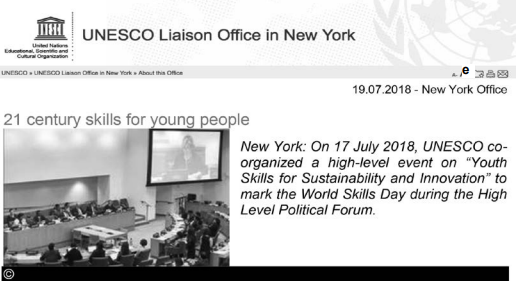
The celebration of the World Youth Skills Day, traditionally organized by the Permanent Missions of Por-
tugal and Sri Lanka, together with UNESCO, ILO and the Office of the Secretary-General’s Envoy on Youth,
brought together high-ranking officials, policy-makers, representatives of diplomatic community, UN entities,
youth organizations and civil society. Representatives of business, tech-companies, labour organizations, ex-
[5] perts in emerging technologies, including UCLA, HP Inc., U.S. Council for International Business, Black in AI,
brought a new perspective to the discussion.
This year, the observance of the Day under the theme “Youth Skills for Sustainability and Innovation” ex-
plored how to equip young people with quality, relevant, 21st century skills that prepare them for the future and
to enable them to address the major challenges and opportunities of our times, such as the rapid digitalization
[10] and climate change.
In his opening remarks, the President of the UN General Assembly H.E. Miroslav Lajcak urged the inter-
national community to invest in skills and education that equips youth not only with basic literacy skills but also
with critical thinking, entrepreneurship skills and adaptability. Recalling the recently held Youth Dialogue, he
outlined the importance of including young people in the decision-making and policy-implementation processes
[15] around the world and at all levels.
"Young people need to take on a leading role in the global effort to create a sustainable world. It is crucial
that we seize young people’s potential” - said the UN Secretary-General’s Envoy on Youth, Jayathma Wickra-
manayake. She outlined that quality education is key to succeed in the job market, and urged to ensure that
young people are equipped with skills and knowledge to respond to technological innovations.
Adaptado de: http://www.unesco.org/new/en/unesco-liaison-office-in-new-york/ about-this-office/single-view/news/21_century_skills_for_young_people/. Acesso em: 28 set. 2018.
Leia as proposições sobre a edição de julho de 2018 do evento World Youth Skills Day, que seguem.
I – Estava centrada na temática das habilidades para a inovação e a sustentabilidade.
II – Discutiu modos de desenvolver as competências necessárias para que jovens possam enfrentar os desafios e oportunidades de nosso tempo.
III – Apontou, a partir da fala do Presidente da Assembleia Geral da ONU, que os jovens participem dos processos de tomada de decisão e de implementação de políticas em todos os níveis, em todo o mundo.
Sobre as proposições acima, pode-se afirmar que
Questão 21 8840484
Unisinos Verão 2019Instrução: a questão referem-se ao texto a seguir.
The celebration of the World Youth Skills Day, traditionally organized by the Permanent Missions of Por-
tugal and Sri Lanka, together with UNESCO, ILO and the Office of the Secretary-General’s Envoy on Youth,
brought together high-ranking officials, policy-makers, representatives of diplomatic community, UN entities,
youth organizations and civil society. Representatives of business, tech-companies, labour organizations, ex-
[5] perts in emerging technologies, including UCLA, HP Inc., U.S. Council for International Business, Black in AI,
brought a new perspective to the discussion.
This year, the observance of the Day under the theme “Youth Skills for Sustainability and Innovation” ex-
plored how to equip young people with quality, relevant, 21st century skills that prepare them for the future and
to enable them to address the major challenges and opportunities of our times, such as the rapid digitalization
[10] and climate change.
In his opening remarks, the President of the UN General Assembly H.E. Miroslav Lajcak urged the inter-
national community to invest in skills and education that equips youth not only with basic literacy skills but also
with critical thinking, entrepreneurship skills and adaptability. Recalling the recently held Youth Dialogue, he
outlined the importance of including young people in the decision-making and policy-implementation processes
[15] around the world and at all levels.
"Young people need to take on a leading role in the global effort to create a sustainable world. It is crucial
that we seize young people’s potential” - said the UN Secretary-General’s Envoy on Youth, Jayathma Wickra-
manayake. She outlined that quality education is key to succeed in the job market, and urged to ensure that
young people are equipped with skills and knowledge to respond to technological innovations.
Adaptado de: http://www.unesco.org/new/en/unesco-liaison-office-in-new-york/ about-this-office/single-view/news/21_century_skills_for_young_people/. Acesso em: 28 set. 2018.
Assinale a opção que apresenta a temática central do texto.
06