


![[Marketing] Questao Topo - deslogado](https://storage.estuda.com.br/banners/0_6b7ebee90b03af1c560c73bb8bcce34a_banner_deslogado_70_dias.png)
Questões de Inglês
19.971 Questões
Questão 48 10780679
UFN Inverno 2019Utilize o texto para responder a questão. Is Time Real or an Illusion?
by Lee Smolin

Diverse thinkers, from the ancient Greek philosophers through to modern day theorists, have called time an illusion. But is there any truth to it?
Diverse thinkers, from the ancient Greek philosophers through to contemporary quantum cosmology and eternal inflation theory, have called time an illusion. For them, the perception of time passing from past moment to present moment is an artefact of our psychology, so that, anything real or true is real or true eternally and timelessly. The belief that reality lies in a timeless realm of truth, rather than in the flow of events our perceptions show us, might be supported by scientific argument but equally, it reflects a metaphysical prejudice.
Contemporary attempts to extend quantum theory to the cosmological, to encompass the whole Universe and not just a sub-system of it, are often couched in equations which suggest time is emergent from a timeless reality. But these attempts suffer from problems, both technical and conceptual, that are even more challenging than the usual conundrums of quantum theory. Several advances in the study of quantum gravity have shown that our four- dimensional space-time is only recovered in a version of the theory in which time is real and not emergent. I would hold that, contrary to the ancient metaphysical tradition, time is not only real, it is likely that it is the only aspect of reality we experience directly that is fundamental and not emergent from anything else.
(Fonte:https://www.sciencefocus.com/)
Com base nas ideias do texto e em seu conhecimento da língua inglesa, é possível afirmar que
Questão 50 10778507
UFN Verão 2019By Reuben Fischer-Baum for The Washington Post
1 In the past three decades, the United States has seen staggering technological changes. In 1984,
just 8 percent of households had a personal computer, the World Wide Web was still five years
away, and cell phones were enormous. Americans born that year are only 34 years old.
Here’s how some key parts of our technological lives have shifted, split loosely into early,
[5] middle and current stages.
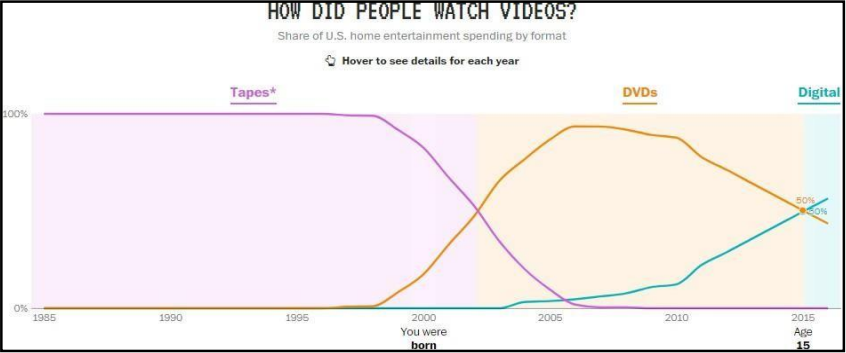
Blockbuster isn’t quite dead yet — as of April there were at least 10 U.S. locations still in operation, mostly in Alaska. But the era of physical videos is on its way out. Children today may never
know the swelling music of a DVD menu that’s looped back to the beginning. And they certainly
will never have to rewind a VHS tape.
[10] But this is just one slice of how home entertainment has changed over the past 30 years. Thanks
to plummeting prices, most Americans now own (large!) HD TVs that were once reserved for the
very wealthy. During the same era, cable overtook network television in profitability and prestige.
Both are now threatened by the twin specters of cord-cutting and streaming.
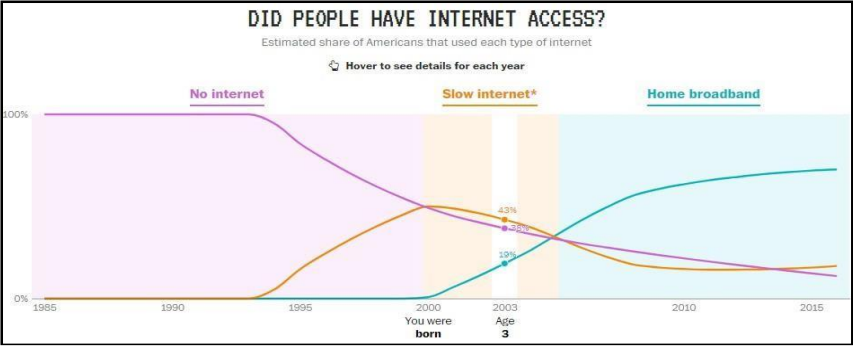
Twenty years ago the Internet was still mostly for play — Geocities was one of the most popular
[15] sites on the Web.
And it was slow! Dial-up — which uses pre-existing telephone lines to connect to the Internet
— was the primary internet technology throughout the ’90s, until faster Broadband services began
to take hold. Dial-up had a max speed of 56 kilobits per second, and could be interrupted by an
incoming phone call
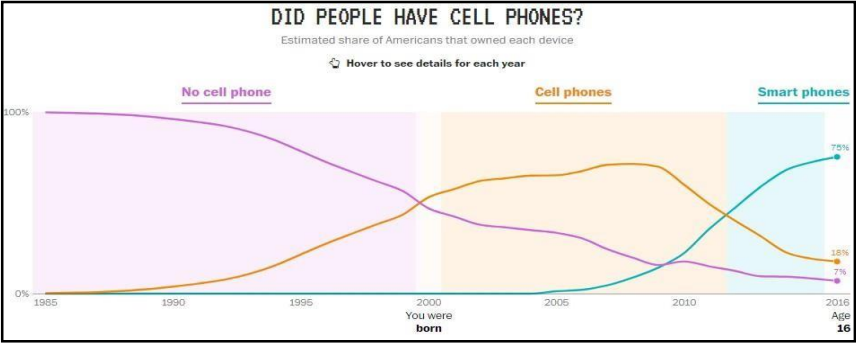
[20] While the first mobile phone call was made in 1973, it took the technology a while to reach the
masses. In the late ’80s, cellphones were still an extravagance, notably used by Gordon Gecko in
1987’s “Wall Street.”
A decade a half later, Nokia and other manufacturers had developed much cheaper models. In
particular, the nearly indestructible Nokia 3310 affectionately known as the “brick” — has a special
[25] place in U.S. mobile history as the first cell phone for many younger Americans.
(Fonte: https://www.washingtonpost.com/adaptado)
Qual alternativa apresenta o uso correto do verbo 'to take' em relação à sentença “[...] it took the technology a while to reach the masses”? (l.20 e 21)
Questão 49 10778506
UFN Verão 2019By Reuben Fischer-Baum for The Washington Post
1 In the past three decades, the United States has seen staggering technological changes. In 1984,
just 8 percent of households had a personal computer, the World Wide Web was still five years
away, and cell phones were enormous. Americans born that year are only 34 years old.
Here’s how some key parts of our technological lives have shifted, split loosely into early,
[5] middle and current stages.
Blockbuster isn’t quite dead yet — as of April there were at least 10 U.S. locations still in operation, mostly in Alaska. But the era of physical videos is on its way out. Children today may never
know the swelling music of a DVD menu that’s looped back to the beginning. And they certainly
will never have to rewind a VHS tape.
[10] But this is just one slice of how home entertainment has changed over the past 30 years. Thanks
to plummeting prices, most Americans now own (large!) HD TVs that were once reserved for the
very wealthy. During the same era, cable overtook network television in profitability and prestige.
Both are now threatened by the twin specters of cord-cutting and streaming.
Twenty years ago the Internet was still mostly for play — Geocities was one of the most popular
[15] sites on the Web.
And it was slow! Dial-up — which uses pre-existing telephone lines to connect to the Internet
— was the primary internet technology throughout the ’90s, until faster Broadband services began
to take hold. Dial-up had a max speed of 56 kilobits per second, and could be interrupted by an
incoming phone call
[20] While the first mobile phone call was made in 1973, it took the technology a while to reach the
masses. In the late ’80s, cellphones were still an extravagance, notably used by Gordon Gecko in
1987’s “Wall Street.”
A decade a half later, Nokia and other manufacturers had developed much cheaper models. In
particular, the nearly indestructible Nokia 3310 affectionately known as the “brick” — has a special
[25] place in U.S. mobile history as the first cell phone for many younger Americans.
(Fonte: https://www.washingtonpost.com/adaptado)
No texto, a palavra “staggering” (l.1) tem o mesmo significado de
Questão 22 10759435
UFT Tarde 2019/2Read the text that follows in order to answer QUESTION.
High-risk areas downhill from mining dams in Brazil
More than 100,000 Brazilians live downhill from mining dams built like the one in Brumadinho that collapsed last month, our estimates found.
Brazil counts 87 mining dams built using the same method, known as upstream tailings construction, as the one that collapsed. That design is risky if not monitored carefully, and experts have warned that a collapse could happen again in a country where neither the mining industry nor regulators have the situation under control.
We looked at each of the 87 upstream dams to estimate if it could threaten populated areas, using geospatial analysis to estimate where the mud could flow if each of the dams failed. For at least 27 of those dams, more than 1,000 people live in high-risk areas. That means they are downhill from the dam and within eight kilometers — the distance the mud flowed after the Brumadinho collapse.
All of those dams were rated by the government at the same risk level, or worse, as the dam that failed in Brumadinho.
“I wouldn’t buy a home downstream of a tailings dam built in an upstream fashion,” said William F. Marcuson III, a former president of the American Society of Civil Engineers. “And I wouldn’t allow my mother to rent or live in a home downstream of a tailings dam built in an upstream fashion.”
Minas Gerais, a state whose name means “general mines”, has been the hub of Brazil’s mining industry for centuries. Today, it still produces 53 percent of the country’s mining output.
Available at: https://www.nytimes.com/interactive/2019/02/14/world/americas/brumadinho-brazildam-collapse.html?smid=pl-share
All alternatives are in accordance with the text, EXCEPT:
Questão 21 10742798
UFT Tarde 2019/2Read the text that follows in order to answer QUESTION.
High-risk areas downhill from mining dams in Brazil
More than 100,000 Brazilians live downhill from mining dams built like the one in Brumadinho that collapsed last month, our estimates found.
Brazil counts 87 mining dams built using the same method, known as upstream tailings construction, as the one that collapsed. That design is risky if not monitored carefully, and experts have warned that a collapse could happen again in a country where neither the mining industry nor regulators have the situation under control.
We looked at each of the 87 upstream dams to estimate if it could threaten populated areas, using geospatial analysis to estimate where the mud could flow if each of the dams failed. For at least 27 of those dams, more than 1,000 people live in high-risk areas. That means they are downhill from the dam and within eight kilometers — the distance the mud flowed after the Brumadinho collapse.
All of those dams were rated by the government at the same risk level, or worse, as the dam that failed in Brumadinho.
“I wouldn’t buy a home downstream of a tailings dam built in an upstream fashion,” said William F. Marcuson III, a former president of the American Society of Civil Engineers. “And I wouldn’t allow my mother to rent or live in a home downstream of a tailings dam built in an upstream fashion.”
Minas Gerais, a state whose name means “general mines”, has been the hub of Brazil’s mining industry for centuries. Today, it still produces 53 percent of the country’s mining output.
Available at: https://www.nytimes.com/interactive/2019/02/14/world/americas/brumadinho-brazildam-collapse.html?smid=pl-share
According to the text, it is CORRECT to affirm:
Questão 20 10742787
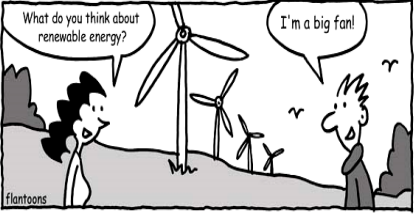
UFT Tarde 2019/2Read the following cartoon in order to answer QUESTION.
Available at: www.ecenglish.com/learnenglish/category/subjects/vocabulary/cartoon?page=1
According to the cartoon, all the following alternatives can be considered correct, EXCEPT:
06