


![[Marketing] Questao Topo - deslogado](https://storage.estuda.com.br/banners/0_6b7ebee90b03af1c560c73bb8bcce34a_banner_deslogado_70_dias.png)
Questões de Inglês
19.971 Questões
Questão 56 1476466
UNESP 1 Fase - Conhecimentos Gerais 2020The General Data Protection Regulation (GDPR), which came into force in 2018, was the biggest shake-up to data privacy in 20 years. A slew of recent high-profile breaches has brought the issue of data security to public attention. Claims surfaced last year that the political consultancy Cambridge Analytica used data harvested from millions of Facebook users without their consent. People are increasingly realizing that their personal data is not just valuable to them, but hugely valuable to others. Now the law on data protection is about to catch up with technological changes.
(Clive Coleman. “GDPR: Are you ready for the EU’s huge data privacy shake-up?”. www.bbc.com, 20.04.2018. Adaptado.)
O texto permite abordar um problema filosófico contemporâneo, que está relacionado
Questão 30 1470037
UNESP 1 Fase - Conhecimentos Gerais 2020Leia o texto sobre uma exposição no museu Tate Modern, em Londres, para responder à questão.
Tate Modern – London
Hélio Oiticica
Until Summer 2019
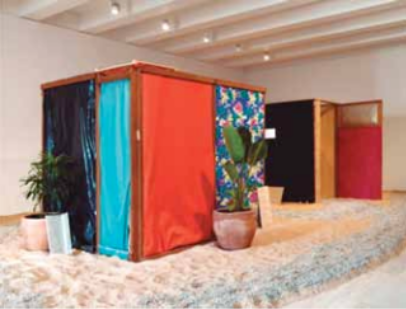
(Hélio Oiticica. Tropicália, Penetrabias PN2 “Purhy is a myth" and PN3 “Imageticar”, 1966-1967.)
Tropicália
Tropicália is used to describe the explosion of cultural creativity in Rio de Janeiro and São Paulo in 1968 as Brazil’s military regime tightened its grip on power.
Many of the artists, writers and musicians associated with Tropicália came of age during the 1950s in a time of intense optimism when the cultural world had been encouraged to play a central role in the creation of a democratic, socially just and modern Brazil. Nevertheless, a military coup in 1964 had brought to power a right-wing regime at odds with the concerns of left-wing artists. Tropicália became a way of exposing the contradictions of modernisation under such an authoritarian rule.
The word Tropicália comes from an installation by the artist Hélio Oiticica, who created environments that were designed to encourage the viewer’s emotional and intellectual participation. Oiticica called them “penetrables” because people were originally encouraged to enter them. They mimic the improvised, colourful dwellings in Rio de Janeiro’s favelas, or shanty towns. The lush plants and sand help to convey a sense of the tropical character of the city. When Oiticica exhibited the work, he also included live parrots.
From its beginning, Tropicália was seen as a re-articulation of Anthropophagia (“cannibalism”), an artistic ideology promoted by Oswald de Andrade.
(www.tate.org.uk. Adaptado.)
De acordo com o terceiro parágrafo, a obra Tropicália, de Hélio Oiticica,
Questão 29 1470035
UNESP 1 Fase - Conhecimentos Gerais 2020Leia o texto sobre uma exposição no museu Tate Modern, em Londres, para responder à questão.
Tate Modern – London
Hélio Oiticica
Until Summer 2019
(Hélio Oiticica. Tropicália, Penetrabias PN2 “Purhy is a myth" and PN3 “Imageticar”, 1966-1967.)
Tropicália
Tropicália is used to describe the explosion of cultural creativity in Rio de Janeiro and São Paulo in 1968 as Brazil’s military regime tightened its grip on power.
Many of the artists, writers and musicians associated with Tropicália came of age during the 1950s in a time of intense optimism when the cultural world had been encouraged to play a central role in the creation of a democratic, socially just and modern Brazil. Nevertheless, a military coup in 1964 had brought to power a right-wing regime at odds with the concerns of left-wing artists. Tropicália became a way of exposing the contradictions of modernisation under such an authoritarian rule.
The word Tropicália comes from an installation by the artist Hélio Oiticica, who created environments that were designed to encourage the viewer’s emotional and intellectual participation. Oiticica called them “penetrables” because people were originally encouraged to enter them. They mimic the improvised, colourful dwellings in Rio de Janeiro’s favelas, or shanty towns. The lush plants and sand help to convey a sense of the tropical character of the city. When Oiticica exhibited the work, he also included live parrots.
From its beginning, Tropicália was seen as a re-articulation of Anthropophagia (“cannibalism”), an artistic ideology promoted by Oswald de Andrade.
(www.tate.org.uk. Adaptado.)
No trecho do segundo parágrafo “a right-wing regime at odds with the concerns of left-wing artists”, a expressão sublinhada tem sentido de
Questão 28 1470032
UNESP 1 Fase - Conhecimentos Gerais 2020Leia o texto sobre uma exposição no museu Tate Modern, em Londres, para responder à questão.
Tate Modern – London
Hélio Oiticica
Until Summer 2019
(Hélio Oiticica. Tropicália, Penetrabias PN2 “Purhy is a myth" and PN3 “Imageticar”, 1966-1967.)
Tropicália
Tropicália is used to describe the explosion of cultural creativity in Rio de Janeiro and São Paulo in 1968 as Brazil’s military regime tightened its grip on power.
Many of the artists, writers and musicians associated with Tropicália came of age during the 1950s in a time of intense optimism when the cultural world had been encouraged to play a central role in the creation of a democratic, socially just and modern Brazil. Nevertheless, a military coup in 1964 had brought to power a right-wing regime at odds with the concerns of left-wing artists. Tropicália became a way of exposing the contradictions of modernisation under such an authoritarian rule.
The word Tropicália comes from an installation by the artist Hélio Oiticica, who created environments that were designed to encourage the viewer’s emotional and intellectual participation. Oiticica called them “penetrables” because people were originally encouraged to enter them. They mimic the improvised, colourful dwellings in Rio de Janeiro’s favelas, or shanty towns. The lush plants and sand help to convey a sense of the tropical character of the city. When Oiticica exhibited the work, he also included live parrots.
From its beginning, Tropicália was seen as a re-articulation of Anthropophagia (“cannibalism”), an artistic ideology promoted by Oswald de Andrade.
(www.tate.org.uk. Adaptado.)
No trecho do segundo parágrafo “Nevertheless, a military coup in 1964”, o termo sublinhado indica
Questão 27 1470028
UNESP 1 Fase - Conhecimentos Gerais 2020Leia o texto sobre uma exposição no museu Tate Modern, em Londres, para responder à questão.
Tate Modern – London
Hélio Oiticica
Until Summer 2019
(Hélio Oiticica. Tropicália, Penetrabias PN2 “Purhy is a myth" and PN3 “Imageticar”, 1966-1967.)
Tropicália
Tropicália is used to describe the explosion of cultural creativity in Rio de Janeiro and São Paulo in 1968 as Brazil’s military regime tightened its grip on power.
Many of the artists, writers and musicians associated with Tropicália came of age during the 1950s in a time of intense optimism when the cultural world had been encouraged to play a central role in the creation of a democratic, socially just and modern Brazil. Nevertheless, a military coup in 1964 had brought to power a right-wing regime at odds with the concerns of left-wing artists. Tropicália became a way of exposing the contradictions of modernisation under such an authoritarian rule.
The word Tropicália comes from an installation by the artist Hélio Oiticica, who created environments that were designed to encourage the viewer’s emotional and intellectual participation. Oiticica called them “penetrables” because people were originally encouraged to enter them. They mimic the improvised, colourful dwellings in Rio de Janeiro’s favelas, or shanty towns. The lush plants and sand help to convey a sense of the tropical character of the city. When Oiticica exhibited the work, he also included live parrots.
From its beginning, Tropicália was seen as a re-articulation of Anthropophagia (“cannibalism”), an artistic ideology promoted by Oswald de Andrade.
(www.tate.org.uk. Adaptado.)
De acordo com o texto, a Tropicália
Questão 26 1470026
UNESP 1 Fase - Conhecimentos Gerais 2020Analyse the following comic.

The objective of the comic is to
06