


![[Marketing] Questao Topo - deslogado](https://storage.estuda.com.br/banners/0_6b7ebee90b03af1c560c73bb8bcce34a_banner_deslogado_70_dias.png)
Questões de Inglês
19.971 Questões
Questão 33 1507505
EPCAR 2020Directions: Read the text below and answer question according to the text.
TEXT
The search for life beyond Earth
We have always been fascinated by the thought of
alien life elsewhere in the universe. The idea has
provided the basis for a huge wealth of science fiction
stories that have been limited only by our imaginations.
[5] But can other creatures exist in the vast reaches of
space or on other planets or moons? And are there
other intelligent forms of life out there—or are we more
likely to find something much simpler?
Where are all the aliens?
[10] Our Sun is just one star among billions in our
galaxy. In the last few years, scientists have detected
thousands of planets around other stars and it seems
that most stars have planetary systems. It’s therefore
likely that there will be large numbers of habitable
[15] planets in the Milky Way galaxy and beyond that are
capable of supporting intelligent life. Some of these
intelligent civilisations, if they’re out there, may have
even developed interstellar travel.
Are there other intelligent forms of life out there—or
[20] are we more likely to find something much simpler?
But Earth hasn’t been visited by any intelligent
aliens (yet?). This apparent high probability of life,
combined with a lack of evidence for its existence, is
called the Fermi Paradox, named for the physicist
[25] Enrico Fermi who first outlined1 the argument back in
1950. This begs the question: where is everybody?
Back in 1961, astronomer Francis Drake tried to
rationalise this question by developing an equation that
takes into account2 all the factors relevant to finding
[30] alien civilisations and gives an estimate of the number
of civilisations out there in the galaxy that should be
able to communicate with us. It considers factors such
as the rate3 of new star formation, how many planets
around those new and existing stars might be able to
[35] support life, the number of planets supporting intelligent
life, how many of those civilisations might have
technology we can detect, whether they’re likely to
communicate with us here on Earth, and so on.
The search for extraterrestrial intelligence
[40] Scientists and radio astronomers have started the
search for extraterrestrial intelligence (SETI) in a
systematic manner. Several international organisations,
including the SETI Institute and the SETI League, are
using radio telescopes to detect signals that might have
[45] been produced by intelligent life.
In 1995, the SETI Institute started Project Phoenix,
which used three of the most powerful radio telescopes
in the world: the Green Bank radio telescope in West
Virginia, USA; the Arecibo telescope in Puerto Rico;
[50] and the Parkes radio telescope in NSW, Australia.
During its initial phase, Project Phoenix used the
Parkes telescope to search for signals coming from 202
Sun-like stars as distant as 155 light years away. By the
end of its operations, Project Phoenix had scanned a
[55] total of 800 ‘nearby’4 (up to 240 light years away) stars
for signs of life. The project detected some cosmic
noises, but none of that could be attributed to aliens.
These days, anyone can become involved in the
search for extraterrestrial intelligence through their
[60] personal computer.
While there’s currently excitement about sending
human crews to Mars, missions beyond the Red Planet
are at this stage pretty much not feasible5 the distances
and travel times involved are simply too great.
[65] Basically, all exploration for life beyond Earth will need
to be done using robotic space probes6 and landing
rovers. These instruments can provide a huge wealth of
information and are capable of exploring as far away as
Pluto, perhaps even beyond our solar system. But as
[70] for life beyond the solar system, the nearest stars are
several light years away, and even communications by
electromagnetic waves (which all travel at the speed of
light) are essentially going to be a one-way message.
While we probably won’t find intelligent life too close
[75] to home, there’s a chance we may still find much
simpler life forms. Do we have neighbours beyond
Earth? Time will tell—and the search continues.
(Adapted from https://www.science.org.au/curious/space-time/search-lifebeyond-earth – Access on 16/02/19)
Glossary:
1. to outline – describe or give the main fact about something
2. to take into account – consider something
3. rate – expansion
4. nearby – short distance away
5. feasible – appropriate; suitable
6. space probe – spy satellite
The text states that
Questão 56 1476466
UNESP 1 Fase - Conhecimentos Gerais 2020The General Data Protection Regulation (GDPR), which came into force in 2018, was the biggest shake-up to data privacy in 20 years. A slew of recent high-profile breaches has brought the issue of data security to public attention. Claims surfaced last year that the political consultancy Cambridge Analytica used data harvested from millions of Facebook users without their consent. People are increasingly realizing that their personal data is not just valuable to them, but hugely valuable to others. Now the law on data protection is about to catch up with technological changes.
(Clive Coleman. “GDPR: Are you ready for the EU’s huge data privacy shake-up?”. www.bbc.com, 20.04.2018. Adaptado.)
O texto permite abordar um problema filosófico contemporâneo, que está relacionado
Questão 30 1470037
UNESP 1 Fase - Conhecimentos Gerais 2020Leia o texto sobre uma exposição no museu Tate Modern, em Londres, para responder à questão.
Tate Modern – London
Hélio Oiticica
Until Summer 2019
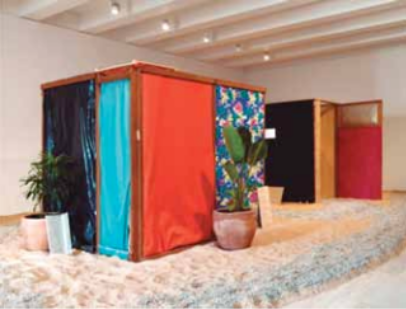
(Hélio Oiticica. Tropicália, Penetrabias PN2 “Purhy is a myth" and PN3 “Imageticar”, 1966-1967.)
Tropicália
Tropicália is used to describe the explosion of cultural creativity in Rio de Janeiro and São Paulo in 1968 as Brazil’s military regime tightened its grip on power.
Many of the artists, writers and musicians associated with Tropicália came of age during the 1950s in a time of intense optimism when the cultural world had been encouraged to play a central role in the creation of a democratic, socially just and modern Brazil. Nevertheless, a military coup in 1964 had brought to power a right-wing regime at odds with the concerns of left-wing artists. Tropicália became a way of exposing the contradictions of modernisation under such an authoritarian rule.
The word Tropicália comes from an installation by the artist Hélio Oiticica, who created environments that were designed to encourage the viewer’s emotional and intellectual participation. Oiticica called them “penetrables” because people were originally encouraged to enter them. They mimic the improvised, colourful dwellings in Rio de Janeiro’s favelas, or shanty towns. The lush plants and sand help to convey a sense of the tropical character of the city. When Oiticica exhibited the work, he also included live parrots.
From its beginning, Tropicália was seen as a re-articulation of Anthropophagia (“cannibalism”), an artistic ideology promoted by Oswald de Andrade.
(www.tate.org.uk. Adaptado.)
De acordo com o terceiro parágrafo, a obra Tropicália, de Hélio Oiticica,
Questão 29 1470035
UNESP 1 Fase - Conhecimentos Gerais 2020Leia o texto sobre uma exposição no museu Tate Modern, em Londres, para responder à questão.
Tate Modern – London
Hélio Oiticica
Until Summer 2019
(Hélio Oiticica. Tropicália, Penetrabias PN2 “Purhy is a myth" and PN3 “Imageticar”, 1966-1967.)
Tropicália
Tropicália is used to describe the explosion of cultural creativity in Rio de Janeiro and São Paulo in 1968 as Brazil’s military regime tightened its grip on power.
Many of the artists, writers and musicians associated with Tropicália came of age during the 1950s in a time of intense optimism when the cultural world had been encouraged to play a central role in the creation of a democratic, socially just and modern Brazil. Nevertheless, a military coup in 1964 had brought to power a right-wing regime at odds with the concerns of left-wing artists. Tropicália became a way of exposing the contradictions of modernisation under such an authoritarian rule.
The word Tropicália comes from an installation by the artist Hélio Oiticica, who created environments that were designed to encourage the viewer’s emotional and intellectual participation. Oiticica called them “penetrables” because people were originally encouraged to enter them. They mimic the improvised, colourful dwellings in Rio de Janeiro’s favelas, or shanty towns. The lush plants and sand help to convey a sense of the tropical character of the city. When Oiticica exhibited the work, he also included live parrots.
From its beginning, Tropicália was seen as a re-articulation of Anthropophagia (“cannibalism”), an artistic ideology promoted by Oswald de Andrade.
(www.tate.org.uk. Adaptado.)
No trecho do segundo parágrafo “a right-wing regime at odds with the concerns of left-wing artists”, a expressão sublinhada tem sentido de
Questão 28 1470032
UNESP 1 Fase - Conhecimentos Gerais 2020Leia o texto sobre uma exposição no museu Tate Modern, em Londres, para responder à questão.
Tate Modern – London
Hélio Oiticica
Until Summer 2019
(Hélio Oiticica. Tropicália, Penetrabias PN2 “Purhy is a myth" and PN3 “Imageticar”, 1966-1967.)
Tropicália
Tropicália is used to describe the explosion of cultural creativity in Rio de Janeiro and São Paulo in 1968 as Brazil’s military regime tightened its grip on power.
Many of the artists, writers and musicians associated with Tropicália came of age during the 1950s in a time of intense optimism when the cultural world had been encouraged to play a central role in the creation of a democratic, socially just and modern Brazil. Nevertheless, a military coup in 1964 had brought to power a right-wing regime at odds with the concerns of left-wing artists. Tropicália became a way of exposing the contradictions of modernisation under such an authoritarian rule.
The word Tropicália comes from an installation by the artist Hélio Oiticica, who created environments that were designed to encourage the viewer’s emotional and intellectual participation. Oiticica called them “penetrables” because people were originally encouraged to enter them. They mimic the improvised, colourful dwellings in Rio de Janeiro’s favelas, or shanty towns. The lush plants and sand help to convey a sense of the tropical character of the city. When Oiticica exhibited the work, he also included live parrots.
From its beginning, Tropicália was seen as a re-articulation of Anthropophagia (“cannibalism”), an artistic ideology promoted by Oswald de Andrade.
(www.tate.org.uk. Adaptado.)
No trecho do segundo parágrafo “Nevertheless, a military coup in 1964”, o termo sublinhado indica
Questão 27 1470028
UNESP 1 Fase - Conhecimentos Gerais 2020Leia o texto sobre uma exposição no museu Tate Modern, em Londres, para responder à questão.
Tate Modern – London
Hélio Oiticica
Until Summer 2019
(Hélio Oiticica. Tropicália, Penetrabias PN2 “Purhy is a myth" and PN3 “Imageticar”, 1966-1967.)
Tropicália
Tropicália is used to describe the explosion of cultural creativity in Rio de Janeiro and São Paulo in 1968 as Brazil’s military regime tightened its grip on power.
Many of the artists, writers and musicians associated with Tropicália came of age during the 1950s in a time of intense optimism when the cultural world had been encouraged to play a central role in the creation of a democratic, socially just and modern Brazil. Nevertheless, a military coup in 1964 had brought to power a right-wing regime at odds with the concerns of left-wing artists. Tropicália became a way of exposing the contradictions of modernisation under such an authoritarian rule.
The word Tropicália comes from an installation by the artist Hélio Oiticica, who created environments that were designed to encourage the viewer’s emotional and intellectual participation. Oiticica called them “penetrables” because people were originally encouraged to enter them. They mimic the improvised, colourful dwellings in Rio de Janeiro’s favelas, or shanty towns. The lush plants and sand help to convey a sense of the tropical character of the city. When Oiticica exhibited the work, he also included live parrots.
From its beginning, Tropicália was seen as a re-articulation of Anthropophagia (“cannibalism”), an artistic ideology promoted by Oswald de Andrade.
(www.tate.org.uk. Adaptado.)
De acordo com o texto, a Tropicália
06