


![[Marketing] Questao Topo - deslogado](https://storage.estuda.com.br/banners/0_6b7ebee90b03af1c560c73bb8bcce34a_banner_deslogado_70_dias.png)
Questões de Inglês
19.971 Questões
Questão 73 6330042
UECE 1ª Fase 2020/1T E X T
I Used to Fear Being a Nobody. Then I Left Social Media.
By Bianca Brooks
What’s happening?”
I stare blankly at the little box as I try to think of something clever for my first tweet. I settle on what’s at the top of my mind: “My only #fear is being a nobody.” How could I know this exchange would begin a dialogue that would continue nearly every day for the next nine years of my life?
I began using Twitter in 2010 as a newly minted high school freshman. Though it began as a hub for my quirky adolescent thoughts, over the years it became an archive of my emotional and intellectual voice — a kind of virtual display for the evolution of my politics and artistic identity. But after nine years, it was time to close the archive. My wanting to share my every waking thought became eclipsed by a desire for an increasingly rare commodity — a private life.
Though I thought disappearing from social media would be as simple as logging off, my refusal to post anything caused a bit of a stir among my small but loyal following. I began to receive emails from strangers asking me where I had gone and when I would return. One message read: “Not to be over familiar, but you have to come back eventually. You’re a writer after all. How will we read your writing?” Another follower inquired, “Where will you go?”
The truth is I have not gone anywhere. I am, in fact, more present than ever.
Over time, I have begun to sense these messages reveal more than a lack of respect for privacy. I realize that to many millennials, a life without a social media presence is not simply a private life; it is no life at all: We possess a widespread, genuine fear of obscurity.
When I consider the near-decade I have spent on social media, this worry makes sense. As with many in my generation, Twitter was my entry into conversations happening on a global scale; long before my byline graced any publication, tweeting was how I felt a part of the world. Twitter functions much like an echo chamber dependent on likes and retweets, and gaining notoriety is as easy as finding someone to agree with you. For years I poured my opinions, musings and outrage onto my timeline, believing I held an indispensable place in a vital sociopolitical experiment.
But these passionate, public observations were born of more than just a desire to speak my mind — I was measuring my individual worth in constant visibility. Implicit in my follower’s question “Where will you go?” is the resounding question “How will we know where you’ve gone?” Privacy is considered a small exchange for the security of being well known and well liked.
After all, a private life boasts no location markers or story updates. The idea that the happenings of our lives would be constrained to our immediate families, friends and real-life communities is akin to social death in a world measured by followers, views, likes and shares.
I grow weary when I think of this as the new normal for what is considered to be a fruitful personal life. Social media is no longer a mere public extension of our private socialization; it has become a replacement for it. What happens to our humanity when we relegate our real lives to props for the performance of our virtual ones?
For one, a predominantly online existence can lull us into a dubious sense of having enacted concrete change, simply because of a tweet or Instagram post. As “hashtag activism” has obscured longstanding traditions of assembly and protest, there’s concern that a failure to transition from the keyboard to in-person organization will effectively stall or kill the momentum of political movements. (See: Occupy Wall Street.)
The sanctity of our most intimate experiences is also diminished. My grandfather Charles Shaw — a notable musician whose wisdoms and jazz scene tales I often shared on Twitter — passed away last year. Rather than take adequate time to privately mourn the loss of his giant influence in my life alongside those who loved him most, I quickly posted a lengthy tribute to him to my followers. At the time I thought, “How will they remember him if I don’t acknowledge his passing?”
Perhaps at the root of this anxiety over being forgotten is an urgent question of how one ought to form a legacy; with the rise of automation, a widening wealth gap and an unstable political climate, it is easy to feel unimportant. It is almost as if the world is too big and we are much too small to excel in it in any meaningful way. We feel we need as many people as possible to witness our lives, so as not to be left out of a story that is being written too fast by people much more significant than ourselves.
“The secret of a full life is to live and relate to others as if they might not be there tomorrow, as if you might not be there tomorrow,” the writer Anais Nin said. “This feeling has become a rarity, and rarer every day now that we have reached a hastier and more superficial rhythm, now that we believe we are in touch with a greater amount of people. This is the illusion which might cheat us of being in touch deeply with the one breathing next to us.”
I think of those words and at once any fear of obscurity is eclipsed by much deeper ones — the fear of forgoing the sacred moments of life, of never learning to be completely alone, of not bearing witness to the incredible lives of those who surround me.
I observe the world around me. It is big and moving fast. “What’s happening?” I think to myself.
I’m just beginning to find out.
From:www.nytimes.com/Oct. 1, 2019
The author was actively involved with social media for
Questão 12 6326280
UECE 1ª Fase 2020/1TEXTO
Diáspora
Acalmou a tormenta
Pereceram
Os que a estes mares ontem se arriscaram
E vivem os que por um amor tremeram
[60] E dos céus os destinos esperaram
Atravessamos o mar Egeu
O barco cheio de fariseus
Como os cubanos, sírios, ciganos
Como romanos sem Coliseu
[65] Atravessamos pro outro lado
No Rio Vermelho do mar sagrado
Os Center shoppings superlotados
De retirantes refugiados
You, where are you?
[70] Where are you?
Where are you?
Onde está
Meu irmão
Sem Irmã
[75] O meu filho sem pai
Minha mãe
Sem avó
Dando a mão pra ninguém
Sem lugar
[80] Pra ficar
Os meninos sem paz
Onde estás
Meu senhor
Onde estás?
[85] Onde estás?
Deus
Ó Deus onde estás
Que não respondes
Em que mundo
[90] Em qu’estrela
Tu t’escondes
Embuçado nos céus
Há dois mil anos te mandei meu grito
Que embalde desde então corre o infinito
[95] Onde estás, Senhor Deus
[...]
ANTUNES, Arnaldo; BROWN, Carlinhos; MONTE, Marisa. Diáspora. In: Tribalistas. Rio de Janeiro: Phonomotor Records Universal Music, 2017. Disponível em: https://www.letras.mus.br/tribalistas/diaspora/. Acesso em: 08 de set. de 2019.
Os versos “You, where are you?/ Where are you?” (linhas 69-71), cuja tradução literal para o português é Você, onde está você? / Onde está você?, encontram-se em língua inglesa porque
Questão 30 6319950
UNICENTRO 2020TEXTO:
Don’t Do This

Given the case of a 43-year-old French
psychiatrist who suffered a minor stroke after spending
more than an hour talking with a telephone between
his head and shoulders, doctors are now warning
[5] us not to cradle the phone between our heads and
shoulders. The stroke caused the man to experience
difficulty speaking and a temporary blindness in his
left eye along with ringing in his left ear. Neurologist
Mathieu Zuber warns, “It shows us how everyday
[10] activities can have unpredictable consequences for
some.”
Speak up, ano XIV, n. 170, p. 36.
“stroke” (l. 2) - derrame cerebral.
“cradle” (l. 5) - to hold.
The “ING” is used as a Present Continuous form in
Questão 28 6319948
UNICENTRO 2020TEXTO:
Don’t Do This
Given the case of a 43-year-old French
psychiatrist who suffered a minor stroke after spending
more than an hour talking with a telephone between
his head and shoulders, doctors are now warning
[5] us not to cradle the phone between our heads and
shoulders. The stroke caused the man to experience
difficulty speaking and a temporary blindness in his
left eye along with ringing in his left ear. Neurologist
Mathieu Zuber warns, “It shows us how everyday
[10] activities can have unpredictable consequences for
some.”
Speak up, ano XIV, n. 170, p. 36.
“stroke” (l. 2) - derrame cerebral.
“cradle” (l. 5) - to hold.
Which question can be answered by the text?
Questão 27 6319946
UNICENTRO 2020TEXTO:
Don’t Do This
Given the case of a 43-year-old French
psychiatrist who suffered a minor stroke after spending
more than an hour talking with a telephone between
his head and shoulders, doctors are now warning
[5] us not to cradle the phone between our heads and
shoulders. The stroke caused the man to experience
difficulty speaking and a temporary blindness in his
left eye along with ringing in his left ear. Neurologist
Mathieu Zuber warns, “It shows us how everyday
[10] activities can have unpredictable consequences for
some.”
Speak up, ano XIV, n. 170, p. 36.
“stroke” (l. 2) - derrame cerebral.
“cradle” (l. 5) - to hold.
The text focuses on
Questão 25 6319943
UNICENTRO 2020Some Schooling on Backpacks
Dr. Ian K. Smith
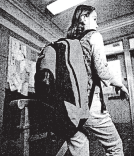
Doctors are concerned that looking cool could be hurting kids.
Here are some ideas to avoid injury.
Like many kids now heading back to school, I used
one of those fashionable single-strap, over-the-shoulder
bags to carry my books around when I was studying in
New York City. But at Dartmouth Medical School, my
[5] city bag turned out to be totally inadequate for lugging
heavy medical texts. I’d lose valuable minutes at the
start of a lecture rubbing an aching arm and shoulder
before I could start writing down what the prof said.
Taking a cue from classmates, I finally got a large, wide
[10] strapped bag with a third strap that wrapped around
the hips. It wasn’t chic but it did wonders for my sore
muscles — and note taking.
That was a first-hand lesson in how the wrong
backpack, or carrying one improperly, can lead to
[15] serious problems. According to the U.S. Consumer
Product Safety Commission, 5,900 kids were treated
at hospital emergency rooms, clinics and doctors’
offices last year for sprains and strains directly caused
by backpacks. Indeed, such injuries are so widespread
[20] that more than 70% of physicians surveyed by the
American Academy of Orthopedic Surgeons listed
backpacks as a potential clinical problem for children,
and 58% said they had treated patients for pain caused
by heavy backpacks.
[25] How to avoid such problems? Like my classmates,
you can choose bags that have wide, padded straps
and a belt. That will help transfer some of the weight
from the back and shoulders to the hips. You should also
tighten both straps firmly, so the pack rests about 5 cm above
[30] your waist. Also, remember to pack your bag with
the heaviest items closest to your back and to bend
both knees when you pick it up.
Have a question? You can e-mail Dr. Ian at ianmedical@aol.com.
Backpacs” (title) - a large bag carried on the back.
“strap” (l. 2) - a strip of leather, cloth or other flexible material.
“lugging” (l. 5) - carrying something with great effort.
“prof” (l. 8) - professor.
“sprains” (l. 18) - injuries.
“strains” (l. 18) - severe demands on physical strengh.
Based on the text the word “that” (l. 10) refers to
06