


![[Marketing] Questao Topo - deslogado](https://storage.estuda.com.br/banners/0_6b7ebee90b03af1c560c73bb8bcce34a_banner_deslogado_70_dias.png)
Questões de Inglês
19.971 Questões
Questão 28 6510873
FMABC 2020Leia o anúncio para responder à questão.

The term “yet” can be replaced, with no change in meaning, by
Questão 27 6510862
FMABC 2020Leia o texto para responder à questão.
A new global crisis?
You drink a Coca-Cola, throw the bottle into the recycling bin... and forget about it. But it doesn’t disappear. Everything you own will one day become the property of the waste industry, a £250 bn global enterprise determined to extract every last penny of value from what remains. In the case of the United Kingdom (UK), some of the waste is kept in the country; but much of it — about half of all paper and cardboard, and twothirds of plastics — will be loaded on to container ships to be sent to Europe or Asia for recycling.
Or, at least, that’s how it used to work. Then, on the first day of 2018, China, the world’s largest market for recycled waste, essentially shut its doors. Under its National Sword policy, China prohibited 24 types of waste from entering the country, arguing that what was coming in was too contaminated. The policy shift was partly attributed to the impact of a documentary, Plastic China, which went viral before censors erased it from China’s internet. The film follows a family working in the country’s recycling industry, where humans pick through vast dunes of western waste. It is filthy, polluting work — and badly paid. The remainder is often burned in the open air. The family lives alongside the sorting machine, their 11-year-old daughter playing with a Barbie pulled from the rubbish.
National Sword was a huge blow1. Still, the waste has to go somewhere. The UK, like most developed nations, produces more waste than it can process: about 1.1 kg per person per day; the US, 2 kg.
There is cause for optimism, though: in December 2018, the UK government published a comprehensive new waste strategy. Among its proposals: a tax on packaging containing less than 30% recycled material and means to force companies to take responsibility for the plastic packaging they produce. They hope to force the industry to invest in recycling infrastructure at home.
Yet such is the torrent of humanity’s refuse that these efforts may not be enough. Recycling rates in the west are stable and packaging use is set to rise in developing countries, where recycling rates are low. If National Sword has shown us anything, it is that recycling — while needed — simply isn’t enough to solve our waste crisis.
(www.theguardian.com, 17.08.2019. Adaptado.)
1 blow: a very disappointing or catastrophic situation.
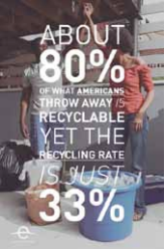
Leia o anúncio para responder à questão.
(inspirationfeed.com)
The lines in the ad correspond to the following idea, explicitly stated in the text:
Questão 26 6510857
FMABC 2020Leia o texto para responder à questão.
A new global crisis?
You drink a Coca-Cola, throw the bottle into the recycling bin... and forget about it. But it doesn’t disappear. Everything you own will one day become the property of the waste industry, a £250 bn global enterprise determined to extract every last penny of value from what remains. In the case of the United Kingdom (UK), some of the waste is kept in the country; but much of it — about half of all paper and cardboard, and twothirds of plastics — will be loaded on to container ships to be sent to Europe or Asia for recycling.
Or, at least, that’s how it used to work. Then, on the first day of 2018, China, the world’s largest market for recycled waste, essentially shut its doors. Under its National Sword policy, China prohibited 24 types of waste from entering the country, arguing that what was coming in was too contaminated. The policy shift was partly attributed to the impact of a documentary, Plastic China, which went viral before censors erased it from China’s internet. The film follows a family working in the country’s recycling industry, where humans pick through vast dunes of western waste. It is filthy, polluting work — and badly paid. The remainder is often burned in the open air. The family lives alongside the sorting machine, their 11-year-old daughter playing with a Barbie pulled from the rubbish.
National Sword was a huge blow1. Still, the waste has to go somewhere. The UK, like most developed nations, produces more waste than it can process: about 1.1 kg per person per day; the US, 2 kg.
There is cause for optimism, though: in December 2018, the UK government published a comprehensive new waste strategy. Among its proposals: a tax on packaging containing less than 30% recycled material and means to force companies to take responsibility for the plastic packaging they produce. They hope to force the industry to invest in recycling infrastructure at home.
Yet such is the torrent of humanity’s refuse that these efforts may not be enough. Recycling rates in the west are stable and packaging use is set to rise in developing countries, where recycling rates are low. If National Sword has shown us anything, it is that recycling — while needed — simply isn’t enough to solve our waste crisis.
(www.theguardian.com, 17.08.2019. Adaptado.)
1 blow: a very disappointing or catastrophic situation.
The reading of the three last paragraphs leads us to understand that, from the author’s point of view,
Questão 25 6510851
FMABC 2020Leia o texto para responder à questão.
A new global crisis?
You drink a Coca-Cola, throw the bottle into the recycling bin... and forget about it. But it doesn’t disappear. Everything you own will one day become the property of the waste industry, a £250 bn global enterprise determined to extract every last penny of value from what remains. In the case of the United Kingdom (UK), some of the waste is kept in the country; but much of it — about half of all paper and cardboard, and twothirds of plastics — will be loaded on to container ships to be sent to Europe or Asia for recycling.
Or, at least, that’s how it used to work. Then, on the first day of 2018, China, the world’s largest market for recycled waste, essentially shut its doors. Under its National Sword policy, China prohibited 24 types of waste from entering the country, arguing that what was coming in was too contaminated. The policy shift was partly attributed to the impact of a documentary, Plastic China, which went viral before censors erased it from China’s internet. The film follows a family working in the country’s recycling industry, where humans pick through vast dunes of western waste. It is filthy, polluting work — and badly paid. The remainder is often burned in the open air. The family lives alongside the sorting machine, their 11-year-old daughter playing with a Barbie pulled from the rubbish.
National Sword was a huge blow1. Still, the waste has to go somewhere. The UK, like most developed nations, produces more waste than it can process: about 1.1 kg per person per day; the US, 2 kg.
There is cause for optimism, though: in December 2018, the UK government published a comprehensive new waste strategy. Among its proposals: a tax on packaging containing less than 30% recycled material and means to force companies to take responsibility for the plastic packaging they produce. They hope to force the industry to invest in recycling infrastructure at home.
Yet such is the torrent of humanity’s refuse that these efforts may not be enough. Recycling rates in the west are stable and packaging use is set to rise in developing countries, where recycling rates are low. If National Sword has shown us anything, it is that recycling — while needed — simply isn’t enough to solve our waste crisis.
(www.theguardian.com, 17.08.2019. Adaptado.)
1 blow: a very disappointing or catastrophic situation.
The short description in the second half of the second paragraph aims to illustrate
Questão 23 6510833
FMABC 2020Leia o texto para responder à questão.
A new global crisis?
You drink a Coca-Cola, throw the bottle into the recycling bin... and forget about it. But it doesn’t disappear. Everything you own will one day become the property of the waste industry, a £250 bn global enterprise determined to extract every last penny of value from what remains. In the case of the United Kingdom (UK), some of the waste is kept in the country; but much of it — about half of all paper and cardboard, and twothirds of plastics — will be loaded on to container ships to be sent to Europe or Asia for recycling.
Or, at least, that’s how it used to work. Then, on the first day of 2018, China, the world’s largest market for recycled waste, essentially shut its doors. Under its National Sword policy, China prohibited 24 types of waste from entering the country, arguing that what was coming in was too contaminated. The policy shift was partly attributed to the impact of a documentary, Plastic China, which went viral before censors erased it from China’s internet. The film follows a family working in the country’s recycling industry, where humans pick through vast dunes of western waste. It is filthy, polluting work — and badly paid. The remainder is often burned in the open air. The family lives alongside the sorting machine, their 11-year-old daughter playing with a Barbie pulled from the rubbish.
National Sword was a huge blow1. Still, the waste has to go somewhere. The UK, like most developed nations, produces more waste than it can process: about 1.1 kg per person per day; the US, 2 kg.
There is cause for optimism, though: in December 2018, the UK government published a comprehensive new waste strategy. Among its proposals: a tax on packaging containing less than 30% recycled material and means to force companies to take responsibility for the plastic packaging they produce. They hope to force the industry to invest in recycling infrastructure at home.
Yet such is the torrent of humanity’s refuse that these efforts may not be enough. Recycling rates in the west are stable and packaging use is set to rise in developing countries, where recycling rates are low. If National Sword has shown us anything, it is that recycling — while needed — simply isn’t enough to solve our waste crisis.
(www.theguardian.com, 17.08.2019. Adaptado.)
1 blow: a very disappointing or catastrophic situation.
De acordo com o segundo parágrafo, um fator que contribuiu para a decisão da China de restringir a importação de lixo reciclável foi
Questão 20 6473749
PUC-Campinas 2020Fiction and local colourists
William Dean Howells,  I in Ohio, was an effective advocate of a new realistic mode of fiction writing. At the start, Howells conceived of realism as a truthful portrayal of ordinary facets of life − with some limitations; he preferred comedy to tragedy, and he tended to be reticent to the point of prudishness. But Howells preferred novels he wrote after he encountered Tolstoy’s writings and was persuaded by them, as he said, to “set art forever below humanity.” In such later novels as Annie Kilburn (1888) and A Hazard of New Fortunes (1890), he chose characters not only because they were commonplace but also because the stories he told about them were commentaries upon society, government, and economics.
Other American authors toward the close of the 19th century or slightly later were avowed followers of French naturalists led by Émile Zola. Theodore Dreiser, for instance, treated subjects that had seemed too daring to earlier realists and, like other Naturalists, illustrated his own beliefs by his depictions of characters and unfolding of plots. Holding that men’s deeds were “chemical compulsions,” he showed characters unable to direct their actions. Holding also that “the race was to the swift and the battle to the strong,” he showed characters defeated by stronger and more ruthless opponents.
(Adapted from https://www.britannica.com)
De acordo com o texto,
06