


![[Marketing] Questao Topo - deslogado](https://storage.estuda.com.br/banners/0_6b7ebee90b03af1c560c73bb8bcce34a_banner_deslogado_70_dias.png)
Questões de Inglês
19.971 Questões
Questão 20 6997363
UESB Caderno 1 2020TEXTO
This is an excerpt from the final speech in the movie “The Great Dictator”.
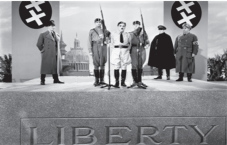
I’m sorry, but I don’t want to be an emperor. I
don’t want to rule or conquer anyone. I should like to
help everyone — if possible — Jew, Gentile — black
man — white. We all want to help one another. Human
[5] beings are like that. (…) In this world there is room for
everyone. And the good earth is rich and can provide
for everyone. (…)
Greed has poisoned men’s souls. (…) The hate
of men will pass, and dictators die, and the power they
[10] took from the people will return to the people. And so
ong as men die, liberty will never perish. (...)Then — in
the name of democracy — let us use that power — let
us all unite. Let us fight for a new world — a decent
world that will give men a chance to work — that will
[15] give youth a future and old age a security. By the
promise of these things, brutes have risen to power.
But they lie! They do not fulfil that promise. They never
will!
Dictators free themselves but they enslave the
[20] people! Now let us fight to fulfill that promise! Let us
fight to free the world — to do away with national
barriers — to do away with greed, with hate and
intolerance. Let us fight for a world of reason, a world
where science and progress will lead to all men’s
[25] happiness. Soldiers! in the name of democracy, let us
all unite!
As far as liberty is concerned, Chaplin says that it is
Questão 19 6997341
UESB Caderno 1 2020TEXTO
This is an excerpt from the final speech in the movie “The Great Dictator”.
I’m sorry, but I don’t want to be an emperor. I
don’t want to rule or conquer anyone. I should like to
help everyone — if possible — Jew, Gentile — black
man — white. We all want to help one another. Human
[5] beings are like that. (…) In this world there is room for
everyone. And the good earth is rich and can provide
for everyone. (…)
Greed has poisoned men’s souls. (…) The hate
of men will pass, and dictators die, and the power they
[10] took from the people will return to the people. And so
ong as men die, liberty will never perish. (...)Then — in
the name of democracy — let us use that power — let
us all unite. Let us fight for a new world — a decent
world that will give men a chance to work — that will
[15] give youth a future and old age a security. By the
promise of these things, brutes have risen to power.
But they lie! They do not fulfil that promise. They never
will!
Dictators free themselves but they enslave the
[20] people! Now let us fight to fulfill that promise! Let us
fight to free the world — to do away with national
barriers — to do away with greed, with hate and
intolerance. Let us fight for a world of reason, a world
where science and progress will lead to all men’s
[25] happiness. Soldiers! in the name of democracy, let us
all unite!
According to the text, fill in the parentheses with T (True) or F (False).
In the role of the Jewish barber in the movie “The Great Dictator”, Chaplin, in this final speech,
( ) advocates that all people should follow the path of peace and brotherhood.
( ) stresses the importance of fighting for wealth and power.
( ) remarks that ordinary people are being manipulated by those in power for their personal gains.
( ) urges all people to oppose technological advances as they may be harmful.
The correct sequence, from top to bottom, is
Questão 18 6997336
UESB Caderno 1 2020TEXTO
The Great Dictator was Charlie Chaplin’s first film
with dialogue. Chaplin plays both a little Jewish barber,
living in the ghetto, and Hynkel, the dictator ruler of
Tomainia – a dead-on parody of German dictator Adolf
[5] Hitler, to whom Chaplin bore a remarkable physical
resemblance, in part because Hitler had chosen the
same toothbrush moustache as the Little Tramp.
Exploiting that resemblance, Chaplin devised a satire
in which the dictator and a Jewish barber from the
[10] ghetto would be mistaken for each other. In the movie,
the Jewish barber, who is mistaken for the dictator
he resembles, is asked to take his place. At the film’s
conclusion, he rejects his position as emperor and
gives an impassioned speech that has become one
[15] of the most famous in film history.
“There was something uncanny in the
resemblance between the Little Tramp and Adolf
Hitler, representing opposite poles of humanity,” writes
Chaplin biographer David Robinson. “Providence was
[20] in an ironical mood when it was ordained that Charles
Chaplin and Adolf Hitler should make their entry into
the world within four days of each other….Each in
his own way has expressed the ideas, sentiments,
aspirations of the millions of struggling citizens
[25] ground between the upper and the lower millstone of
society. (…) Each has mirrored the same reality – the
predicament of the “little man” in modern society. Each
is a distorting mirror, the one for good, the other for
untold evil.”
[30] The movie, released in 1940, was the highestgrossing of his career (was nominated for five
Academy Awards), although it would cause him great
difficulties and indirectly lead to his long exile from the
United States.
Disponível em: charliechaplin.com/en/articles/29-the-final-speechfrom-the-great-dictator. Acesso em: 28 dez. 2020. Adaptado.
According to the text, fill in the parentheses with T (True) or F (False).
( ) Chaplin and Hitler were about the same age.
( ) Both Chaplin and Hitler fought for identical ideals.
( ) Due to the movie’s success, Chaplin was given permanent American Citizenship.
( ) Chaplin and Hitler had opposite points of view concerning leadership and people’s situation.
The correct sequence, from top to bottom, is
Questão 17 6997325
UESB Caderno 1 2020TEXTO
The Great Dictator was Charlie Chaplin’s first film
with dialogue. Chaplin plays both a little Jewish barber,
living in the ghetto, and Hynkel, the dictator ruler of
Tomainia – a dead-on parody of German dictator Adolf
[5] Hitler, to whom Chaplin bore a remarkable physical
resemblance, in part because Hitler had chosen the
same toothbrush moustache as the Little Tramp.
Exploiting that resemblance, Chaplin devised a satire
in which the dictator and a Jewish barber from the
[10] ghetto would be mistaken for each other. In the movie,
the Jewish barber, who is mistaken for the dictator
he resembles, is asked to take his place. At the film’s
conclusion, he rejects his position as emperor and
gives an impassioned speech that has become one
[15] of the most famous in film history.
“There was something uncanny in the
resemblance between the Little Tramp and Adolf
Hitler, representing opposite poles of humanity,” writes
Chaplin biographer David Robinson. “Providence was
[20] in an ironical mood when it was ordained that Charles
Chaplin and Adolf Hitler should make their entry into
the world within four days of each other….Each in
his own way has expressed the ideas, sentiments,
aspirations of the millions of struggling citizens
[25] ground between the upper and the lower millstone of
society. (…) Each has mirrored the same reality – the
predicament of the “little man” in modern society. Each
is a distorting mirror, the one for good, the other for
untold evil.”
[30] The movie, released in 1940, was the highestgrossing of his career (was nominated for five
Academy Awards), although it would cause him great
difficulties and indirectly lead to his long exile from the
United States.
Disponível em: charliechaplin.com/en/articles/29-the-final-speechfrom-the-great-dictator. Acesso em: 28 dez. 2020. Adaptado.
In the movie, the dictator Hynkel and the Jewish barber were confused with each other because they
Questão 16 6997309
UESB Caderno 1 2020TEXTO
The Great Dictator was Charlie Chaplin’s first film
with dialogue. Chaplin plays both a little Jewish barber,
living in the ghetto, and Hynkel, the dictator ruler of
Tomainia – a dead-on parody of German dictator Adolf
[5] Hitler, to whom Chaplin bore a remarkable physical
resemblance, in part because Hitler had chosen the
same toothbrush moustache as the Little Tramp.
Exploiting that resemblance, Chaplin devised a satire
in which the dictator and a Jewish barber from the
[10] ghetto would be mistaken for each other. In the movie,
the Jewish barber, who is mistaken for the dictator
he resembles, is asked to take his place. At the film’s
conclusion, he rejects his position as emperor and
gives an impassioned speech that has become one
[15] of the most famous in film history.
“There was something uncanny in the
resemblance between the Little Tramp and Adolf
Hitler, representing opposite poles of humanity,” writes
Chaplin biographer David Robinson. “Providence was
[20] in an ironical mood when it was ordained that Charles
Chaplin and Adolf Hitler should make their entry into
the world within four days of each other….Each in
his own way has expressed the ideas, sentiments,
aspirations of the millions of struggling citizens
[25] ground between the upper and the lower millstone of
society. (…) Each has mirrored the same reality – the
predicament of the “little man” in modern society. Each
is a distorting mirror, the one for good, the other for
untold evil.”
[30] The movie, released in 1940, was the highestgrossing of his career (was nominated for five
Academy Awards), although it would cause him great
difficulties and indirectly lead to his long exile from the
United States.
Disponível em: charliechaplin.com/en/articles/29-the-final-speechfrom-the-great-dictator. Acesso em: 28 dez. 2020. Adaptado.
About the movie “The Great Dictator”, it’s correct to say:
Questão 23 6995640
USF Medicina 2020Read the text carefully.
BENEFICIAL SKIN BACTERIA PROTECT AGAINST SKIN CANCER
Date: March 1, 2018
Source: University of California - San Diego
Science continues to peel away layers of the skin microbiome to reveal its protective properties. In a study published in Science Advances on February 28, 2018, University of California San Diego School of Medicine researchers report a potential new role for some bacteria on the skin: protecting against cancer.
1 "We have identified a strain of Staphylococcus epidermidis, common on healthy human skin, that exerts a selective ability to inhibit the growth of some cancers," said Richard Gallo, MD, PhD, Distinguished Professor and chair of the Department of Dermatology at UC San Diego School of Medicine. "This unique strain of skin bacteria produces a chemical that kills several types of cancer cells but does not appear to be toxic to normal cells."
The team discovered the S. epidermidis strain produces the chemical compound 6-N-hydroxyaminopurine (6-HAP). Mice with S. epidermidis on their skin that did not 2make 6-HAP had many skin tumors after being exposed to cancer-causing ultraviolet rays (UV), but mice with the S. epidermidis strain 3producing 6-HAP did not.
6-HAP is a molecule that impairs the creation of DNA, known as DNA synthesis, and prevents the spread of transformed tumor cells as well as the potential to suppress development of UV-induced skin tumors.
Mice that received intravenous injections of 6-HAP every 48 hours over a two-week period experienced no apparent toxic effects, but when transplanted with melanoma cells, their tumor size was suppressed by more than 50 percent compared to controls.
"There is 4 increasing evidence that the skin microbiome is an important element of human health. In fact, 5we previously reported that some bacteria on our skin produce antimicrobial peptides that defend against pathogenic bacteria such as, Staphylococcus aureus," said Gallo.
In the case of S. epidermidis, it appears to also be adding a layer of protection against some forms of cancer, said Gallo. Further studies are needed to understand how 6-HAP is produced, if it can be used for prevention of cancer or if loss of 6-HAP increases cancer risk, said Gallo.
More than 1 million cases of skin cancer are diagnosed in the United States each year. More than 95 percent of these are non-melanoma skin cancer, which is typically caused by overexposure to the sun's UV rays. Melanoma is the most serious form of skin cancer that starts in the pigment- producing skin cells, called melanocytes.
Adapted from: . Access in: 20/08/2019 (Adapted).
Consider the statements extracted from the text and choose the alternative in which there is a correct proposition.
06