


![[Marketing] Questao Topo - deslogado](https://storage.estuda.com.br/banners/0_6b7ebee90b03af1c560c73bb8bcce34a_banner_deslogado_70_dias.png)
Questões de Inglês
19.971 Questões
Questão 9 7758173
FGV-SP Administração - LEI/HUM. BLOCO 2 2020/2Texto para a pergunta
A POLAR AFFAIR
1 A report this past summer that two male penguins at the Berlin Zoo had adopted and were hatching an egg was no surprise to New Zealand naturalist
Lloyd Spencer Davis. From his decades of field work, he knew penguin behavior included homosexuality, infidelity, divorce, rape, and even necrophilia.
However, he had been surprised a few years earlier to learn that these behaviors had been discovered by the author of the very first book on penguins,
George Murray Levick, a surgeon and naturalist on Robert Scott's 1911 Antarctic expedition.
2 Levick, in keeping with the public morality of Victorian England, found penguin sex reprehensible, confining his observations to logbook entries
encrypted in Greek characters. His short paper on the subject as a chapter in his landmark Antarctic Penguins: A Study of their Social Habits, was
suppressed by the publisher and remained unknown until 2012, when a copy was found in a file box at the British Museum. Antarctic Penguins, thoroughly
bowdlerized [expurgado], "treats the mating behavior of the penguins as if they were married couples," writes Davis. As a result, "pretty much every book,
documentary and scientific paper" up until the late 1990s, "collectively suggest that penguins are prim and proper [recatados e bem comportados],
monogamous little creatures that mate for life.”
3 To correct the historical and biological record, and to give belated credit to the man who discovered a century earlier the sexual life of penguins, Davis
consulted Levick’s original notes and visited important sites in the naturalist’s career. The result is the book A Polar Affair: Antarctica’s Forgotten Hero and
the Secret Love Lives of Penguins, an expert journalistic retelling of the Antarctic expeditions of the early twentieth century, centered on Levick’s year of
observing penguins. The climax of what otherwise would have been routine field work is a harrowing [horrível, traumático] trek by Levick and several
companions to explore Antarctica’s north coast, where they were forced to spend the winter in a snow cave. Without Levick’s rationing of seal meat and
his community-building readings from a book of stories, no one would have survived. Levick’s saga [narrativa épica] is interwoven with well-worn threads
about the explorers Scott, Nansen, Amundsen, and Shackleton, occasionally interspersed [entremeada] with evolutionary insights Davis gleaned [colheu]
from his own observations of penguins.
4 Ironically, the sex lives of the humans in this story are as tangled [embaraçadas, complicadas] as those of the penguins. Fridtjof Nansen was as famous
for his romantic conquests as his "conquests of Arctic regions." Roald Amundsen dallied [namorava por divertimento] with married women. Robert Scott's
wife, Kathleen Bruce, embodied raw sexual selection – she chose Scott, according to her own testimony, so she could bear [dar luz a] a hero's son – and
she may have had liaisons with several of his friends. Murray Levick, notably, is one of the few figures in this book to have comported himself as a
supposedly proper penguin. Davis's book is, thus, a welcome look behind the scenes, representing Levick as a brilliant explorer and a keen observer of
nature.
Adapted from Natural History, October 2019.
According to the information in the article, Lloyd Spencer Davis
Questão 5 7758093
FGV-SP Administração - LEI/HUM. BLOCO 2 2020/2Texto para a pergunta.
RUM IN VENEZUELA
1 Some wondered if the bosses of Venezuela’s oldest rum company had been sampling [provando] too much of their product. In January, with Venezuela
in one of the deepest recessions in modern world history, Ron Santa Teresa launched the country’s first public share issue [oferta de ações ao público] in
more than a decade. The new equity [ações, participação financeira] was priced in bolívares, the world’s worst performing currency. Others speculated
that the rum-maker, which daringly notes on its website that its distillery in the Aragua valley near Caracas has survived “wars, revolutions, invasions,
even dictators”, had decided that change was taking place.
2 Evidence of the second interpretation is that the latest dictator, Nicolás Maduro, has recently become a capitalist, sort of. The disciple of Hugo Chávez
(whose "21st-century socialism" set Venezuela on its road to ruin) has quietly lifted price controls and restrictions on dollar transactions. He now says firms
can issue shares in hard currencies [moedas estáveis, de confiança]. He is thought to be contemplating a sale to foreign investors of a stake [participação
financeira] in PDVSA, the decrepit state oil company.
3 Ron Santa Teresa’s president, Alberto Vollmer, a fifth-generation rum-maker, says the company, whose shares were already listed, needs the money
to buy barrels and build warehouses. It signed an international-distribution deal with Bacardi in 2016. Mr. Maduro’s tentative pro-market turn is “a happy
coincidence”, he says. The sale of 1 million shares, which raised the equivalent of $300,000, was a fillip [estímulo] for the near-dormant stock market,
which lists just 31 companies. Demand exceeded supply.
4 The investors are not as daft [tolos, malucos] as you might think. Although denominated in bolívares, share prices tend to keep pace with inflation. This
has dropped, from an annual rate of more than 2 million% early in 2019 to a mere 9,500% for the year. That is partly because the government has increased
the amount of reserves that banks must hold.
5 But this has caused a shortage of bolívares. The total amount of bank loans is the equivalent of $225 million, less than 0.5% of GDP [PIB]. Sanctions
imposed by the United States and EU have made lending harder. The share issue raised more money in a day than the large banks could lend to Mr Vollmer’s
firm.
6 No one expects a dramatic recovery of the economy, which has shrunk by two-thirds since Mr Maduro took over from Chávez in 2013. But Mr Vollmer
welcomes the shift towards pragmatism. ”That is what happens when you run out of money to fund ideas that didn’t work.”
Adapted from The Economist, February 8th 2020.
The “happy coincidence” mentioned in paragraph 3 most likely refers to the fact that
Questão 4 7758080
FGV-SP Administração - LEI/HUM. BLOCO 2 2020/2Texto para a pergunta.
RUM IN VENEZUELA
1 Some wondered if the bosses of Venezuela’s oldest rum company had been sampling [provando] too much of their product. In January, with Venezuela
in one of the deepest recessions in modern world history, Ron Santa Teresa launched the country’s first public share issue [oferta de ações ao público] in
more than a decade. The new equity [ações, participação financeira] was priced in bolívares, the world’s worst performing currency. Others speculated
that the rum-maker, which daringly notes on its website that its distillery in the Aragua valley near Caracas has survived “wars, revolutions, invasions,
even dictators”, had decided that change was taking place.
2 Evidence of the second interpretation is that the latest dictator, Nicolás Maduro, has recently become a capitalist, sort of. The disciple of Hugo Chávez
(whose "21st-century socialism" set Venezuela on its road to ruin) has quietly lifted price controls and restrictions on dollar transactions. He now says firms
can issue shares in hard currencies [moedas estáveis, de confiança]. He is thought to be contemplating a sale to foreign investors of a stake [participação
financeira] in PDVSA, the decrepit state oil company.
3 Ron Santa Teresa’s president, Alberto Vollmer, a fifth-generation rum-maker, says the company, whose shares were already listed, needs the money
to buy barrels and build warehouses. It signed an international-distribution deal with Bacardi in 2016. Mr. Maduro’s tentative pro-market turn is “a happy
coincidence”, he says. The sale of 1 million shares, which raised the equivalent of $300,000, was a fillip [estímulo] for the near-dormant stock market,
which lists just 31 companies. Demand exceeded supply.
4 The investors are not as daft [tolos, malucos] as you might think. Although denominated in bolívares, share prices tend to keep pace with inflation. This
has dropped, from an annual rate of more than 2 million% early in 2019 to a mere 9,500% for the year. That is partly because the government has increased
the amount of reserves that banks must hold.
5 But this has caused a shortage of bolívares. The total amount of bank loans is the equivalent of $225 million, less than 0.5% of GDP [PIB]. Sanctions
imposed by the United States and EU have made lending harder. The share issue raised more money in a day than the large banks could lend to Mr Vollmer’s
firm.
6 No one expects a dramatic recovery of the economy, which has shrunk by two-thirds since Mr Maduro took over from Chávez in 2013. But Mr Vollmer
welcomes the shift towards pragmatism. ”That is what happens when you run out of money to fund ideas that didn’t work.”
Adapted from The Economist, February 8th 2020.
With respect to Venezuela’s economy, the information in the article most supports which of the following?
Questão 2 7758045
FGV-SP Administração - LEI/HUM. BLOCO 2 2020/2Texto para a pergunta.
RUM IN VENEZUELA
1 Some wondered if the bosses of Venezuela’s oldest rum company had been sampling [provando] too much of their product. In January, with Venezuela
in one of the deepest recessions in modern world history, Ron Santa Teresa launched the country’s first public share issue [oferta de ações ao público] in
more than a decade. The new equity [ações, participação financeira] was priced in bolívares, the world’s worst performing currency. Others speculated
that the rum-maker, which daringly notes on its website that its distillery in the Aragua valley near Caracas has survived “wars, revolutions, invasions,
even dictators”, had decided that change was taking place.
2 Evidence of the second interpretation is that the latest dictator, Nicolás Maduro, has recently become a capitalist, sort of. The disciple of Hugo Chávez
(whose "21st-century socialism" set Venezuela on its road to ruin) has quietly lifted price controls and restrictions on dollar transactions. He now says firms
can issue shares in hard currencies [moedas estáveis, de confiança]. He is thought to be contemplating a sale to foreign investors of a stake [participação
financeira] in PDVSA, the decrepit state oil company.
3 Ron Santa Teresa’s president, Alberto Vollmer, a fifth-generation rum-maker, says the company, whose shares were already listed, needs the money
to buy barrels and build warehouses. It signed an international-distribution deal with Bacardi in 2016. Mr. Maduro’s tentative pro-market turn is “a happy
coincidence”, he says. The sale of 1 million shares, which raised the equivalent of $300,000, was a fillip [estímulo] for the near-dormant stock market,
which lists just 31 companies. Demand exceeded supply.
4 The investors are not as daft [tolos, malucos] as you might think. Although denominated in bolívares, share prices tend to keep pace with inflation. This
has dropped, from an annual rate of more than 2 million% early in 2019 to a mere 9,500% for the year. That is partly because the government has increased
the amount of reserves that banks must hold.
5 But this has caused a shortage of bolívares. The total amount of bank loans is the equivalent of $225 million, less than 0.5% of GDP [PIB]. Sanctions
imposed by the United States and EU have made lending harder. The share issue raised more money in a day than the large banks could lend to Mr Vollmer’s
firm.
6 No one expects a dramatic recovery of the economy, which has shrunk by two-thirds since Mr Maduro took over from Chávez in 2013. But Mr Vollmer
welcomes the shift towards pragmatism. ”That is what happens when you run out of money to fund ideas that didn’t work.”
Adapted from The Economist, February 8th 2020.
The information in the article most supports which of the following?
Questão 1 7758009
FGV-SP Administração - LEI/HUM. BLOCO 2 2020/2Texto para a pergunta.
RUM IN VENEZUELA
1 Some wondered if the bosses of Venezuela’s oldest rum company had been sampling [provando] too much of their product. In January, with Venezuela
in one of the deepest recessions in modern world history, Ron Santa Teresa launched the country’s first public share issue [oferta de ações ao público] in
more than a decade. The new equity [ações, participação financeira] was priced in bolívares, the world’s worst performing currency. Others speculated
that the rum-maker, which daringly notes on its website that its distillery in the Aragua valley near Caracas has survived “wars, revolutions, invasions,
even dictators”, had decided that change was taking place.
2 Evidence of the second interpretation is that the latest dictator, Nicolás Maduro, has recently become a capitalist, sort of. The disciple of Hugo Chávez
(whose "21st-century socialism" set Venezuela on its road to ruin) has quietly lifted price controls and restrictions on dollar transactions. He now says firms
can issue shares in hard currencies [moedas estáveis, de confiança]. He is thought to be contemplating a sale to foreign investors of a stake [participação
financeira] in PDVSA, the decrepit state oil company.
3 Ron Santa Teresa’s president, Alberto Vollmer, a fifth-generation rum-maker, says the company, whose shares were already listed, needs the money
to buy barrels and build warehouses. It signed an international-distribution deal with Bacardi in 2016. Mr. Maduro’s tentative pro-market turn is “a happy
coincidence”, he says. The sale of 1 million shares, which raised the equivalent of $300,000, was a fillip [estímulo] for the near-dormant stock market,
which lists just 31 companies. Demand exceeded supply.
4 The investors are not as daft [tolos, malucos] as you might think. Although denominated in bolívares, share prices tend to keep pace with inflation. This
has dropped, from an annual rate of more than 2 million% early in 2019 to a mere 9,500% for the year. That is partly because the government has increased
the amount of reserves that banks must hold.
5 But this has caused a shortage of bolívares. The total amount of bank loans is the equivalent of $225 million, less than 0.5% of GDP [PIB]. Sanctions
imposed by the United States and EU have made lending harder. The share issue raised more money in a day than the large banks could lend to Mr Vollmer’s
firm.
6 No one expects a dramatic recovery of the economy, which has shrunk by two-thirds since Mr Maduro took over from Chávez in 2013. But Mr Vollmer
welcomes the shift towards pragmatism. ”That is what happens when you run out of money to fund ideas that didn’t work.”
Adapted from The Economist, February 8th 2020.
The article’s first sentence – “Some wondered if the bosses of Venezuela’s oldest rum company had been sampling too much of their own product” – was most likely written to
Questão 31 7690643
UniAtenas 2020Read the comic strips bellow:
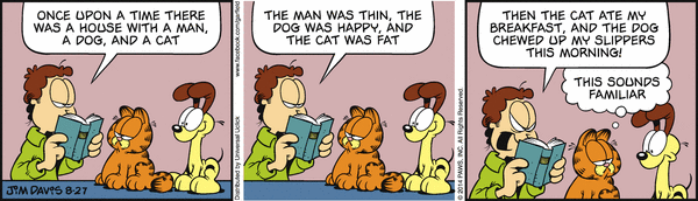
In end of the story, Garfield’s behaivor make us conclude that:
06