


![[Marketing] Questao Topo - deslogado](https://storage.estuda.com.br/banners/0_6b7ebee90b03af1c560c73bb8bcce34a_banner_deslogado_70_dias.png)
Questões de Inglês
19.971 Questões
Questão 31 9911655
Humanitas Medicina 2020/1Leia o texto para responder à questão
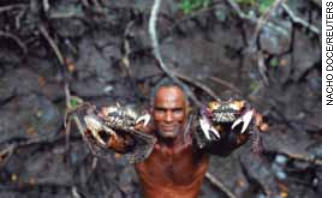
Reuters photographer Nacho Doce has documented the mangrove forests in Cairu, Brazil. He visited a community of mud houses along the edge of the Caratingui River, known as The Train because the single-file homes look like train carriages.
Mangroves cover 13,989 sq km of Brazil’s coast and are an important protection against climate change, with one acre of mangrove forest absorbing nearly the same amount of carbon dioxide as an acre of Amazon rainforest.
Fisherman Jose da Cruz makes his living by fishing for crabs where freshwater rivers meet the brackish Atlantic Ocean. Instead of a rod or a net, he uses his hands to search for crabs in the mud among the mangrove trees, sometimes lying flat on the ground and reaching deep down. His daily catch of several dozen crabs will earn him 200 reais (£40) a week, enough on which to survive. Mr Da Cruz says his daily catch is half what it was 10 years ago and in that time the water line has advanced 3m (10ft) inland.
According to climate researcher Carlos Nobre, at the University of Sao Paulo, water levels have risen 20-30cm (1ft) over the past 100 years in coastal Bahia state. Scientists predict the global surface temperature will have risen by more than 1.5C by the end of the 21st Century. And some prediction models in a 2014 report say this temperature increase will actually exceed 2C, without unprecedented changes within human societies. “Nature is upset”, Mr da Cruz says.
(www.bbc.com, 13.06.2019. Adaptado.)
The title that best summarizes the main idea of this text is
Questão 56 9722499
IFRR Superior 2020/1Choose the only INCORRECT alternative which exposes an opposite idea of outpost:
Questão 55 9722468
IFRR Superior 2020/1Choose the CORRECT antonym of comprises:
Questão 54 9722403
IFRR Superior 2020/1Read the text and answer the question:
TEXT
It was the end of an era: In July 1997, as the flag of the United Kingdom was lowered over Hong Kong, the prosperous colony was returned to China after over 150 years of British rule. The sun had finally set on one of the wealthiest modern outposts of the British Empire. But was it the beginning of lasting autonomy for Hong Kong?
The United Kingdom had held Hong Kong as a colony since 1841, when it occupied the area during the First Opium War. The war broke out after Qing-dynasty China attempted to crack down an illegal opium trade that led to widespread addiction in China. Defeat came at a high cost: In 1842, China agreed to cede the island of Hong Kong to the British in perpetuity through the Treaty of Nanjing.
Over the next half-century, the United Kingdom gained control over all three main regions of Hong Kong: After Hong Kong Island came the Kowloon Peninsula, and finally the New Territories, a swath of land that comprises the bulk of Hong Kong today. The final treaty, the 1898 Convention for the Extension of Hong Kong Territory, leased the New Territories to Britain for 99 years. Under the terms of the treaty, China would regain control of its leased lands on July 1, 1997.
British Hong Kong’s trajectory was different from that of mainland China, which became a Communist country in 1949. Up to 100,000 Chinese found refuge in Hong Kong after the Communist Party took power. Capitalist Hong Kong soon experienced an economic boom, becoming home to a multicultural, international community.
As the treaty’s expiration loomed, separating the New Territories from the rest of Hong Kong became increasingly unthinkable. Starting in the late 1970s, the U.K. and China began to discuss Hong Kong’s future. In 1984, British Prime Minister Margaret Thatcher and China’s premier Zhao Ziyang signed the Sino-British Joint Declaration, agreeing that China would give Hong Kong some political and social autonomy through a “one country, two systems” policy for a 50-year- period.
After the handover, Hong Kong became a Special Administrative Region of China with its own “mini constitution,” legal system, and some democratic rights like free speech and the freedom of assembly under its Basic Law. However, Hong Kong residents cannot elect their own leaders; rather, a chief executive is elected by a 1,200-member election committee.
Starting in 2014, elections were conducted using a list of candidates vetted by Beijing. That and other Chinese policies, like a recent attempt to allow extradition to the mainland, have led to mass protests, strained British-Chinese diplomatic relations, and fueled increasing concerns that China is stifling public dissent, interfering in localpolitics, and eroding human rights in Hong Kong. The handover still has another phase ahead: the expiration of China’s agreement to honor Hong Kong’s Basic Law. Will China continue to recognize Hong Kong’s autonomy after then? We’ll find out in 2047.
(Fragment from “How Hong Kong’s complex history explains its current crisis with China”, by Erin Blakemore. Online since 07 August 2019. URL: http://nationalgeographic.com/culture/topics/references/hong- kong-history-explain-relationship-china/)
It is the only CORRECT synonym of stifling:
Questão 52 9722305
IFRR Superior 2020/1Read the text and answer the question:
TEXT
It was the end of an era: In July 1997, as the flag of the United Kingdom was lowered over Hong Kong, the prosperous colony was returned to China after over 150 years of British rule. The sun had finally set on one of the wealthiest modern outposts of the British Empire. But was it the beginning of lasting autonomy for Hong Kong?
The United Kingdom had held Hong Kong as a colony since 1841, when it occupied the area during the First Opium War. The war broke out after Qing-dynasty China attempted to crack down an illegal opium trade that led to widespread addiction in China. Defeat came at a high cost: In 1842, China agreed to cede the island of Hong Kong to the British in perpetuity through the Treaty of Nanjing.
Over the next half-century, the United Kingdom gained control over all three main regions of Hong Kong: After Hong Kong Island came the Kowloon Peninsula, and finally the New Territories, a swath of land that comprises the bulk of Hong Kong today. The final treaty, the 1898 Convention for the Extension of Hong Kong Territory, leased the New Territories to Britain for 99 years. Under the terms of the treaty, China would regain control of its leased lands on July 1, 1997.
British Hong Kong’s trajectory was different from that of mainland China, which became a Communist country in 1949. Up to 100,000 Chinese found refuge in Hong Kong after the Communist Party took power. Capitalist Hong Kong soon experienced an economic boom, becoming home to a multicultural, international community.
As the treaty’s expiration loomed, separating the New Territories from the rest of Hong Kong became increasingly unthinkable. Starting in the late 1970s, the U.K. and China began to discuss Hong Kong’s future. In 1984, British Prime Minister Margaret Thatcher and China’s premier Zhao Ziyang signed the Sino-British Joint Declaration, agreeing that China would give Hong Kong some political and social autonomy through a “one country, two systems” policy for a 50-year- period.
After the handover, Hong Kong became a Special Administrative Region of China with its own “mini constitution,” legal system, and some democratic rights like free speech and the freedom of assembly under its Basic Law. However, Hong Kong residents cannot elect their own leaders; rather, a chief executive is elected by a 1,200-member election committee.
Starting in 2014, elections were conducted using a list of candidates vetted by Beijing. That and other Chinese policies, like a recent attempt to allow extradition to the mainland, have led to mass protests, strained British-Chinese diplomatic relations, and fueled increasing concerns that China is stifling public dissent, interfering in localpolitics, and eroding human rights in Hong Kong. The handover still has another phase ahead: the expiration of China’s agreement to honor Hong Kong’s Basic Law. Will China continue to recognize Hong Kong’s autonomy after then? We’ll find out in 2047.
(Fragment from “How Hong Kong’s complex history explains its current crisis with China”, by Erin Blakemore. Online since 07 August 2019. URL: http://nationalgeographic.com/culture/topics/references/hong- kong-history-explain-relationship-china/)
About citizens’ social rights from Hong Kong is CORRECT to affirm:
Questão 51 9722209
IFRR Superior 2020/1Read the text and answer the question:
TEXT
It was the end of an era: In July 1997, as the flag of the United Kingdom was lowered over Hong Kong, the prosperous colony was returned to China after over 150 years of British rule. The sun had finally set on one of the wealthiest modern outposts of the British Empire. But was it the beginning of lasting autonomy for Hong Kong?
The United Kingdom had held Hong Kong as a colony since 1841, when it occupied the area during the First Opium War. The war broke out after Qing-dynasty China attempted to crack down an illegal opium trade that led to widespread addiction in China. Defeat came at a high cost: In 1842, China agreed to cede the island of Hong Kong to the British in perpetuity through the Treaty of Nanjing.
Over the next half-century, the United Kingdom gained control over all three main regions of Hong Kong: After Hong Kong Island came the Kowloon Peninsula, and finally the New Territories, a swath of land that comprises the bulk of Hong Kong today. The final treaty, the 1898 Convention for the Extension of Hong Kong Territory, leased the New Territories to Britain for 99 years. Under the terms of the treaty, China would regain control of its leased lands on July 1, 1997.
British Hong Kong’s trajectory was different from that of mainland China, which became a Communist country in 1949. Up to 100,000 Chinese found refuge in Hong Kong after the Communist Party took power. Capitalist Hong Kong soon experienced an economic boom, becoming home to a multicultural, international community.
As the treaty’s expiration loomed, separating the New Territories from the rest of Hong Kong became increasingly unthinkable. Starting in the late 1970s, the U.K. and China began to discuss Hong Kong’s future. In 1984, British Prime Minister Margaret Thatcher and China’s premier Zhao Ziyang signed the Sino-British Joint Declaration, agreeing that China would give Hong Kong some political and social autonomy through a “one country, two systems” policy for a 50-year- period.
After the handover, Hong Kong became a Special Administrative Region of China with its own “mini constitution,” legal system, and some democratic rights like free speech and the freedom of assembly under its Basic Law. However, Hong Kong residents cannot elect their own leaders; rather, a chief executive is elected by a 1,200-member election committee.
Starting in 2014, elections were conducted using a list of candidates vetted by Beijing. That and other Chinese policies, like a recent attempt to allow extradition to the mainland, have led to mass protests, strained British-Chinese diplomatic relations, and fueled increasing concerns that China is stifling public dissent, interfering in localpolitics, and eroding human rights in Hong Kong. The handover still has another phase ahead: the expiration of China’s agreement to honor Hong Kong’s Basic Law. Will China continue to recognize Hong Kong’s autonomy after then? We’ll find out in 2047.
(Fragment from “How Hong Kong’s complex history explains its current crisis with China”, by Erin Blakemore. Online since 07 August 2019. URL: http://nationalgeographic.com/culture/topics/references/hong- kong-history-explain-relationship-china/)
About the text ideas it is INCORRECT to say:
06