


![[Marketing] Questao Topo - deslogado](https://storage.estuda.com.br/banners/0_6b7ebee90b03af1c560c73bb8bcce34a_banner_deslogado_70_dias.png)
Questões de Inglês
19.971 Questões
Questão 16 11064050
UNIG Itaperuna 2020/2TEXTO:
How to stop handing business to the competition
Most businesses fail to achieve their potential
because of faulty thinking. It happens because
business executives, owners and managers don’t
like news that runs contrary to the pictures inside
[5] their heads. While those delivering unacceptable
messages to a manager or executive no longer lose
their heads as they did centuries ago, they can lose
their jobs. As a result, those who need to know the
truth first are often the last to get it.
[10] The effects of such shielding and denial account
for many of the irrational and unnecessary mistakes
companies make. Why does it take so long for the
negative news to get to the top? Why do those sitting
around the table fail to speak up? No one wants to
[15] hear bad news. In fact, we tune it out. Rather than
processing it, we get rid of it. “Sure, sales have gone
down but just wait until next quarter.” Next quarter
comes and then we hear, “We took a hit with the bad
weather.”
[20] Not wanting to listen to the negative and turning
away from what we don’t want to hear is obviously
dangerous since it leads to inappropriate decisions.
Rejecting information that goes against what we want
to believe or that fits our perception of our business
[25] can send companies down dangerous paths.
GRAHAM, John. How to stop handing business to the competition. LAB. Bolivian Airlines. Latin VIP, p. 55, s.d.
The expression that indicates a circumstance of time in the past is
Questão 15 11064039
UNIG Itaperuna 2020/2TEXTO:
How to stop handing business to the competition
Most businesses fail to achieve their potential
because of faulty thinking. It happens because
business executives, owners and managers don’t
like news that runs contrary to the pictures inside
[5] their heads. While those delivering unacceptable
messages to a manager or executive no longer lose
their heads as they did centuries ago, they can lose
their jobs. As a result, those who need to know the
truth first are often the last to get it.
[10] The effects of such shielding and denial account
for many of the irrational and unnecessary mistakes
companies make. Why does it take so long for the
negative news to get to the top? Why do those sitting
around the table fail to speak up? No one wants to
[15] hear bad news. In fact, we tune it out. Rather than
processing it, we get rid of it. “Sure, sales have gone
down but just wait until next quarter.” Next quarter
comes and then we hear, “We took a hit with the bad
weather.”
[20] Not wanting to listen to the negative and turning
away from what we don’t want to hear is obviously
dangerous since it leads to inappropriate decisions.
Rejecting information that goes against what we want
to believe or that fits our perception of our business
[25] can send companies down dangerous paths.
GRAHAM, John. How to stop handing business to the competition. LAB. Bolivian Airlines. Latin VIP, p. 55, s.d.
All the verbs are irregular in the sequence
Questão 17 11050970
Estácio 2020/1Texto 1

UNDERSTANDING AND ADDRESSING SOCIAL DETERMINANTS TO ADVANCE CANCER
HEALTH EQUITY IN THE UNITED STATES: A BLUEPRINT FOR PRACTICE, RESEARCH,
AND POLICY
Kassandra I. Alcaraz PhD, MPH; Tracy L. Wiedt MPH; Elvan C. Daniels MD, MPH;
K. Robin Yabroff PhD; Carmen E. Guerra MD; Richard C. Wender MD
Although cancer mortality rates declined in the United States in recent decades, some populations
experienced little benefit from advances in cancer prevention, early detection, treatment, and
survivorship care. In fact, some cancer disparities between populations of low and high socioeconomic
status widened during this period. Many potentially preventable cancer deaths continue to occur,
[5] and disadvantaged populations bear a disproportionate burden. Reducing the burden of cancer and
eliminating cancer related disparities will require more focused and coordinated action across multiple
sectors and in partnership with communities. This article, part of the American Cancer Society’s Cancer
Control Blueprint series, introduces a framework for understanding and addressing social determinants
to advance cancer health equity and presents actionable recommendations for practice, research, and
[10] policy. The article aims to accelerate progress toward eliminating disparities in cancer and achieving
health equity.
onlinelibrary.wiley.com. First published: 29 October 2019
Texto 2
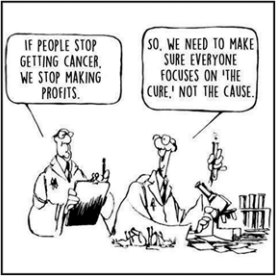
powerpix.cultu.be
So, we need to make sure everyone focuses on ‘the cure’ not the cause. (text 2)
In text 1, several ways of eliminating cancer are considered. According to the sentence above used in the cartoon, scientists should continue focussing on the following aspect, mentioned in the first text:
Questão 19 11048919
Estácio 2020/1Texto
powerpix.cultu.be
Text uses informal language.
If the word “So” were used in a more formal situation, such as in an academic article, for example, it could be replaced with:
Questão 18 11048897
Estácio 2020/1Texto
powerpix.cultu.be
Text resorts to irony to make its points.
With this irony, the author is criticizing
Questão 11 11004883
EBMSP Medicina 2020/1New research has identified a potential way to reverse graying hair and treat skin pigment disorders. By studying stem cells in mice, scientists at NYU Langone Medical Center in New York City have found the molecular pathways responsible for creating the color of skin and hair. Their findings could one day lead to cosmetic treatments that restore graying locks to more youthful colors such as brown, blond and red. The research may also be useful for developing drug candidates for people with vitiligo, a disease that causes skin to lose its color and leads to blotchy white patches.
The researchers conducted a series of experiments on stem cells to investigate the biological process at work in pigmentation. They found that a certain signaling pathway – known as EdnrB – interacts with other pathways, in particular the Wnt signaling pathways, which in turn causes the proliferation of melanocyte, stem cells involved in the earliest stage of skin and hair pigmentation.
When the researchers bred mice to have EdnrB pathway deficiencies, the rodents experienced premature graying of their fur. “The mice that normally had black hair turned into grayish mice. They looked like old people, with gray hair”, they said. Conversely, when they stimulated the mice’s EdnrB pathways, it produced a 15-fold increase in melanocyte stem cell pigment production, which caused hyperpigmentation in the mice. The researchers made small wounds on the animals and noticed that the skin was much darker when it began to heal. Finally, when researchers blocked the mice’s Wnt signaling, it slowed melanocyte growth and resulted in unpigmented gray hair. Mice with black fur became more gray.
This finding suggests that targeting the Wnt pathway may be one way to reverse gray hair. Moreover, “if scientists can eventually find ways to activate those signaling pathways in humans with vitiligo, the melanocyte stem cells could migrate to the surface of their skin and re-pigment it”, they explained.
FIRGER, Jessica. Disponível em: http://www.newsweek.com. Acesso em: set. 2019. Adptado.
As far as the experiments with mice are concerned, the text says that
06