


![[Marketing] Questao Topo - deslogado](https://storage.estuda.com.br/banners/0_6b7ebee90b03af1c560c73bb8bcce34a_banner_deslogado_70_dias.png)
Questões de Inglês
19.971 Questões
Questão 35 14730605
UPE SSA 1ª Fase - 1° Dia 2020Japanese Women Protest High Heels Rules
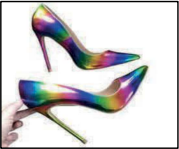
Should women be forced to wear high heels for their jobs? Yumi Ishikawa, a 32-year-old actress from Japan, says no. And she's collected the signatures of almost 30,000 people who agree with her.
Ms. Ishikawa has a part time job which requires her to stand in high heels for many hours. High heels can be painful. They are hard to walk in and nearly impossible to run in.
One day, Ms. Ishikawa noticed the shoes of a man who worked with her. She realized her job would be far easier if she was allowed to wear comfortable shoes like his. After work, she posted that idea on the social media site Twitter. Her post got a huge response — 67,000 people "liked" the post.
Using high heels for a long period of time can lead to injuries far more serious than just blisters or foot pain. High heels can cause ankle problems and change the shape of leg muscles, putting extra strain on them. Wearing high heels can also cause back pain.
Many women like the look of high heels and don't mind if the shoes are uncomfortable. But there's a difference between choosing to wear something and being forced to. One Japanese website reported that about 60% of Japanese women are forced to wear high heels at work.
Ms. Ishikawa created a petition — a request which other people sign to show their support. She asked Japan to make requiring high heels at work against the law. The petition explained the problems caused by high heels. It also pointed out that it was unfair that women were often required to wear high heels, but men were not.
Disponível em: https://www.theguardian.com/world/2019/jun/03/women-in-japan-protest-against-having-to-wear-high-heels-to-work-kutoo-
Mark the FALSE alternative.
Questão 33 14730602
UPE SSA 1ª Fase - 1° Dia 2020Japanese Women Protest High Heels Rules
Should women be forced to wear high heels for their jobs? Yumi Ishikawa, a 32-year-old actress from Japan, says no. And she's collected the signatures of almost 30,000 people who agree with her.
Ms. Ishikawa has a part time job which requires her to stand in high heels for many hours. High heels can be painful. They are hard to walk in and nearly impossible to run in.
One day, Ms. Ishikawa noticed the shoes of a man who worked with her. She realized her job would be far easier if she was allowed to wear comfortable shoes like his. After work, she posted that idea on the social media site Twitter. Her post got a huge response — 67,000 people "liked" the post.
Using high heels for a long period of time can lead to injuries far more serious than just blisters or foot pain. High heels can cause ankle problems and change the shape of leg muscles, putting extra strain on them. Wearing high heels can also cause back pain.
Many women like the look of high heels and don't mind if the shoes are uncomfortable. But there's a difference between choosing to wear something and being forced to. One Japanese website reported that about 60% of Japanese women are forced to wear high heels at work.
Ms. Ishikawa created a petition — a request which other people sign to show their support. She asked Japan to make requiring high heels at work against the law. The petition explained the problems caused by high heels. It also pointed out that it was unfair that women were often required to wear high heels, but men were not.
Disponível em: https://www.theguardian.com/world/2019/jun/03/women-in-japan-protest-against-having-to-wear-high-heels-to-work-kutoo-
Mark the CORRECT alternative, according to the text.
Questão 38 14727943
UPE SSA 2ª Fase - 1° Dia 2020Após uma análise linguística do texto, conclui-se que
I. o trecho 'But many migratory birds, like people, are struggling amid unsustainable conditions.‘(1º parágrafo) apresenta uma comparação.
II. as partes destacadas em: 'hunger and poverty are frequently linked to the state (...)' e 'migratory birds is closely interconnected with our own prospects (...)‘, ambas no 6º parágrafo, têm estrutura sintática semelhante e contêm advérbios.
III. as palavras destacadas nos trechos: 'They provide both sustenance and delight (...) (1º parágrafo); 'They provide food and income.’ (2º parágrafo) e 'and provide food and livelihoods for nearly a billion people.' (3º parágrafo) apresentam uma relação semântica de antonímia.
IV. em: 'Making sure that migratory birds find healthy and welcoming places to settle on their repeated journeys' (8º parágrafo), as palavras destacadas são adjetivos.
V. no 5º parágrafo (Every year, World Migratory Bird Day is observed...), há informações acerca de quantidade, condição e localização do evento citado.
Estão CORRETOS, apenas, os itens
Questão 33 14727868
UPE SSA 2ª Fase - 1° Dia 2020
Tokyo, Japan — Japanese car rental companies have learned something interesting about their customers – many people in Japan don‘t rent cars to drive somewhere, they rent because they‘re looking for a quiet, private space.
The Japanese newspaper Asahi Shimbum says that in the summer of 2018, a car-sharing company called Orix Auto discovered that quite a few of its cars ―traveled no distance‖ when they were rented. The people at Orix couldn‘t explain it. ―The only thing we can say is that…a number of people rent cars without driving them,‖ they said.
Other car sharing and rental companies soon noticed the same thing. One car rental company learned that one out of every eight customers said they didn‘t rent their cars for driving.
The companies were curious. If customers weren‘t renting cars to drive them, then why were they renting? They began to ask their customers some questions to learn more about what was going on.
It turned out that customers were using the cars in many unexpected ways.
Besides driving, the most common use for rental cars was napping. It‘s likely that many Japanese people could use a nap. The Guardian newspaper points out that Japanese people report sleeping about 45 minutes less each day than the worldwide average. In one group of Japanese adults who were questioned, nearly 93% said they did not get enough sleep.
Disponível em: https://www.theguardian.com/world/2019/jul/15/asleep-at-wheel-japanese-rental-cars-used-anything-butdriving. Adapted. Acesso em: ago., 2019.
Mark the CORRECT alternative, according to the text.
Questão 80 12506960
UECE 2ª Fase - 1º Dia 2020/2TEXT
Americans May Add Five Times More Plastic to the Oceans Than Thought
The United States is using more
plastic than ever, and waste exported for
recycling is often mishandled, according
to a new study.
[5] The United States contribution
to coastal plastic pollution worldwide is
significantly larger than previously
thought, possibly by as much as five
times, according to a study published
[10] Friday. The research, published in Science
Advances, is the sequel to a 2015 paper
by the same authors. Two factors
contributed to the sharp increase:
Americans are using more plastic than
[15] ever and the current study included
pollution generated by United States
exports of plastic waste, while the earlier
one did not.
The United States, which does
[20] not have sufficient infrastructure to
handle its recycling demands at home,
exports about half of its recyclable waste.
Of the total exported, about 88 percent
ends up in countries considered to have
[25] inadequate waste management.
“When you consider how much
of our plastic waste isn’t actually
recyclable because it is low-value,
contaminated or difficult to process, it’s
[30] not surprising that a lot of it ends up
polluting the environment,” said the
study’s lead author, Kara Lavender Law,
research professor of oceanography at
Sea Education Association, in a
[35] statement.
The study estimates that in
2016, the United States contributed
between 1.1 and 2.2 million metric tons of
plastic waste to the oceans through a
[40] combination of littering, dumping and
mismanaged exports. At a minimum,
that’s almost double the total estimated
waste in the team’s previous study. At the
high end, it would be a fivefold increase
[45] over the earlier estimate.
Nicholas Mallos, a senior
director at the Ocean Conservancy and an
author of the study, said the upper
estimate would be equal to a pile of
[50] plastic covering the area of the White
House Lawn and reaching as high as the
Empire State Building.
The ranges are wide partly
because “there’s no real standard for
[55] being able to provide good quality data on
collection and disposal of waste in
general,” said Ted Siegler, a resource
economist at DSM Environmental
Solutions, a consulting firm, and an
[60] author of the study. Mr. Siegler said the
researchers had evaluated waste-disposal
practices in countries around the world
and used their “best professional
judgment” to determine the lowest and
[65] highest amounts of plastic waste likely to
escape into the environment. They settled
on a range of 25 percent to 75 percent.
Tony Walker, an associate
professor at the Dalhousie University
[70] School for Resource and Environmental
Studies in Halifax, Nova Scotia, said that
analyzing waste data can amount to a
“data minefield” because there are no
data standards across municipalities.
[75] Moreover, once plastic waste is shipped
overseas, he said, data is often not
recorded at all.
Nonetheless, Dr. Walker, who
was not involved in the study, said it
[80] could offer a more accurate accounting of
plastic pollution than the previous study,
which likely underestimated the United
States’ contribution. “They’ve put their
best estimate, as accurate as they can be
[85] with this data,” he said, and used ranges,
which underscores that the figures are
estimates.
Of the plastics that go into the
United States recycling system, about 9
[90] percent of the country’s total plastic
waste, there is no guarantee that they’ll
be remade into new consumer goods. New
plastic is so inexpensive to manufacture
that only certain expensive, high-grade
[95] plastics are profitable to recycle within the
United States, which is why roughly half
of the country’s plastic waste was shipped
abroad in 2016, the most recent year for
which data is available.
[100] Since 2016, however, the
recycling landscape has changed. China
and many countries in Southeast Asia
have stopped accepting plastic waste
imports. And lower oil prices have further
[105] reduced the market for recycled plastic.
“What the new study really underscores is
we have to get a handle on source
reduction at home,” Mr. Mallos said. “That
starts with eliminating unnecessary and
[110] problematic single-use plastics.”
From: https://www.nytimes.com/2020/10/30/
The superlative forms of the adjectives accurate, large, and easy are, respectively,
Questão 79 12506955
UECE 2ª Fase - 1º Dia 2020/2TEXT
Americans May Add Five Times More Plastic to the Oceans Than Thought
The United States is using more
plastic than ever, and waste exported for
recycling is often mishandled, according
to a new study.
[5] The United States contribution
to coastal plastic pollution worldwide is
significantly larger than previously
thought, possibly by as much as five
times, according to a study published
[10] Friday. The research, published in Science
Advances, is the sequel to a 2015 paper
by the same authors. Two factors
contributed to the sharp increase:
Americans are using more plastic than
[15] ever and the current study included
pollution generated by United States
exports of plastic waste, while the earlier
one did not.
The United States, which does
[20] not have sufficient infrastructure to
handle its recycling demands at home,
exports about half of its recyclable waste.
Of the total exported, about 88 percent
ends up in countries considered to have
[25] inadequate waste management.
“When you consider how much
of our plastic waste isn’t actually
recyclable because it is low-value,
contaminated or difficult to process, it’s
[30] not surprising that a lot of it ends up
polluting the environment,” said the
study’s lead author, Kara Lavender Law,
research professor of oceanography at
Sea Education Association, in a
[35] statement.
The study estimates that in
2016, the United States contributed
between 1.1 and 2.2 million metric tons of
plastic waste to the oceans through a
[40] combination of littering, dumping and
mismanaged exports. At a minimum,
that’s almost double the total estimated
waste in the team’s previous study. At the
high end, it would be a fivefold increase
[45] over the earlier estimate.
Nicholas Mallos, a senior
director at the Ocean Conservancy and an
author of the study, said the upper
estimate would be equal to a pile of
[50] plastic covering the area of the White
House Lawn and reaching as high as the
Empire State Building.
The ranges are wide partly
because “there’s no real standard for
[55] being able to provide good quality data on
collection and disposal of waste in
general,” said Ted Siegler, a resource
economist at DSM Environmental
Solutions, a consulting firm, and an
[60] author of the study. Mr. Siegler said the
researchers had evaluated waste-disposal
practices in countries around the world
and used their “best professional
judgment” to determine the lowest and
[65] highest amounts of plastic waste likely to
escape into the environment. They settled
on a range of 25 percent to 75 percent.
Tony Walker, an associate
professor at the Dalhousie University
[70] School for Resource and Environmental
Studies in Halifax, Nova Scotia, said that
analyzing waste data can amount to a
“data minefield” because there are no
data standards across municipalities.
[75] Moreover, once plastic waste is shipped
overseas, he said, data is often not
recorded at all.
Nonetheless, Dr. Walker, who
was not involved in the study, said it
[80] could offer a more accurate accounting of
plastic pollution than the previous study,
which likely underestimated the United
States’ contribution. “They’ve put their
best estimate, as accurate as they can be
[85] with this data,” he said, and used ranges,
which underscores that the figures are
estimates.
Of the plastics that go into the
United States recycling system, about 9
[90] percent of the country’s total plastic
waste, there is no guarantee that they’ll
be remade into new consumer goods. New
plastic is so inexpensive to manufacture
that only certain expensive, high-grade
[95] plastics are profitable to recycle within the
United States, which is why roughly half
of the country’s plastic waste was shipped
abroad in 2016, the most recent year for
which data is available.
[100] Since 2016, however, the
recycling landscape has changed. China
and many countries in Southeast Asia
have stopped accepting plastic waste
imports. And lower oil prices have further
[105] reduced the market for recycled plastic.
“What the new study really underscores is
we have to get a handle on source
reduction at home,” Mr. Mallos said. “That
starts with eliminating unnecessary and
[110] problematic single-use plastics.”
From: https://www.nytimes.com/2020/10/30/
The phrase “The research, published in Science Advances…” (lines 10-11) can be correctly rewritten as
06