


![[Marketing] Questao Topo - deslogado](https://storage.estuda.com.br/banners/0_6b7ebee90b03af1c560c73bb8bcce34a_banner_deslogado_70_dias.png)
Questões de Inglês
19.971 Questões
Questão 23 5596398
Escola Naval 1° Dia 2021Read the text below and answer question.
Dedicated to helping his community
December 2020
When the country went into coronavirus lockdown this year, one Royal Navy sailor sprang into action to protect his local community with all the dedication and efficiency of a military operation.
Chief Petty Officer Sean Mackenzie has served in the Royal Navy for 29 years and works at Royal Navy Air Station Culdrose in Cornwall. So when people in his village of Tregony faced the uncertainty of lockdown in March, CPO Mackenzie knew exactly what to do.
In the navy, he specialises in logistics at 1700 Naval Air Squadron, which deploys teams of sailors around the world to allow flying operations on navy warships, support ships and air bases. He also supervises a team of 70 personnel at Culdrose's extensive supply chain depot.
“From the first day of lockdown, | got together with a couple of former military men and we created our own group,” he said. “We did rounds of the village and we deliberately made it as military as we could. | wanted to help my community and these people in it are all part of that together.”
His team of volunteers, which grew to 27 people, immediately set up a 'smiley-face system' where anyone, many of them elderly, could indicate with a simple sign in their window if they needed help or not.
Regular smiley-face patrols were soon underway every day in the village of around 450 households. This was followed by a 'buddy system', where socially-isolated people could receive a visit and talk to someone - for many it could be their only contact all day, [...] from a safe distance outside.
The team also prepared an emergency kitchen [...], established their own foodbank and updated noticeboards with the latest advice.
They bought food for those who could not get out, including up to 20 visits a day to the local shop. Soon, dog- walking and pizza-delivery services followed as well as a medicine delivery service, which collected more than 2,000 prescriptions over lockdown, which were then personally handed out to each patient.
All of this was on top of Chief Petty Officer Mackenzie's responsibilities at work, where he continued as a key-worker, helping to ensure that the Royal Navy could still meet its key defence requirements.
“I was really aware that everyone needed help and | was capable of helping. | was also aware that my own parents were sat in a similar situation, but 300 miles away. Here | could do something to help my community.”
He has now been singled out for an award by the commanding officer of RNAS Culdrose, Captain Stuart Finn, who said: “Chief Petty Officer Mackenzie has displayed exemplary leadership skills, both in his professional capacity with the Royal Navy and a selfless approach to service in his local community.”
(Adapted from “Dedicated to helping his community”. Naval News, p. 39, December 2020. & https:/Awww.cornwalilive.com)
Decide if the statements below are true (T) or false (F) according to the text.
Then choose the option that contains the correct sequence.
( ) After retiring from the Navy, Sean Mackenzie decided to help his community during coronavirus fockdown.
( ) Sean Mackenzie was helped by a team of 70 volunteers.
( ) People could show that they needed help by putting a sign in their window.
( ) Mackenzie and other volunteers helped people in different ways, such as delivering food and medicine to them.
( ) Mackenzie's parents, who live near him, also needed help during lockdown.
Questão 4 5581386
UFPR 2021The following text refers to question.
There have been 18 opioid-related deaths in Nova Scotia so far this year
Paramedics in Nova Scotia used naloxone to save 165 people from opioid overdoses in 2018 and 188 people in 2019. In 2020, 102 people were saved as of July 31.
Eight years ago, Matthew Bonn watched his friend turn blue and become deathly quiet as fentanyl flooded his body. Bonn jumped in, performing rescue breathing until paramedics arrived. That was the first time Bonn fought to keep someone alive during an overdose.
But it wouldn't be his last. Over the years, he tried more dangerous ways to snap people out of an overdose. "I remember doing crazy things like throwing people in bathtubs, or, you know, giving them cocaine. As we know now, that doesn't help," said Bonn, a harm-reduction advocate in Halifax. "But ... in those panic modes, you try to do whatever you can to keep that person alive."
This was before naloxone – a drug that can reverse an opioid overdose – became widely available to the public. In 2017, the Nova Scotia government made kits with the drug available for free at pharmacies.
Whether used by community members or emergency crews, naloxone has helped save hundreds of lives in the province. Matthew Bonn is a program co-ordinator with the Canadian Association of People Who Use Drugs, and a current drug user himself.
Almost every other day in Nova Scotia, paramedics and medical first responders in the province use the drug to reverse an opioid overdose, according to Emergency Health Services (EHS).
(Available in: https://www.cbc.ca/news/canada/nova-scotia/ehs-naloxone-opioids-drug-use-emergency-care-1.5745907.)
In the text, the word “whether” underlined and in bold type can be replaced without losing its meaning by:
Questão 3 5581367
UFPR 2021The following text refers to question.
There have been 18 opioid-related deaths in Nova Scotia so far this year
Paramedics in Nova Scotia used naloxone to save 165 people from opioid overdoses in 2018 and 188 people in 2019. In 2020, 102 people were saved as of July 31.
Eight years ago, Matthew Bonn watched his friend turn blue and become deathly quiet as fentanyl flooded his body. Bonn jumped in, performing rescue breathing until paramedics arrived. That was the first time Bonn fought to keep someone alive during an overdose.
But it wouldn't be his last. Over the years, he tried more dangerous ways to snap people out of an overdose. "I remember doing crazy things like throwing people in bathtubs, or, you know, giving them cocaine. As we know now, that doesn't help," said Bonn, a harm-reduction advocate in Halifax. "But ... in those panic modes, you try to do whatever you can to keep that person alive."
This was before naloxone – a drug that can reverse an opioid overdose – became widely available to the public. In 2017, the Nova Scotia government made kits with the drug available for free at pharmacies.
Whether used by community members or emergency crews, naloxone has helped save hundreds of lives in the province. Matthew Bonn is a program co-ordinator with the Canadian Association of People Who Use Drugs, and a current drug user himself.
Almost every other day in Nova Scotia, paramedics and medical first responders in the province use the drug to reverse an opioid overdose, according to Emergency Health Services (EHS).
(Available in: https://www.cbc.ca/news/canada/nova-scotia/ehs-naloxone-opioids-drug-use-emergency-care-1.5745907.)
In the text, the underlined and in bold type word “this” refers, among other things, to the act of:
Questão 1 5581259
UFPR 2021The following text refers to question.
There have been 18 opioid-related deaths in Nova Scotia so far this year
Paramedics in Nova Scotia used naloxone to save 165 people from opioid overdoses in 2018 and 188 people in 2019. In 2020, 102 people were saved as of July 31.
Eight years ago, Matthew Bonn watched his friend turn blue and become deathly quiet as fentanyl flooded his body. Bonn jumped in, performing rescue breathing until paramedics arrived. That was the first time Bonn fought to keep someone alive during an overdose.
But it wouldn't be his last. Over the years, he tried more dangerous ways to snap people out of an overdose. "I remember doing crazy things like throwing people in bathtubs, or, you know, giving them cocaine. As we know now, that doesn't help," said Bonn, a harm-reduction advocate in Halifax. "But ... in those panic modes, you try to do whatever you can to keep that person alive."
This was before naloxone – a drug that can reverse an opioid overdose – became widely available to the public. In 2017, the Nova Scotia government made kits with the drug available for free at pharmacies.
Whether used by community members or emergency crews, naloxone has helped save hundreds of lives in the province. Matthew Bonn is a program co-ordinator with the Canadian Association of People Who Use Drugs, and a current drug user himself.
Almost every other day in Nova Scotia, paramedics and medical first responders in the province use the drug to reverse an opioid overdose, according to Emergency Health Services (EHS).
(Available in: https://www.cbc.ca/news/canada/nova-scotia/ehs-naloxone-opioids-drug-use-emergency-care-1.5745907.)
According to the text, it is correct to say that in the province of Nova Scotia:
Questão 57 5347153
UNIFOR Medicina 2021/1NETTIQUETTE
Emails are an inevitable part of the modern business world, and they are part of your business image. But can we improve the way we communicate by email?
• Remember that emails are not private! Only write what you wouldn’t mind other peple reading.
• Avoid replying to an email when you are angry. Sending and angry reply is called ‘flaming’.
• Don’t expect an instant reply. Emails are not phone calls.
• Don’t forward someone’s message without permission. It may be confidential.
• Be polite and warm – open and close your email with a greeting and closing salutation.
• Keep your message brief – it’s not a novel! Use only a few paragraphs.
• Read your message through for ‘tone and voice’ and content. Have you said all you need to say?
• Don’t include the whole previous email. Only quote the relevant part of the original message. Put the symbols <> around the quote.
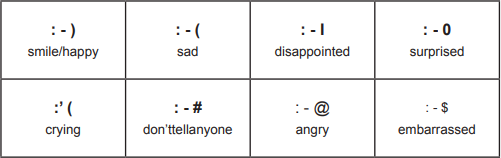
• Limit your use of abbreviations and emoticons – not everyone understands them!
EMOTICONS
É correto afirmar que o texto
Questão 16 5321893
EPCAR 2021Directions: Answer question according to the text.
TEXT
Many parents are concerned with their child’s
seemingly obsessive video game play. Fortnite, the
most recent gaming phenomenon, has taken the world
by storm and has parents asking if the shooter game is
[5] okay for kids. The short answer is yes, Fortnite is
generally fine. Furthermore, parents can breathe easier
knowing that research suggests gaming (on its own)
does not cause disorders like addiction.
However, there’s more to the story. A
[10] comprehensive answer to the question of whether video
games are prejudicial must take into account other
factors, and parents need to understand why kids play,
as well as when to worry and when to relax.
The word “addiction” gets tossed around quite
[15] a bit these days, but if it isn’t causing serious harm and
disorder to daily function, it isn’t an addiction. Parents
may worry that their kids are addicted, but if the children
can pull themselves away from a game to join the family
for a conversation over dinner and shows interest in
[20] other activities, like sports or socializing with friends,
then they are not addicted.
Generally, parents panic when their kid’s video
game playing comes at the expense of doing other
things, like studying or helping around the house. But
[25] let’s be honest, kids have been avoiding these activities
for ages. Equally true is the fact that parents have been
complaining about their unhelpful children well before the
first video game was plugged into its socket.
In fact, moderate video game play has been
[30] shown to be beneficial. A study conducted at Oxford by
Dr. Andrew Przybylski revealed that playing about one
hour per day improved psychological well-being, while
when taken to an extreme, playing over three hours per
day, was correlated with less well-being.
[35] The real question should be what is it about
the special attraction of gaming that makes it the
preferred pastime of so many millions of kids? What
makes it so difficult for even non-addicted kids to step
away from video games sometimes? The answer has to
[40] do with the way games address basic psychological
needs.
Fortnite, like any well-designed video game,
satisfies what we are all looking for. According to Drs.
Edward Deci and Richard Ryan, people need three
[45] things to flourish. We look for competence — the need
for mastery, progression, achievement, and growth. We
seek autonomy — the need for volition and freedom of
control over our choice. And finally, we look for
relatedness — the need to feel like we matter to others,
[50] and that others matter to us. Unfortunately, when
considering the state of modern childhood, many kids
aren’t getting enough of these three essential elements.
School, where kids spend most of their waking
hours, is in many ways the antithesis of a place where
[55] kids feel competence, autonomy, and relatedness.
There, kids are told what to do, where to be, what to
think, what to wear, and what to eat. While some argue
that discipline and control provide structure, it’s clear
why teachers and students might struggle with
[60] motivation in the classroom.
Gamers feel competence when they practice
strengths to reach their goals. In a game, players have
the autonomy to call the shots, do what they want, and
experiment with creative strategies to solve problems.
[65] Games are also social outlets where players can feel
relatedness. In Fortnite, for example, players often
meet in the virtual environment to chat and socialize,
because doing so in the real world is often inconvenient
or off limits.
[70] Of course, none of this is to say video games
are a good substitution — quite the opposite. No game
can give a child the feeling of competence that comes
from accomplishing a difficult task or learning a new
skill on their own accord. Fortnite can’t compete with
[75] the exhilaration that comes from the autonomy of
exploring reality, where a child is free to ask questions
and unlock mysteries in the real world. No social media
site can give a kid the sense of relatedness, safety, and
warmth that comes from an adult who loves that child
[80] unconditionally just the way they are, no matter what,
and takes the time to tell them so.
Some kids suffer from gaming disorders, but
such dependencies are often combined with preexisting
conditions, including problems with impulse control. For
[85] most children, however, parents understanding the
deeper truth behind what kids are getting out of games
empowers them to take steps to give their children
more of what they need. Video games are this
generation’s outlet, and some kids use them as a tool to
[90] escape the same way some of us use our own flavor of
dissociative devices to tune out reality for a while.
(Adapted from https://www.psychologytoday.com. Access on March 25th, 2021)
Glossary:
1. to toss around – to discuss possibilities or new ideas
2. to step away – to not become involved with something
3. to flourish – to grow or develop successfully
4. volition – the power to make your own decision
5. exhilaration – excitement and happiness
6. to call the shots – to be in position to decide
7. outlet – a way in which emotions, energy or abilities can be expressed or made use of
8. to tune out – to stop paying attention to something or someone
Mark the sentence in which the underlined expression does NOT express frequency.
06