


![[Marketing] Questao Topo - deslogado](https://storage.estuda.com.br/banners/0_6b7ebee90b03af1c560c73bb8bcce34a_banner_deslogado_70_dias.png)
Questões de EFAF Inglês - Essay -
6 Questões
Questão 21 11577907
Pref. de São Paulo 7º Ano Prova Semestral 2019WAFFLES
Ingredients
- 2 cups flour - 2 tea spoons baking powder
- 2 cups milk - 5 tea spoons butter
- 3 eggs, separated - 1/2 tea spoon salt
Preparation
1. Mix all dry ingredients.
2. Add yolks, milk and butter.
3. Beat until smooth.
4. Gently add beaten egg whites and mix, but do not overmix.
5. Pour about ½ cup at a time into a waffle maker.
6. Cook waffles until crispy.
Enjoy!
Disponível em: http://allrecipes.com/recipe/20513/classic-waffles. Acesso em: 18 abr. 2019.
O texto “Waffles” serve para
Questão 22 11495005
Pref. de São Paulo 9º Ano Prova Semestral 2019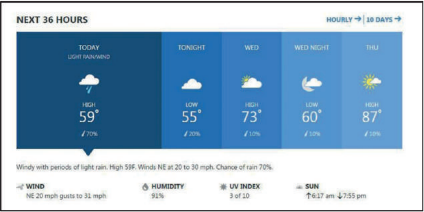
Disponível em: https://weather.com/weather/today/l/USDC0001:1:US. Acessado em: 18 abr. 2019.
Esse texto é
Questão 10 168427
IFMG 2013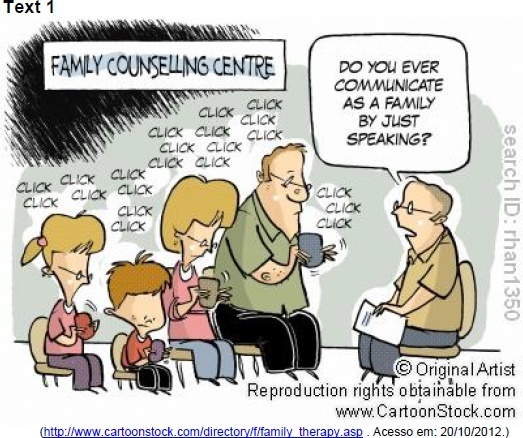
The translation of the sentence “Family Counselling Center” is
Questão 9 168386
IFMG 2014NSTRUCTIONS: Read the text carefully and choose the best alternative.

The text is
Questão 29 10066131
CN 1º dia 2022Read text do question.
TEXT
Who Is Kamala Harris?
Kamala Harris is the vice president of the United States, making her the first female vice president and first Black person and Asian American to hold the position. After attending Howard University and the University of California's Hastings College of the Law, Kamala Harris embarked on a rise through the California legal system, emerging as state attorney general in 2010, Following the November 2016 elections, Harris became just the second African American woman and the first South Asian American to win a seat in the U.S. Senate. She declared her candidacy for the 2020 U.S. presidential election on Martin Luther King Jr. Day 2019 but dropped out of the race before the end of the year. In August 2020, Joe Biden
“(..) Joe Biden announced Harris as vice presiden running mate”.
It is possible to rewrite the sentences substituting underlined parts for:
Questão 41 10365320
EFOMM 2017Part I - Reading Comprehension
Pidgins and creoles
Pidgin Languages
A pidgin is a system of communication which
has grown up among people who do not share a
common language, but who want to talk to each other,
for trading or other reasons. Pidgins have been
[5] variously called ‘makeshift’, ‘marginal’, or ‘mixed’
languages. They have a limited vocabulary, a reduced
grammatical structure, and a much narrower range of
functions, compared to the languages which gave rise
to them. They are the native language of no one, but
[10] they are nonetheless a main means of communication
for millions of people, and a major focus of interest to
those who study the way languages change.
It is essential to avoid the stereotype of a
pidgin language, as perpetrated over the years in
[15] generations of children’s comics and films. The ‘Me
Tarzan, you Jane’ image is far from the reality. A
pidgin is not a language which has broken down; nor
is it the result of baby talk, laziness, corruption,
primitive thought processes, or mental deficiency. On
[20] the contrary: pidgins are demonstrably creative
adaptations of natural languages, with a structure and
rules of their own. Along with creoles, they are
evidence of a fundamental process of linguistic
change, as languages come into contact with each
[25] other, producing new varieties whose structures and
uses contract and expand. They provide the clearest
evidence of language being created and shaped by
society for its own ends, as people adapt to new social
circumstances. This emphasis on processes of change
[30] is reflected in the terms pidginization and
creolization.
Most pidgins are based on European
languages – English, French, Spanish, Dutch, and
Portuguese – reflecting the history of colonialism.
[35] However, this observation may be the result only of
our ignorance of the languages used in parts of
Africa, South America, or South-east Asia, where
situations of language contact are frequent. One of
the best-known non-European pidgins is Chinook
[40] Jargon, once used for trading by American Indians in
north-west USA. Another is Sango, a pidginized
variety of Ngbandi, spoken widely in west-central
Africa.
Because of their limited function, pidgin
[45] languages usually do not last for very long –
sometimes for only a few years, and rarely for more
than a century. They die when the original reason for
communication diminishes or disappears, as
communities move apart, or one community learns
[50] the language of the other. (Alternatively, the pidgin
may develop into a creole.) The pidgin French which
was used in Vietnam all but disappeared when the
French left; similarly, the pidgin English which
appeared during the American Vietnam campaign
[55] virtually disappeared as soon as the war was over. But
there are exceptions. The pidgin known as
Mediterranean Lingua Franca, or Sabir, began in the
Middle Ages and lasted until the 20th century.
Some pidgins have become so useful as a
[60] means of communication between languages that they
have developed a more formal role, as regular
auxiliary languages. They may even be given official
status by a community, as lingua francas. These cases
are known as ‘expanded pidgins’, because of the way
[65] in which they have added extra forms to cope with the
needs of their users, and have come to be used in a
much wider range of situations than previously. In
time, these languages may come to be used on the
radio, in the press, and may even develop a literature
[70] of their own. Some of the most widely used expanded
pidgins are Krio (in Sierra Leone), Nigerian Pidgin
English, and Bislama (in Vanuatu). In Papua New
Guinea, the local pidgin (Tok Pisin) is the most
widely used language in the country.
(CRYSTAL, David. The Cambridge Encyclopedia of Language, 3rd ed., 2010, p.344).
In line 27, “(...) they have added extra forms to cope with the needs of their users (...)”, the phrasal verb in bold is closest in meaning to:
06