


![[Marketing] Questao Topo - deslogado](https://storage.estuda.com.br/banners/0_9254036bace1df786bf2f5978b4a35d7_combo_enem_meme_home_treineiro_desk.png)
Questões de EFAF Inglês
6.497 Questões
Questão 8361102
FEI FEI 2017 2 FaseU Exame1 2017
What does the store of the future look like?
Wednesday 25 January 2017
No check-out staff. No queueing. Amazon’s new physical grocery store which enables shoppers to effectively grab and go, stunned consumers and the retail industry alike (3). So, will robots be serving us in the future, and will there even be a need for a physical store? We asked four experts for their views on the future of bricks-and-mortar shopping.
José Neves, founder and chief executive of luxury fashion website Farfetch, which owns London boutique Browns
I always say “fashion isn’t downloadable”. You need the human element - a program or piece of technology won’t provide the full level of care, attention and assistance that a shop assistant or customer service team will give. This interaction and engagement is an essential component of providing a luxury experience. On the other hand, you can’t ignore technology (1). To succeed we need to strike a balance between the online and offline experience.
Toby Pickard, senior retail analyst at grocery research firm IGD
Physical stores are certain to become more closely synced with shoppers’ smartphones. The priorities will be to speed up the shopping process and to make the experience more exciting and engaging. There will be new and faster cashless ways to pay, and a growing number of experimental, checkout-free stores. Shoppers will be automatically identified - unless they opt out (2) - when they enter the store and are offered unique information and deals through their devices, tailored to their needs and purchasing history. Robots will take on the more repetitive tasks, freeing up staff to offer more expert and personalised advice. Stores will become more like a showroom for people to discover and try new products.
David Walmsley, chief customer officer at House of Fraser
Department stores are here to stay but they will need to move quickly to offer experiences that surprise and delight, and that are out of the ordinary. The role of technology in-store has to be to support these experiences.
Petah Marian, retail editor at trends forecaster WGSN
Since Amazon’s announcement, there has certainly been a lot of noise from technology firms around their self-service and lower friction checkout systems, and retailers will be looking at whether this sort of solution is appropriate. Robots have the potential to replace sales assistants. If you look at Gen Z, you can see that human interaction in stores is not something customers always love. Some consumers feel judged by sales people. I don’t like to say it, but there’ll be fewer people working in retail (4).
(www.theguardian.com (Adapted))
The pronoun “they” in the sentence “unless they opt out” (2) refers to:
What does the store of the future look like?
Wednesday 25 January 2017
No check-out staff. No queueing. Amazon’s new physical grocery store which enables shoppers to effectively grab and go, stunned consumers and the retail industry alike (3). So, will robots be serving us in the future, and will there even be a need for a physical store? We asked four experts for their views on the future of bricks-and-mortar shopping.
José Neves, founder and chief executive of luxury fashion website Farfetch, which owns London boutique Browns
I always say “fashion isn’t downloadable”. You need the human element - a program or piece of technology won’t provide the full level of care, attention and assistance that a shop assistant or customer service team will give. This interaction and engagement is an essential component of providing a luxury experience. On the other hand, you can’t ignore technology (1). To succeed we need to strike a balance between the online and offline experience.
Toby Pickard, senior retail analyst at grocery research firm IGD
Physical stores are certain to become more closely synced with shoppers’ smartphones. The priorities will be to speed up the shopping process and to make the experience more exciting and engaging. There will be new and faster cashless ways to pay, and a growing number of experimental, checkout-free stores. Shoppers will be automatically identified - unless they opt out (2) - when they enter the store and are offered unique information and deals through their devices, tailored to their needs and purchasing history. Robots will take on the more repetitive tasks, freeing up staff to offer more expert and personalised advice. Stores will become more like a showroom for people to discover and try new products.
David Walmsley, chief customer officer at House of Fraser
Department stores are here to stay but they will need to move quickly to offer experiences that surprise and delight, and that are out of the ordinary. The role of technology in-store has to be to support these experiences.
Petah Marian, retail editor at trends forecaster WGSN
Since Amazon’s announcement, there has certainly been a lot of noise from technology firms around their self-service and lower friction checkout systems, and retailers will be looking at whether this sort of solution is appropriate. Robots have the potential to replace sales assistants. If you look at Gen Z, you can see that human interaction in stores is not something customers always love. Some consumers feel judged by sales people. I don’t like to say it, but there’ll be fewer people working in retail (4).
(www.theguardian.com (Adapted))
Questão 8361101
FEI FEI 2017 2 FaseU Exame1 2017
What does the store of the future look like?
Wednesday 25 January 2017
No check-out staff. No queueing. Amazon’s new physical grocery store which enables shoppers to effectively grab and go, stunned consumers and the retail industry alike (3). So, will robots be serving us in the future, and will there even be a need for a physical store? We asked four experts for their views on the future of bricks-and-mortar shopping.
José Neves, founder and chief executive of luxury fashion website Farfetch, which owns London boutique Browns
I always say “fashion isn’t downloadable”. You need the human element - a program or piece of technology won’t provide the full level of care, attention and assistance that a shop assistant or customer service team will give. This interaction and engagement is an essential component of providing a luxury experience. On the other hand, you can’t ignore technology (1). To succeed we need to strike a balance between the online and offline experience.
Toby Pickard, senior retail analyst at grocery research firm IGD
Physical stores are certain to become more closely synced with shoppers’ smartphones. The priorities will be to speed up the shopping process and to make the experience more exciting and engaging. There will be new and faster cashless ways to pay, and a growing number of experimental, checkout-free stores. Shoppers will be automatically identified - unless they opt out (2) - when they enter the store and are offered unique information and deals through their devices, tailored to their needs and purchasing history. Robots will take on the more repetitive tasks, freeing up staff to offer more expert and personalised advice. Stores will become more like a showroom for people to discover and try new products.
David Walmsley, chief customer officer at House of Fraser
Department stores are here to stay but they will need to move quickly to offer experiences that surprise and delight, and that are out of the ordinary. The role of technology in-store has to be to support these experiences.
Petah Marian, retail editor at trends forecaster WGSN
Since Amazon’s announcement, there has certainly been a lot of noise from technology firms around their self-service and lower friction checkout systems, and retailers will be looking at whether this sort of solution is appropriate. Robots have the potential to replace sales assistants. If you look at Gen Z, you can see that human interaction in stores is not something customers always love. Some consumers feel judged by sales people. I don’t like to say it, but there’ll be fewer people working in retail (4).
(www.theguardian.com (Adapted))
The expression “on the other hand” in the sentence “On the other hand, you can’t ignore technology” (1) could be replaced by:
What does the store of the future look like?
Wednesday 25 January 2017
No check-out staff. No queueing. Amazon’s new physical grocery store which enables shoppers to effectively grab and go, stunned consumers and the retail industry alike (3). So, will robots be serving us in the future, and will there even be a need for a physical store? We asked four experts for their views on the future of bricks-and-mortar shopping.
José Neves, founder and chief executive of luxury fashion website Farfetch, which owns London boutique Browns
I always say “fashion isn’t downloadable”. You need the human element - a program or piece of technology won’t provide the full level of care, attention and assistance that a shop assistant or customer service team will give. This interaction and engagement is an essential component of providing a luxury experience. On the other hand, you can’t ignore technology (1). To succeed we need to strike a balance between the online and offline experience.
Toby Pickard, senior retail analyst at grocery research firm IGD
Physical stores are certain to become more closely synced with shoppers’ smartphones. The priorities will be to speed up the shopping process and to make the experience more exciting and engaging. There will be new and faster cashless ways to pay, and a growing number of experimental, checkout-free stores. Shoppers will be automatically identified - unless they opt out (2) - when they enter the store and are offered unique information and deals through their devices, tailored to their needs and purchasing history. Robots will take on the more repetitive tasks, freeing up staff to offer more expert and personalised advice. Stores will become more like a showroom for people to discover and try new products.
David Walmsley, chief customer officer at House of Fraser
Department stores are here to stay but they will need to move quickly to offer experiences that surprise and delight, and that are out of the ordinary. The role of technology in-store has to be to support these experiences.
Petah Marian, retail editor at trends forecaster WGSN
Since Amazon’s announcement, there has certainly been a lot of noise from technology firms around their self-service and lower friction checkout systems, and retailers will be looking at whether this sort of solution is appropriate. Robots have the potential to replace sales assistants. If you look at Gen Z, you can see that human interaction in stores is not something customers always love. Some consumers feel judged by sales people. I don’t like to say it, but there’ll be fewer people working in retail (4).
(www.theguardian.com (Adapted))
Questão 8360939
UNESP UNESP 2017 2 Fase1 Gerais 2017
“One never builds something finished”:
the brilliance of architect Paulo Mendes da Rocha
Oliver Wainwright February 4, 2017
“All space is public,” says Paulo Mendes da Rocha. “The only private space that you can imagine is in the human mind.” It is an optimistic statement from the 88-year-old Brazilian architect, given he is a resident of São Paulo, a city where the triumph of the private realm over the public could not be more stark. The sprawling megalopolis is a place of such marked inequality that its superrich hop between their rooftop helipads because they are too scared of street crime to come down from the clouds.
But for Mendes da Rocha, who received the 2017 gold medal from the Royal Institute of British Architects this week - an accolade previously bestowed on such luminaries as Le Corbusier and Frank Lloyd Wright - the ground is everything. He has spent his 60-year career lifting his massive concrete buildings up, in gravity-defying balancing acts, or else burying them below ground in an attempt to liberate the Earth’s surface as a continuous democratic public realm. “The city has to be for everybody,” he says, “not just for the very few.”
(www.theguardian.com. Adaptado.)
No trecho do segundo parágrafo “The city has to be for everybody”, a expressão em destaque pode ser substituída, sem alteração de sentido, por
“One never builds something finished”:
the brilliance of architect Paulo Mendes da Rocha
Oliver Wainwright February 4, 2017
“All space is public,” says Paulo Mendes da Rocha. “The only private space that you can imagine is in the human mind.” It is an optimistic statement from the 88-year-old Brazilian architect, given he is a resident of São Paulo, a city where the triumph of the private realm over the public could not be more stark. The sprawling megalopolis is a place of such marked inequality that its superrich hop between their rooftop helipads because they are too scared of street crime to come down from the clouds.
But for Mendes da Rocha, who received the 2017 gold medal from the Royal Institute of British Architects this week - an accolade previously bestowed on such luminaries as Le Corbusier and Frank Lloyd Wright - the ground is everything. He has spent his 60-year career lifting his massive concrete buildings up, in gravity-defying balancing acts, or else burying them below ground in an attempt to liberate the Earth’s surface as a continuous democratic public realm. “The city has to be for everybody,” he says, “not just for the very few.”
(www.theguardian.com. Adaptado.)
Questão 8360937
UNESP UNESP 2017 2 Fase1 Gerais 2017
Public space and the right to the city
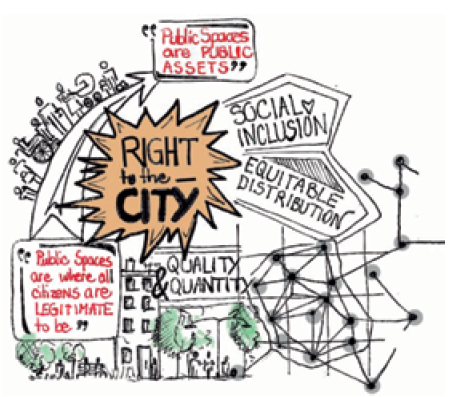
It is essential to promote social inclusion by providing spaces for people of all socio-economic backgrounds to use and enjoy. Quality public spaces such as libraries and parks can supplement housing as study and recreational spaces for the urban poor.
There is a need to ensure that there is an equitable distribution of public spaces within cities. Through the provision of quality public spaces in cities can reduce the economic and social segregation that is prevalent in many developed and developing cities. By ensuring the distribution, coverage and quality of public spaces, it is possible to directly influence the dynamics of urban density, to combine uses and to promote the social mixture of cities’ inhabitants.
Rights and duties of all the public space stakeholders should be clearly defined. Public spaces are public assets as a public space is by definition a place where all citizens are legitimate to be and discrimination should be tackled there. Public space has the capacity to gather people and break down social barriers. Protecting the inclusiveness of public space is a key prerequisite for the right to the city and an important asset to foster tolerance, conviviality and dialogue.
Public spaces in slums are only used to enable people to move. There is a lack of public space both in quantity and quality, leading to high residential density, high crime rates, lack of public facilities such as toilets or water, difficulties to practice outdoor sports and other recreational activities among others.
(www.leaming.uclg.org)
No trecho do terceiro parágrafo “Public spaces are public assets”, o termo em destaque tem sentido, em português, de
Public space and the right to the city
It is essential to promote social inclusion by providing spaces for people of all socio-economic backgrounds to use and enjoy. Quality public spaces such as libraries and parks can supplement housing as study and recreational spaces for the urban poor.
There is a need to ensure that there is an equitable distribution of public spaces within cities. Through the provision of quality public spaces in cities can reduce the economic and social segregation that is prevalent in many developed and developing cities. By ensuring the distribution, coverage and quality of public spaces, it is possible to directly influence the dynamics of urban density, to combine uses and to promote the social mixture of cities’ inhabitants.
Rights and duties of all the public space stakeholders should be clearly defined. Public spaces are public assets as a public space is by definition a place where all citizens are legitimate to be and discrimination should be tackled there. Public space has the capacity to gather people and break down social barriers. Protecting the inclusiveness of public space is a key prerequisite for the right to the city and an important asset to foster tolerance, conviviality and dialogue.
Public spaces in slums are only used to enable people to move. There is a lack of public space both in quantity and quality, leading to high residential density, high crime rates, lack of public facilities such as toilets or water, difficulties to practice outdoor sports and other recreational activities among others.
(www.leaming.uclg.org)
Questão 8360936
UNESP UNESP 2017 1 Fase1 Gerais 2017Question: Is there anything I can do to train my body to need less sleep?
Karen Weintraub
June 17, 2016

Many people think they can teach themselves to need less sleep, but they’re wrong, said Dr. Sigrid Veasey, a professor at the Center for Sleep and Circadian Neurobiology at the University of Pennsylvania’s Perelman School of Medicine. We might feel that we’re getting by fine on less sleep, but we’re deluding ourselves, Dr. Veasey said, largely because lack of sleep skews our self-awareness. “The more you deprive yourself of sleep over long periods of time, the less accurate you are of judging your own sleep perception,” she said.
Multiple studies have shown that people don’t functionally adapt to less sleep than their bodies need. There is a range of normal sleep times, with most healthy adults naturally needing seven to nine hours of sleep per night, according to the National Sleep Foundation. Those over 65 need about seven to eight hours, on average, while teenagers need eight to 10 hours, and school-age children nine to 11 hours. People’s performance continues to be poor while they are sleep deprived, Dr. Veasey said.
Health issues like pain, sleep apnea or autoimmune disease can increase people’s need for sleep, said Andrea Meredith, a neuroscientist at the University of Maryland School of Medicine. A misalignment of the clock that governs our sleep-wake cycle can also drive up the need for sleep, Dr. Meredith said. The brain’s clock can get misaligned by being stimulated at the wrong time of day, she said, such as from caffeine in the afternoon or evening, digital screen use too close to bedtime, or even exercise at a time of day when the body wants to be winding down.
No trecho do primeiro parágrafo “We might feel that we’re getting by fine on less sleep”, o termo em destaque pode ser substituído, sem alteração de sentido, por(http://well.blogs.nytimes.com. Adaptado.)
Questão 8360935
UNESP UNESP 2017 1 Fase1 Gerais 2017
"A study from Brigham Young University reported that teenagers _________ 23 sleep seven hours, compared to nine hours of sleep, perform better academically. This study contradicts federal guidelines, stating teenagers should sleep as much as they need to." –
THESTATECOLUMN.COM
"A study from Brigham Young University reported that teenagers _________ 23 sleep seven hours, compared to nine hours of sleep, perform better academically. This study contradicts federal guidelines, stating teenagers should sleep as much as they need to." –
THESTATECOLUMN.COM

06
